ExploitEaster

Like many human holidays and celebrations, Easter is another day humans have turned into an exploitation event.
And in this particular holiday the exploitation is quite diverse.

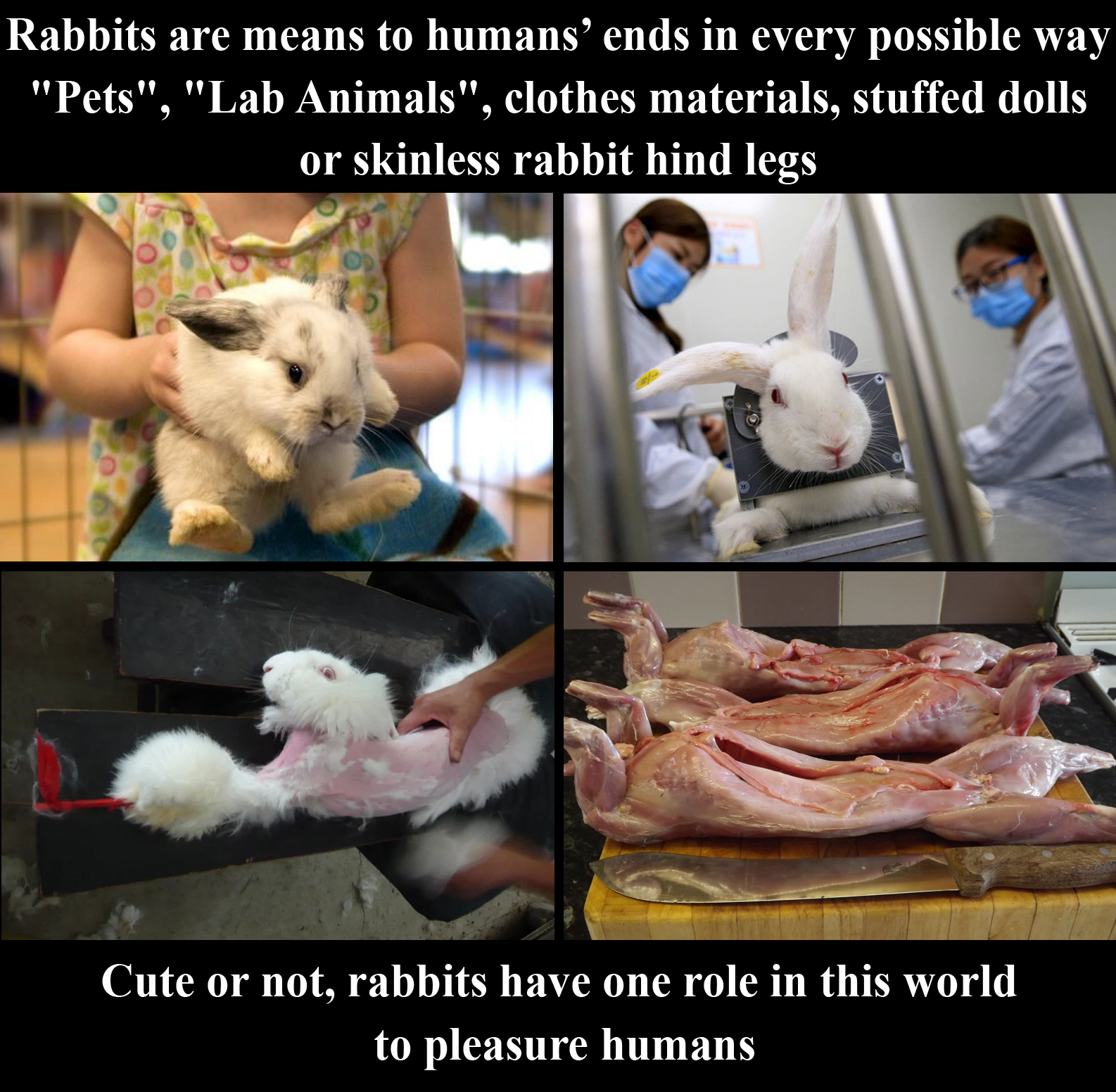
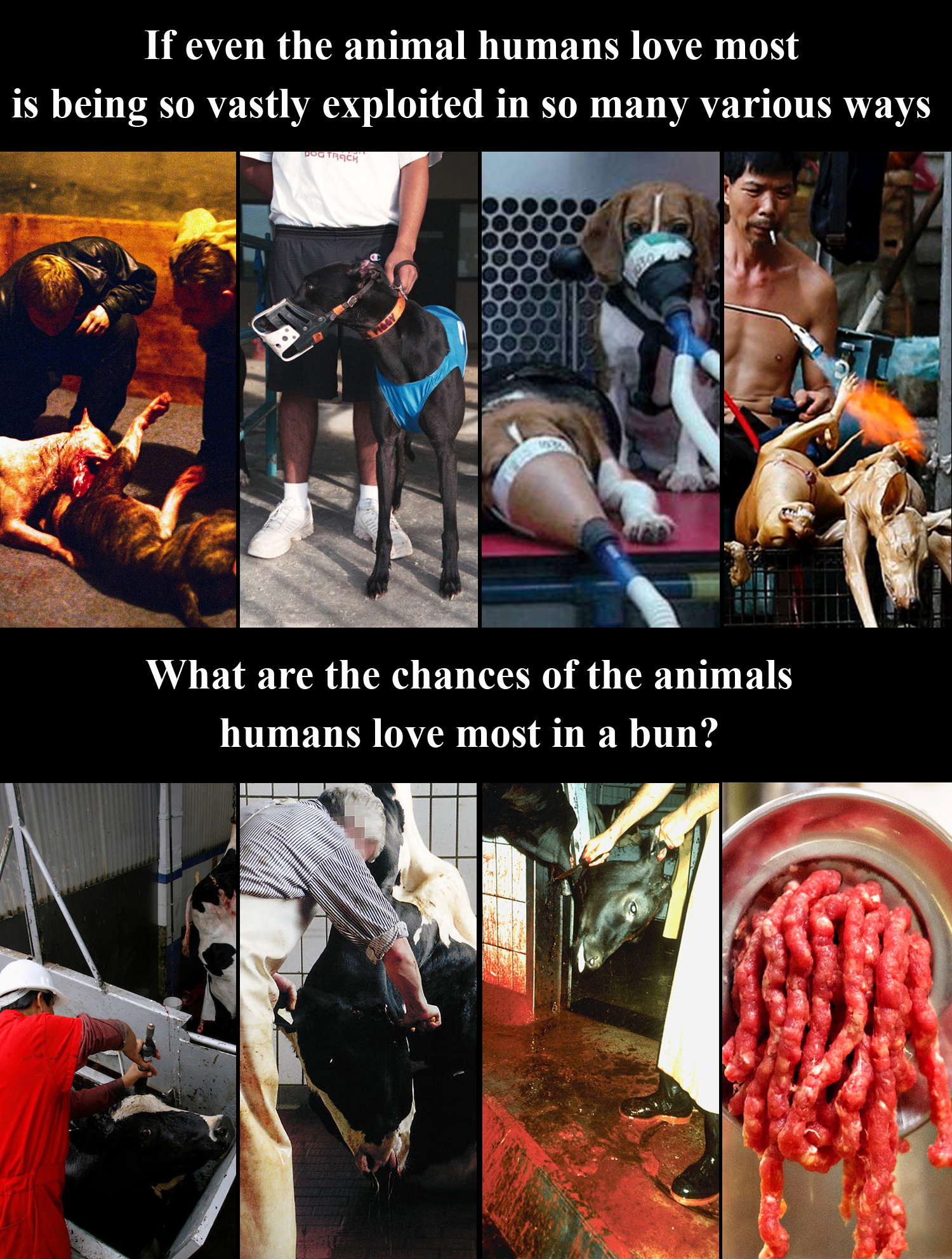
Being a significant symbol of the holiday, many humans purchase rabbits for their children for Easter, which is obviously appalling conceptually and practically.
The Easter Bunny origin is in pre-Christian fertility lore. Rabbits symbolize fertility and new life during the spring season in human culture. But these are the actual lives of rabbits in human culture:

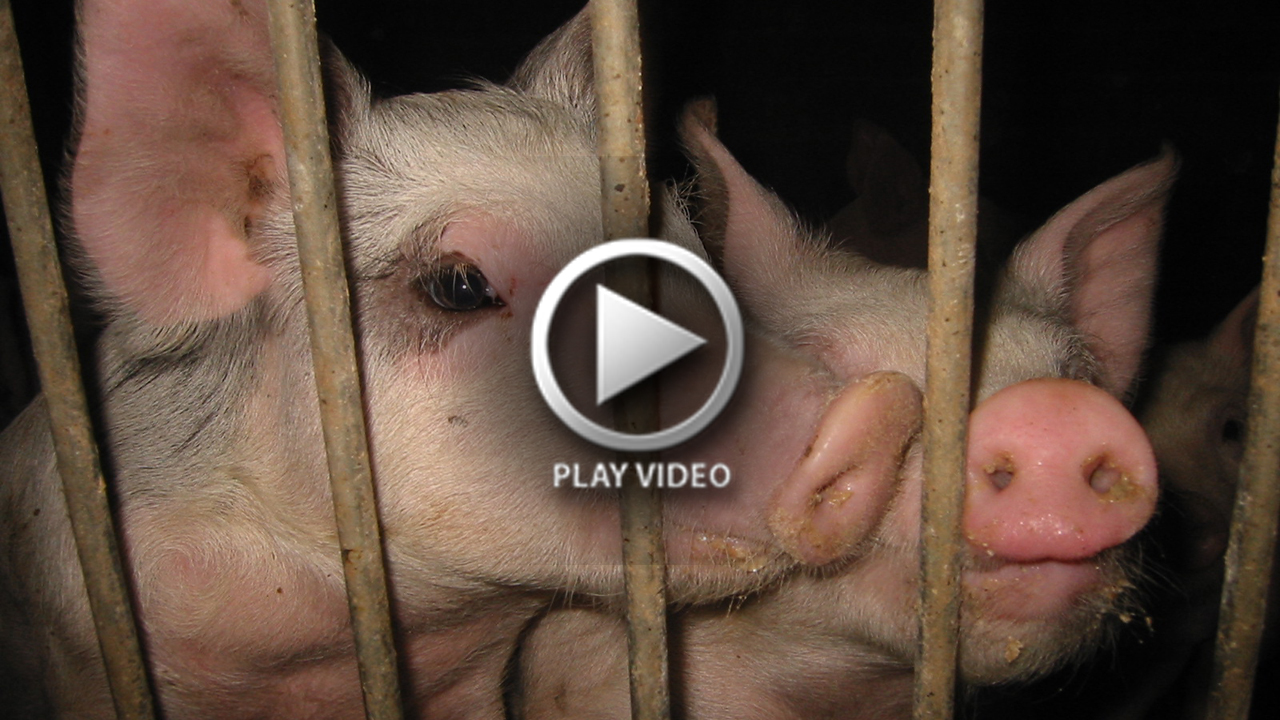
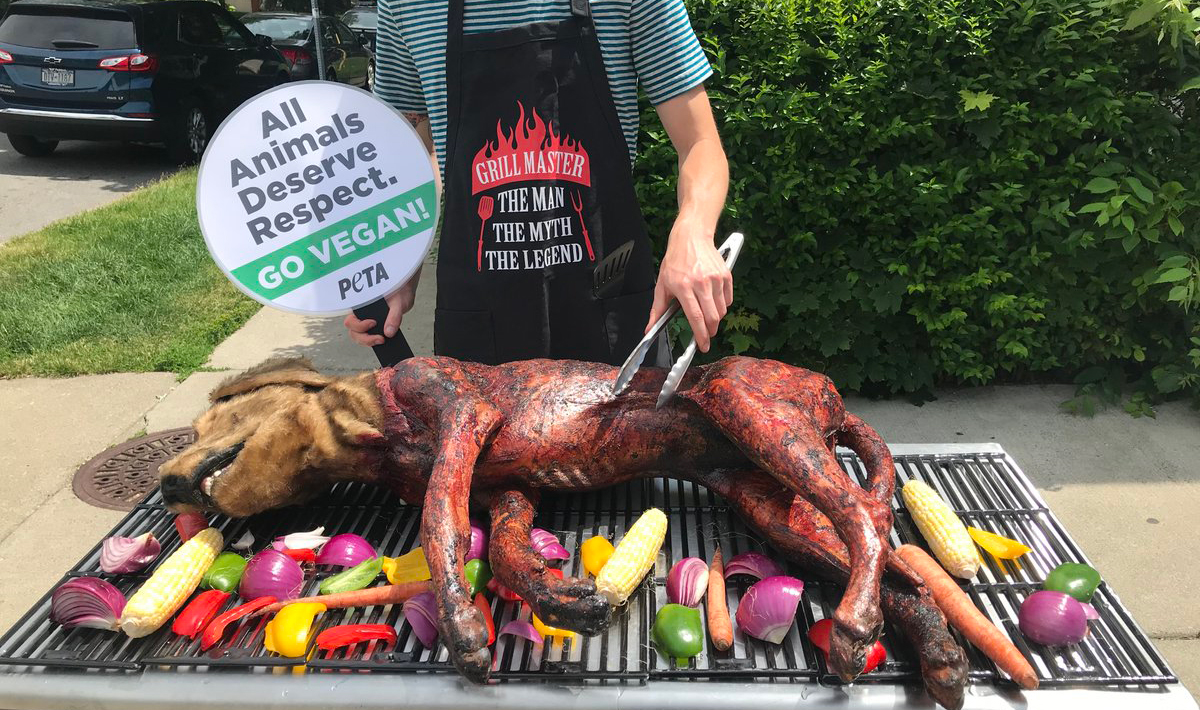
Even more humans celebrate Easter by consuming pigs’ thighs.

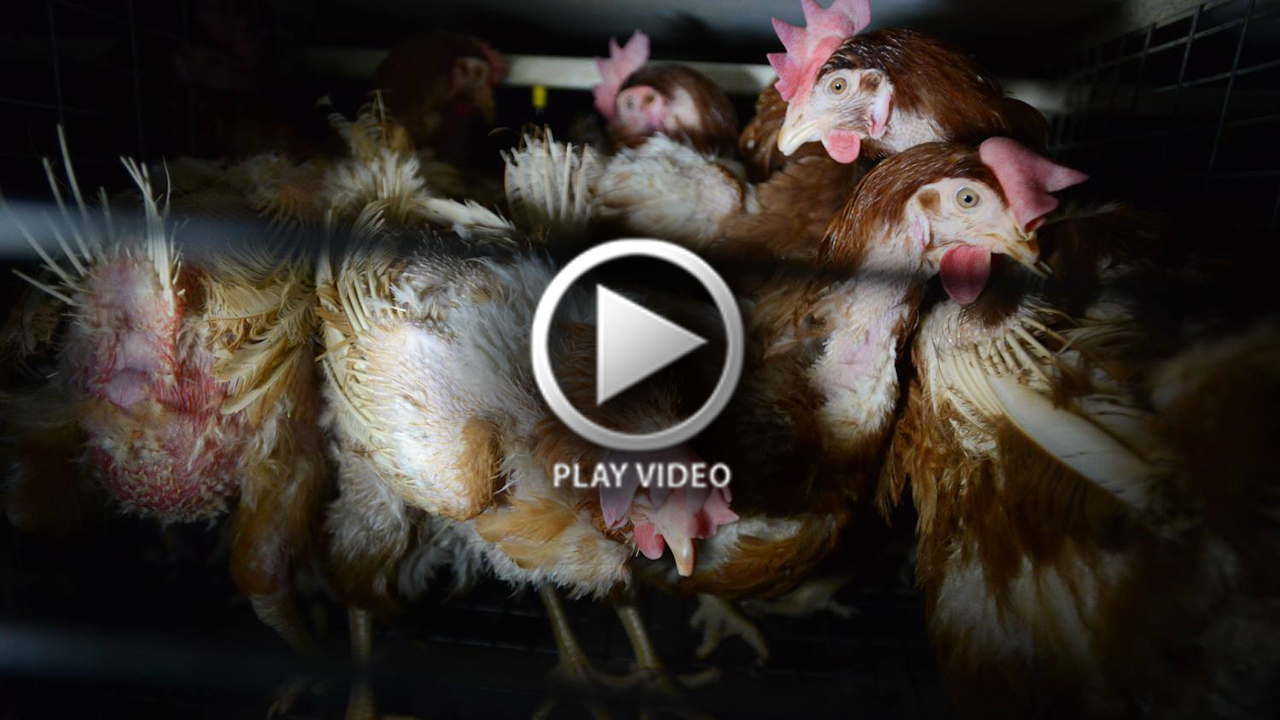
And many children spend the holiday playing with eggs, despite that the egg industry is the farthest thing from a child’s play, and is actually hell on earth.

And not only during Easter, but all year round and all over the world, millions of humans imprison millions of hens, to use their eggs for their idiotic amusement.

Super Cruelty

It is expected that nearly 1.5 billion chicken wings will be consumed during the Super Bowl weekend.
Let’s take a closer look at the miserable life of each of these 750 million victims.

The Suffering Begins At Birth

None of these hundreds of millions of chicks will ever experience maternal care. Under natural conditions the mother hen is fiercely protective of her chicks, sheltering them under her wings for their first months of life. In the chickens flesh industry, a few hours-old chicks are thrown into prisons. Motherless from day one, the chicks must fend for themselves in huge windowless sheds with up to 100,000 other birds. Humans have broken their ties with their own mothers and their natural environment.

Under natural conditions, chickens live in complex social structure and have complex communication. They spend about 50% of their time foraging for food and have strong sense of personal space. But in the sheds, the chicks are denied any normal social structure, adequate resting periods, the opportunity to dust bath, the ability to forage, fresh air, sunshine, natural diet and space.

As the birds grow, the space for each individual decreases. At some point each bird has only 20x20cm of floor so they must push their way through a solid mass of other chickens to reach food and water points. Many are left starved.

Violent Body Invasion

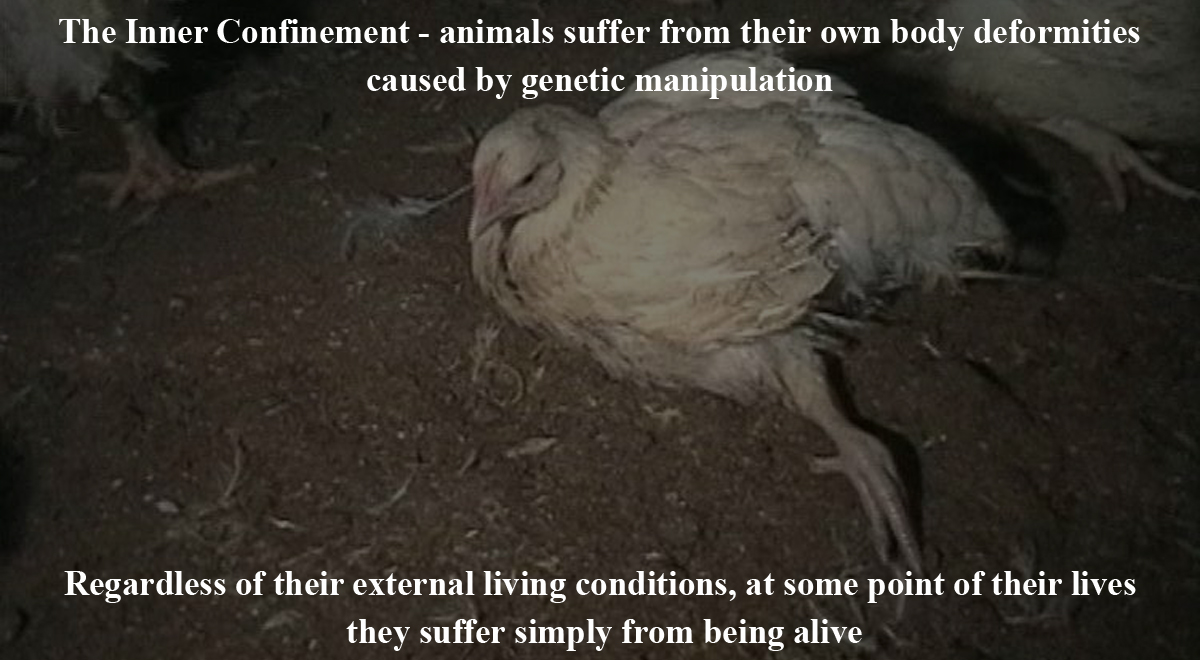
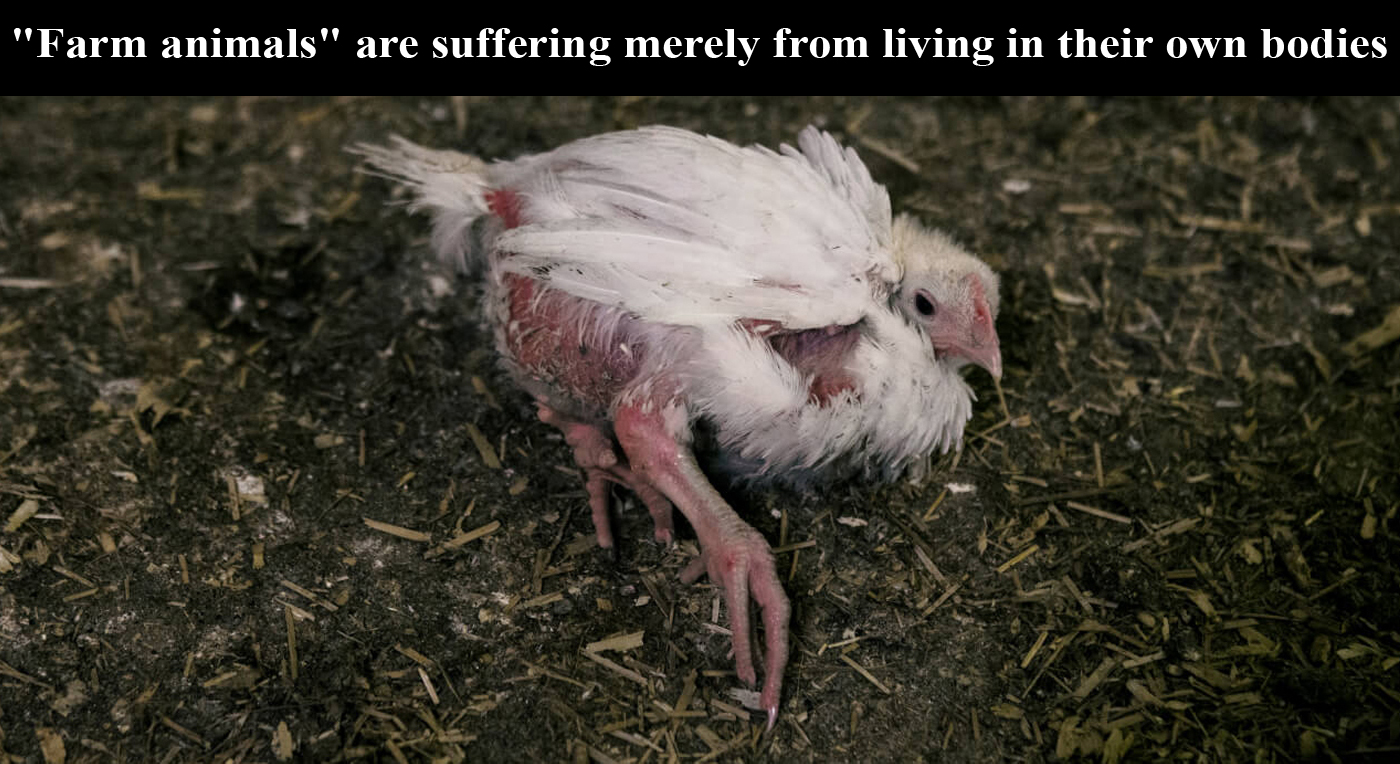
Humans severely cripple billions of sentient beings every year for the sake of maximum flesh in minimum time. Today’s meat chickens have been genetically altered to grow three times faster and three times larger than their ancestors. Pushed beyond their biological limits hundreds of millions don’t even reach 6 weeks of age which is when the whole flock is slaughtered.

Naturally chicks reach maturity at 18 weeks of age, when they weigh less than 1kg (2.2lb). A human child reaches maturity at 18 years of age weighing about 60kg. By 1976, exploited chickens reached 1kg just after 6 weeks rather than 18. So picture, for comparison, not an eighteen-year-old but a six-year-old child weighing about 60kg.
Today, because of the intensive selective breeding by the chickens industry in the past 25 years, the six-week-old chicken weighs up to 2.6kg.

Picture a six-year-old child weighting 156kg. Terrifying!
Now try to imagine this child walk. Hideous and cruel for a child, but a reality for a six weeks old chick.

Tibial Dyschondroplasia (TD)

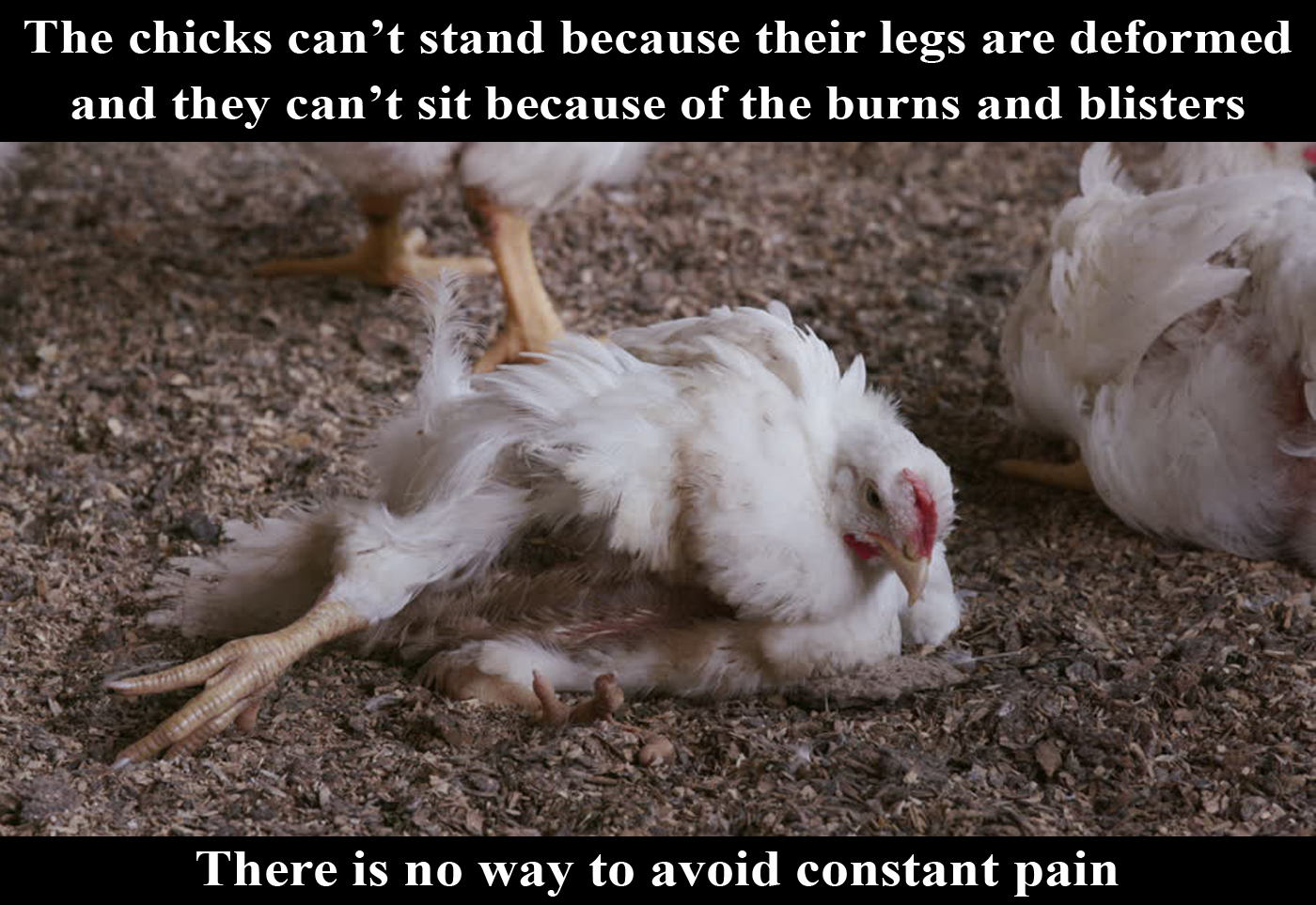
Forced to grow three times faster than normal chickens through dietary, lighting and mainly genetic manipulations, the chicks suffer from painful skeletal and metabolic diseases. One of the harshest is Tibial Dyschondroplasia (TD), in which the young leg bones of the growing birds develop crippling fissures and fractures.
The combination of forced rapid growth and excessive weight causes chronic, painful lameness and abnormal posture. The bird’s body grows too fast for the bone plates to accommodate. Consequently, the birds develop angular bone deformities and Spondylolisthesis (“kinky back”), in which the vertebra snaps and puts pressure on the spinal cord, causing paralysis. The birds can only move by using their wings for balance.

Several decades ago, 1.2% of chickens suffered from Tibial Dyschondroplasia. Today, 50% of the chickens suffer from this human-created disease.

In addition to TD, studies have shown that 90% of birds have a detectable abnormality in their gait. Other pathological leg conditions which have been found in chickens are: Rotated Tibia, Rickets, Angular Bone Deformity and Chondrodystrophy (“slipped tendons”).

Sick Lives

Though they live only a few weeks, the chicks suffer old-age illnesses such as heart attacks, as their hearts and lungs are unable to keep up with the fast growth of their body muscles.

The strain on their cardiovascular system is enormous, causing “congestive heart failure” which causes ascites ­- pooling of blood fluids in the abdomen.
The high oxygen demand of rapid growth in the modern chicken combined with restricted space for blood, which flows through the capillaries of the lung, results in an internal accumulation of yellow or blood-stained fluid in the abdomen.
Cardiac arrhythmias have been found in chickens as young as 7 days of age!

The faster a bird grows the higher the incidence of leg problems. The birds spend 40% less time walking because of legs weakness and chronic pain.
Humans severely disable billions every year to squeeze a few more cents out of the soar body of each “little money unit”.

The unnatural growth rate of chickens combined with the lack of space to move or exercise, force the birds to rest on the wet, dirty, ammonia-ridden litter. This leads to painful breast blisters and hock burns. Foot and breast lesions and ulcerations are also frequent.

The health problems of the chickens are so severe that if they were allowed to live on, instead of being slaughtered at 6 weeks, most would die before reaching the age of puberty, at 18 weeks.

Chronic Hunger

The chicken industry has virtually bred animals which are simply not viable. They are unable to reach adulthood because of the related problems of crippling leg and heart diseases.
Generally, it doesn’t concern the industry, because the vast majority of the birds will be slaughtered before reaching adulthood. But the industry is in a bind, some of the birds must reach adulthood to be the breeder flocks, those that are to produce the future generations. These birds must not only survive, but also remain sufficiently healthy to breed.

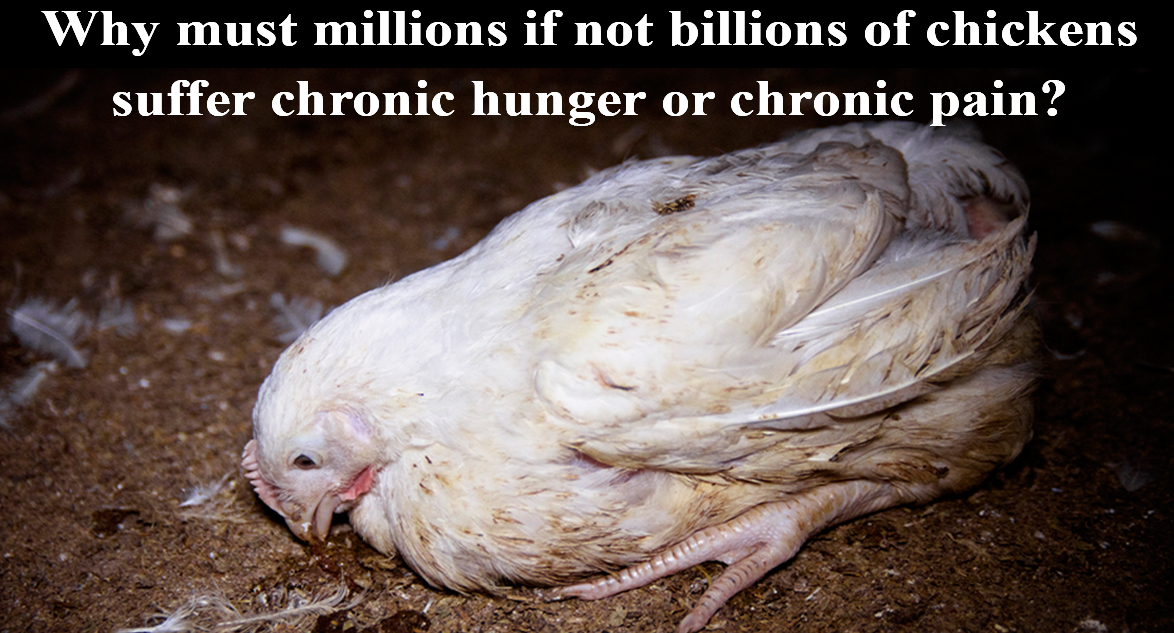
If these chickens were fed normally, most would die before puberty and the survivors would suffer from reduced fertility. To avoid this, the industry has to find a way of slowing down the fast growth rates of the breeders (growth rates which have been imposed on the breeders to ensure that their offspring put on weight as quickly as possible). The industry’s “solution” is to feed breeders severely restricted rations – in some cases, just 25% – 50% of what they would eat if given free access to food. Chickens in the breeding flock are chronically hungry, frustrated and stressed. The birds are highly motivated to eat all the time and display abnormal forms of oral behaviour such as stereotyped pecking at non-food objects and excessive preening. They are literally going mad of hunger.

And despite the severely restricted rations, male breeders still experience chronic orthopaedic problems, which cause chronic pain.

Dimmed Lives

The effort to make more and more money over the chicks broken and deformed body, leads to various manipulations. One example regards the lighting. Artificial lighting in the chicken sheds is carefully controlled. Initially, lighting is bright to accustom the chicks to the location of food and water and encourage maximum eating and rapid growth. This lighting is then dimmed (to a level of 2-5 lux) in order to discourage aggression and fighting between chickens. The chickens endure a gloomy lighting all day long.

Filthy Lives

Farmers usually rear five or six batches of chickens a year. Two or three weeks are needed between batches to allow the sheds to be fumigated and cleared of the litter. The litter is not changed or cleaned, during the chickens’ time in the shed, and so becomes increasingly wet and greasy and covered with the bird’s faeces. It is estimated that 80% of the litter by weight consists of faeces by the time of slaughter. Stress and disease are inevitable under these conditions. Strong ammonia fumes can lead to Keratocon-Junctivitis, a painful eye condition leading to blindness. Heart attacks, chronic respiratory disease, kidney syndrome, a wide range of bacterial and viral infections lead to high mortality amongst flocks.

The Brutal End

Their last day is probably the most traumatic one. The chickens are violently grabbed while asleep, in the middle of the night, by humans who are yelling at them while pitching and stuffing them into the crates, in which they will be transported to the next stage of human atrocity – the slaughterhouse.

Teams of catchers “depopulate” the sheds as quickly as possible, carrying four or more birds upside down in each hand. The chickens are held by just one leg. Their well-being is of little importance as the catchers “must” yield 400-500 chickens per hour. This brutal process is referred to by the industry as “harvesting”.

As a result of the brutal yanking of chickens from their prisons to the transportation trucks, their hips are often dislocated, causing immense pain.

During the journey the birds experience sudden jolting movements, vibration, loud noises, deprivation of food and water and overcrowding. The birds also suffer extreme cold or heat and high levels of humidity especially due to trucks’ bad ventilation. All contribute to the already inconceivable stress and horror.

Long delays can occur between arrival at the slaughterhouse and unloading. This intensifies the stress imposed by the transport. These delays occur when birds arrive too late to the slaughterhouse. They are then left in the containers on the lorry to be slaughtered on the next day. In many cases these delays are accompanied by poor weather conditions, such as extreme heat or cold.

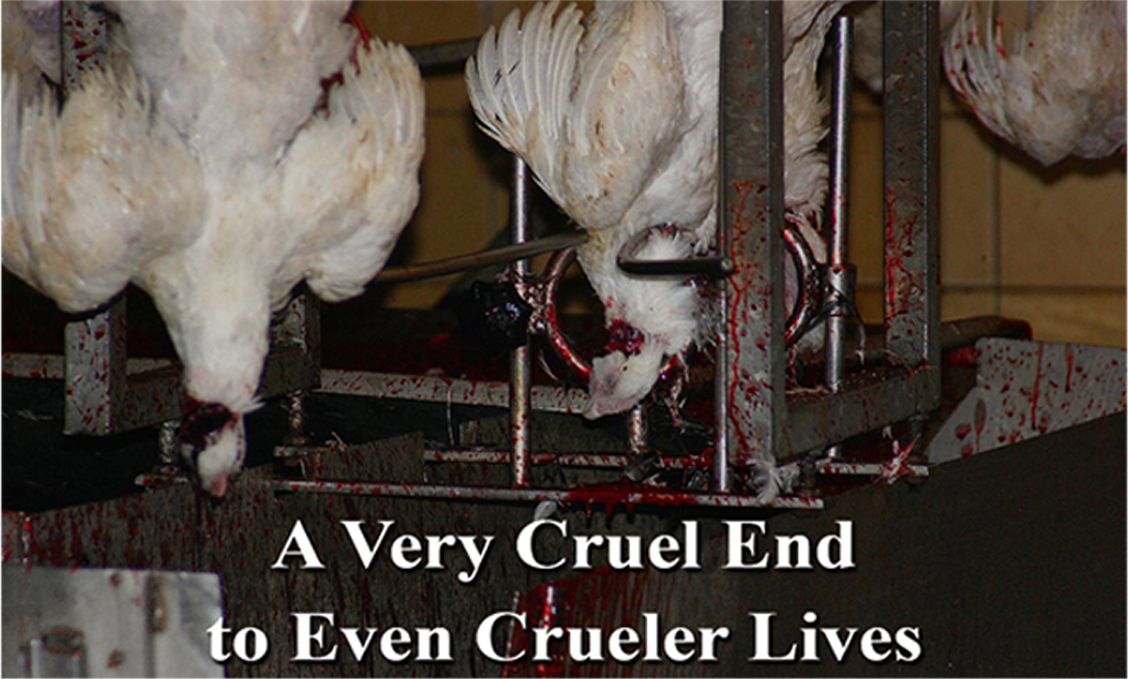
Once they arrive to the murder factory, the chickens that survived so far are yanked from the crates and shackled onto a conveyor belt by their feet, while still alive.

In cases that the bird’s legs are too big for the shackles, the workers break them to fit them in.

The conveyor carries them into the slaying room where their heads pass through an electrified water bath intended to stun them. As they pass along further, an automatic knife cuts their throat, and then they proceed into a scalding tank to loosen their feathers before plucking. Unfortunately some birds miss the electrified water bath and are therefore still fully conscious when they reach the automatic knife. Some birds may also miss the knife and are then lowered into the 50-degrees scalding tank while still alive. Some regain consciousness inside the scalding tank, which means that they will be conscious when the plucking knives tear their bodies.

What emphasizes speciesism and humans’ alienation more than anything, is the farming regulation – “40 kilogram per meter”.
One expression that unfortunately describes the relationship between human and nonhuman animals, in the most accurate way.

This relationship is devastating to all nonhuman animals. To more than 150 billion animals per year.
This relationship has got to end.

Human Waste

Considering how severe the effect of food production, any type of food, is in terms of suffering, food waste, must be given much more attention than this important issue currently receives. And a new study aiming to separate animal flesh waste from the rest of food waste, reveals that food waste is even more important than realized.

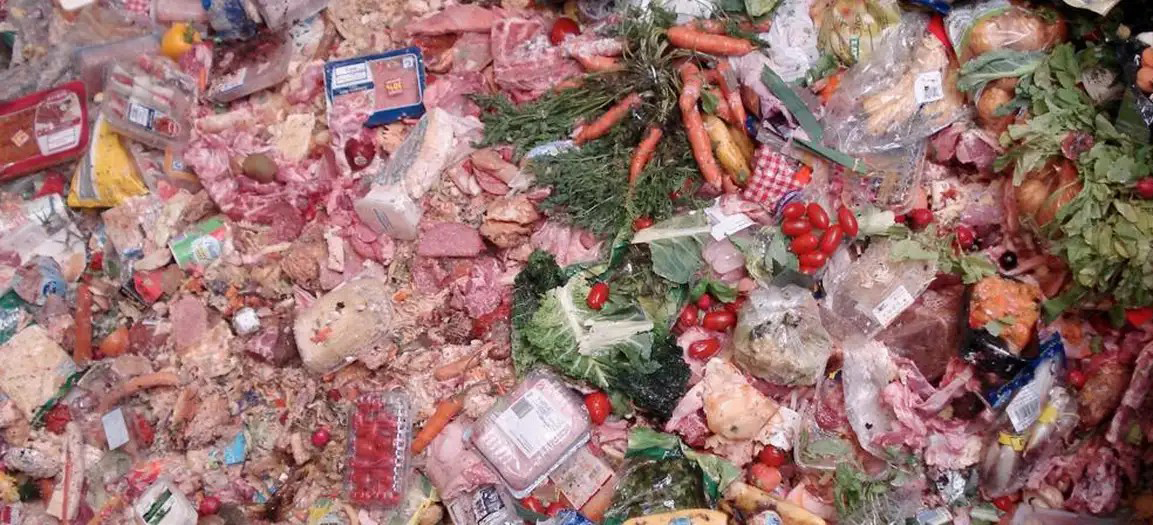
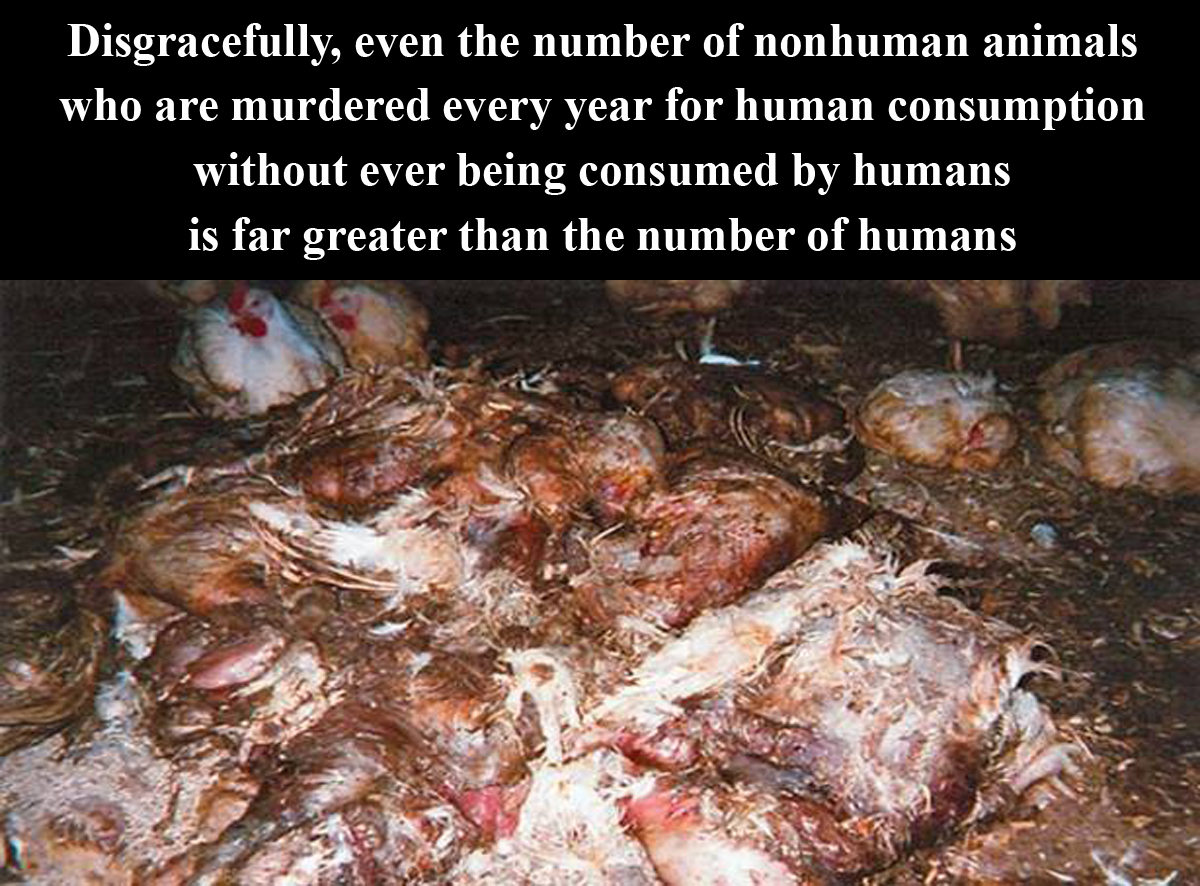
Few people know that about a third of the produced food around the world is going to waste. Some during the production phase, some during transport, some while being stored in retailers, and some in households. And until now almost no one knew how many animals are being tortured for their entire lives until they are murdered so they can be consumed by humans, without ever being consumed by a human, since somewhere along the way their flesh has been thrown away. A new study conducted at Leiden University in the Netherlands, that tried to figure out how many individual animals end up being thrown away after being exploited all their lives, concludes that the number is about 18 billion animals of the 75 billion pigs, chickens, turkeys, cows, goats, and sheeps raised for food around the world. The study counted animals who were never consumed, for any reason and at any point in the supply chain, that is animals who died on the farm due to the horrendous living conditions, on the transportation truck on the way to be murdered, during one of the various processing stages after they have already been murdered, or in warehouses, grocery stores, restaurants and households.

The importance and pioneering of this study is the isolation of animal based food waste from the rest of the food waste, as well as figuring out which stages, which countries and which exploitation industries are responsible for most of the “waste” of animals.
Unsurprisingly, due to the fact that chickens in the flesh industry are of breeds humans have manipulated to grow incredibly large, incredibly fast, which not only means chronic pain, but often also leads to leg deformities and other health issues that cause death at a very early age (like heart attacks and starvation or dehydration due to the inability to walk and get food and water), the chickens flesh industry is responsible for the vast majority of animals being tortured and murdered for humans consumption without any human consuming them. It is estimated that about 16.8 billion chickens per year endure extreme suffering and then being thrown away as waste. The second most “wasted” animal is turkeys, then pigs, sheeps, goats, and cows.

Besides the obvious practical aspect there is also an important symbolic aspect to these dire figures and that is how cheap nonhuman animals’ lives are to humans if one in every four nonhuman animal individual is not even consumed by humans.
Humanity is so careless about nonhuman animals, that not only are efforts to reduce animal “waste” not conducted, so far there hasn’t even been an effort to figure out how many individual animals are being “wasted” every year.

Which brings us to another extremely depressing aspect of this study, which is its suggestions as to how to reduce animal “waste”. According to the study it is possible to spare billions of animals from enduring the most extreme suffering without even reducing the amount of animal flesh that humans consume. It is argued that these horrible figures could be reduced by 7.9 billion individual animals if the different world regions would achieve the best currently observed efficiencies across the global Food Supply Chain, and by 4.2 if the ‘United Nations: Sustainable Development Goal 12.3’ was implemented to a minimal extent, or 8.8 billion if implemented to a full extent.
Grocery stores, restaurants, and food manufacturers can do a lot to reduce food waste if they’ll pay more attention to the subject. Besides obvious measures such as hygiene and refrigeration, or donating more unsold food, standardizing expiration labels on foods bought at the grocery store for example can make a big difference in waste by consumers who some confuse the label “best if used by” with “expires on”.

In addition, humanity is supposed to have another incentive to reduce food waste in general, and animal based food “waste” in particular, and that is its significant impact on the planet they see as their own. All animal products use more land, water and emit more GHGs than almost all plant foods. Experts from institutions such as the UN and the University of Oxford have stated that Western countries need to dramatically reduce meat in their diets in order to combat these issues. A study published earlier this year found that plant-based diets resulted in 75% less emissions, water pollution, and land use. In other words, humans should care about food waste, and animal food waste in particular, considering that animal based food has a much stronger environmental impact than plant based food, not only because of the suffering they are causing to nonhuman animals but because by that they are also harming other humans, including their own future generations. But humans are so myopic and self-involved that even the future of the planet they view as their property, is not really in their interests.

And finally, as if the fact that about 18 billion animals are tortured and murdered every year for human consumption without even being consumed by any humans is not shocking and depressing enough, the study did not include the dairy industry, the egg industry with its inherent “waste” of billions of male chicks, or the number of fishes who are tortured and murdered without being consumed.
The researchers have also pointed out that they couldn’t find reliable data regarding the geese, ducks, pigeons and camels industries, so individuals from these industries are also not counted. Obviously, if they were, the figures would have been even more extremely depressing.
But even without counting everyone who needs to be counted, the fact that every year, the number of individual sentient beings that humanity produces, tortures and murders and are not even consumed by them is more than double the number of humans themselves, is sufficient to conclude that it is a case of obvious speciesism to not at least consider the option of getting rid of humans for good.

No Transition

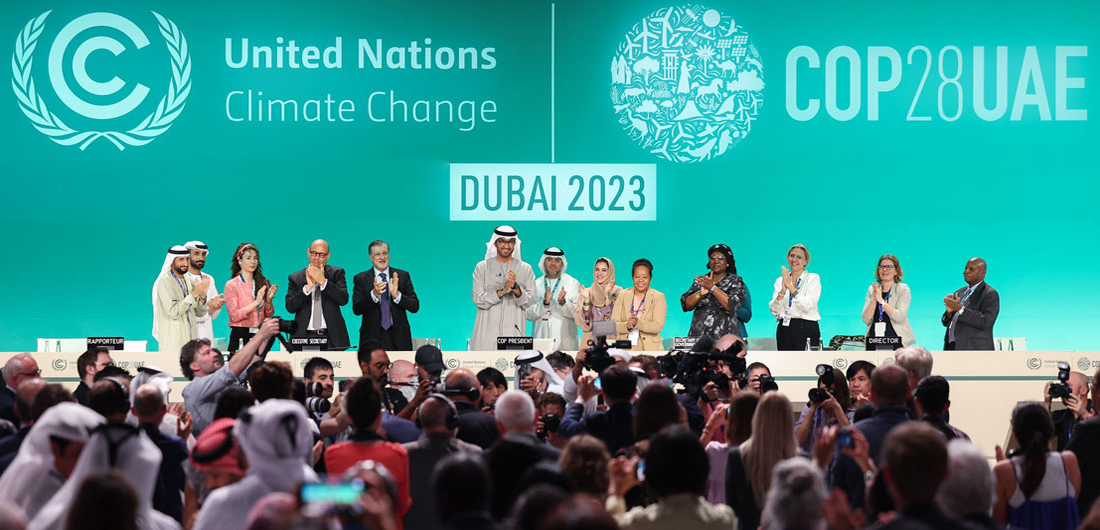
Despite the diplomatic hype, COP28 is not an historic success and is not at all a breakthrough. As expected, the 28th climate convention, like all previous ones, has ended without a final paper stating the obvious which is the end of fossil fuels (finally mentioning fossil fuels in a final agreement for the first time after 27 climate conventions is not a success). And similar to previous climate conventions it has been a failure in all other aspects as well. Some exclude the COP21 held in Paris and regard it as successful, however as we elaborated in our critical review of that convention, COP21 was in fact also another failure of humanity to seriously address what it considers to be its greatest challenge. In another post we tried to explain why it is so. Therefore regarding COP28 we want to focus on a seemingly positive change.

Clearly, animal food industries should have been in focus during climate conventions decades ago considering that one-third of global greenhouse gas emissions can be attributed to the food industry with flesh and dairy accounting for most of it (as well as for many other environmental harms), and considering that dairy production alone emits more greenhouse gases than global aviation, and considering that in the latest IPCC’s Special Report on Climate Change and Land, scientists wrote that animal flesh and dairy do more damage to the environment than any other food, or in their words: “meat was consistently identified as the single food with the greatest impact on the environment”; yet it didn’t happen.
It took 27 climate conventions, and decades of knowing and deliberately ignoring, but on the face of it, it seems that finally there is a formal recognition of the animal food industry’s contribution to climate change.

However, after reading The Declaration on Sustainable Agriculture, Resilient Food Systems, And Climate Action that was signed during COP28 and doesn’t mention any specific action nor animal based agriculture’s emissions, not to mention, recommending plant-based diets; and after considering the development and use of a tool such as Global Warming Potential Star (GWP*) – a new method of measuring methane emissions that will practically allow animal based agriculture to keep the exploitation business as usual even if someday there will be a general requirement of emission reduction from the agriculture sector; and considering the fact that this convention had the highest ever number of lobbyists in general as well as specifically of animal exploitation industries (there were four times the number of industry-affiliated lobbyists compared with last year’s summit and that number may be even much higher as it relies on delegates openly disclosing their connections to fossil fuel and their interests to the organizers), then clearly, exactly like the words ‘phase out of fossil fuels’ have never been agreed on in any final agreement of any climate convention, the words ‘phase out of animal agriculture’ will never be agreed upon. Exactly like no previous convention has reached an agreement on the obvious needed decision regarding fossil fuels, same would go for animal agriculture.

That is despite that at least technically speaking, it’s supposed to be much easier to phase out the animal based food industry as all it takes is to stop consuming animal based products and maintaining a plant based diet, than to change the entire energy industry. But actually it is much harder because while humans don’t care about the energy source that is charging their phones, they care a lot about the food they are eating. That is of course care in the sense of wanting it to be familiar and tasty, not care in the sense of caring about the dire effects their choices have on others. So it’s a much tougher change and way more demanding of humans. Humans are not emotionally attached to their energy source, but they are deeply attached to their favorite food. Unfortunately they are not at all emotionally attached to the ones whom their food is made of.

Maybe agriculture will play a part in climate conventions at last. But unfortunately it is highly unlikely to last. If decades of acting on the issue including 28 conventions have yet to produce an agreement about the obvious thing to do in terms of the energy industry, there is no chance it will ever happen regarding the food industry.

Animal Liberation Revision

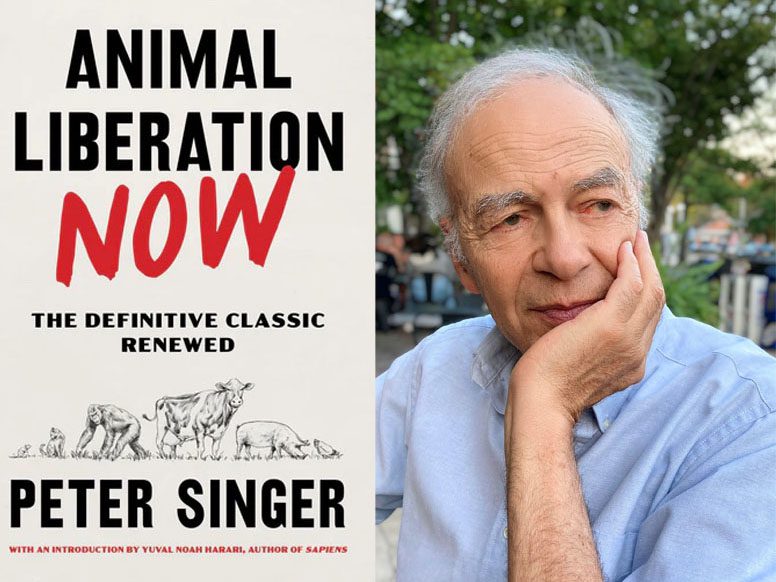
For World Vegan Day held today, we wish to refer to Peter Singer’s disappointment, expressed in Animal Liberation Now: The Definitive Classic Renewed, published earlier this year, that his “call for a boycott of meat has been a dismal failure“.

Singer writes:
“If avoiding factory farm products is a form of boycott, then what do we do if the boycott isn’t working? That question has to be asked, because since I called on readers to boycott meat in the first edition of this book, worldwide consumption of meat has increased from 112 million tons to more than 300 million tons, with virtually all of the additional meat coming from factory farms. A large part of that increase is due to the world’s population having doubled in size during that period, and most of the rest is the result of an otherwise welcome reduction in poverty, especially in Asia. Meat is expensive, and so people consume it only when they can afford to do so.
China’s per capita meat consumption tripled between 1990 and 2021, and Vietnam’s quadrupled over the same period, while there were also sharp increases in Brazil, India, Indonesia, Mexico, Pakistan, and South Africa. Countries that were already affluent in 1990 did not have such a clear trend, with moderate increases in Australia, Israel, Norway, and Japan, more modest increases in the United Kingdom and United States, and decreases in Canada, New Zealand, and Switzerland.”

Singer’s question is painful but necessary. It’s very difficult for us activists to acknowledge that the movement we are part of, all the effort that was put in, the life work of so many, is failing. It’s painful to admit that activists rely on small achievements missing the bigger picture and fail to recognize the mechanism.

Obviously we are not arguing that Animal Liberation didn’t positively affect the scale of suffering in the world. Of course it did. But undoubtedly the world since Animal Liberation is one in which there are many more suffering sentient beings who suffer even more.

Since 1975 new exploitation practices have been formed, joining the ones that already existed and constantly expand. Many countries have added more species to the list of “exploitable animals” (ones who weren’t subjected to commercial exploitation in these regions before), and further intensify their exploitation all the time. The prices got cheaper and cheaper and a greater variety of available products was introduced to the market.

Singer mentions some positive changes as well, such as the EU regulations in the egg, veal calves and pig’s flesh industries. However, as we elaborated in the articles about the Egg industry, the veal calves industry, and the pig’s flesh industry, these regulations are actually far from the titles and statements of ending some of the cruelest practices common in these industries, and it is certainly far from what activists hoped for, and it is most certainly extremely far from what the victims want and need.
Singer also mentions the European Citizens Initiative called “End the Cage Age” which was eventually dropped as we detailed in our former post.

Every year, additional tens of millions of sentient beings are born into a life of suffering. Every day is worse than the one before. Our website is full of facts and figures about suffering in the world, but the worst ones are the mentioned acute per capita increase, and that every second 5 more human babies are born. This world is so horrible that one of the greatest suffering factors is the human birth rate.

Apathy not ignorance

Singer decided to update and revision the two more informative chapters of the book, the one about animal experiments and the one about factory farming.
One immediate terrible thing about these chapters is that all the horrors that were practiced in 1975 are still common nowadays. The other depressing thing about it is the false belief that people keep supporting animal abuse because they are unaware of the details.

While it’s true that still most people aren’t exposed to what the animals go through in factory farms, they are aware of the basic facts. Humans don’t have to know every detail about the cruelest exploitation system ever in history, it is enough to generally know that factory farms exist to be morally accountable.

And it is even more basic than that, humans know that meat is animals’ flesh. Even the least informed humans are at least aware that meat is made of animals who were murdered specifically to make the meat they eat. They are aware of at least that, and still freely choose to participate. They know that animals are born to be killed for their flesh. Meat is never made of animals who died of diseases, accidents, by other nonhuman animals, or of old age, but only of animals that other humans murdered. So humans are not only fully aware of animals being murdered for their meat, murder is an obligatory condition for a corpse to be considered as meat. Humans know meat is murder. Knowing that they participate in hurting nonhumans is sufficient for them to stop. Humans consume animal products because they want to, not because they don’t know better.

The only thing that at least some humans can honestly say is that they didn’t know the extent of how horrible animals’ lives actually are. But the basic fact that meat is a piece of carcass, should definitely be sufficient to at least ignite basic curiosity and motivation to look for more information, if humans cared. However, humans don’t even try to figure out what happens to nonhumans before they become their meat. Extensive information is available for everyone nowadays, and activists are more than willing to explain to everyone what is going on and what they can do about it. So even saying that they didn’t know how horrible animals are treated, is less a case of lack of knowledge, and more a case of lack of caring.

Humans know enough to at least start asking questions. But they don’t want to know more, or know but don’t want to think about it. And when someone knows but doesn’t want to know more or doesn’t want to think about it, s/he doesn’t care. The problem is not ignorance, but apathy.

The argument that ‘the problem is that people don’t know what is going on’ is quite popular among activists since the counter assumption is deeply depressing. It is very discouraging to internalize that humans know but don’t care enough to stop, or that humans choose to eat meat fully aware of the fact that it is made of animals (and maybe even because it is made of animals). Clearly it is more empowering for activists to believe that humans are basically and naturally compassionate, and they are doing horrible things as a result of deceit and manipulations, as it is the hardest thing to make others care about something they don’t really care about. Raising awareness and informing humans is the relatively easy task, making others care about something to the point of changing their beloved habits, is a whole different story. So of course believing that humans are not doing the bad things they do because they want to, but because they don’t know better, is a much more comforting position than that they know what’s going on and do it anyway.

Humans know meat is a corpse of an animal that was raised and murdered for them. They see animals in all kinds of situations during their lives, in farms when driving outside the city, inside crowded trucks when driving on highways, dead but in a relatively whole and unprocessed state in markets, alive in the case of fish and crustaceans in markets and even restaurants, and of course in the last couple of decades in the movement’s publications, on TV, and online. People know what’s going on. They just don’t care enough to do something about it.

Nowadays, more and more humans, in more and more places are exposed to more and more of the violence from factory farms by activists who face them with the truth. But the reaction of most is not a moral repugnance, but mainly avoidance from any ethical consideration. Most don’t want to watch violence towards animals, but to keep enjoying the “products” of it.
If slaughterhouses had glass walls, almost everyone would look away from the violent sight and keep eating animals flesh.

ise to the challenge

Singer writes:
“I am often asked if, when I first wrote Animal Liberation, I expected it to have the success that it has had. The truth is that I didn’t know what to expect. On the one hand, the core argument I was putting forward seemed so irrefutable, so undeniably right, that I thought everyone who read it would surely be convinced by it and would tell their friends to read it, and therefore everyone would stop eating meat and demand changes to our treatment of animals. On the other hand, in the 1970s, few people took issues concerning animals seriously. That speciesist attitude could have meant that the book would be ignored. If I succeeded in getting some attention, I was aware that the huge industries that exploit animals would fight against ideas that threatened their existence. Could rational and ethical arguments make headway against such powerful opposition? Alas, I thought, probably not.

What happened falls between these two opposing scenarios. Yes, there are more vegetarians and vegans than there were in 1975, and some of the reforms mentioned in this chapter have improved the lives of hundreds of millions of animals. On the other hand, there are now more animals suffering in laboratories and factory farms than ever before. We need much more radical changes than we have seen so far.

The animals themselves are incapable of demanding their own liberation, of protesting against their condition with rallies, votes, civil disobedience, or boycotts, or even of thanking those who advocate on their behalf. We humans have the power to continue to oppress other species forever, or until we make ourselves extinct. Will our tyranny continue, proving that morality counts for nothing when it clashes with self-interest, as many cynics have always said? Or will we rise to the challenge and prove our capacity for genuine altruism by ending our ruthless exploitation of the species over which we have power, not because we are forced to do so by rebels or terrorists, but because we recognize that our position is morally indefensible? I believe that this recognition will come, eventually, because over the past millennium we have made progress in expanding the sphere of those to whom we extend equal consideration. I do not know how long it will take for us to include nonhuman animals within this sphere, nor how many trillions of animals will continue to suffer until that happens. The way in which you and other readers respond to this book can shorten that time, and reduce that number.”

It’s time to open our eyes and admit that human society is irrevocably speciesist. So far there is every reason to believe that even within the human race, selfishness and discrimination will never be overcome. Anthropologists have never discovered a human society free of violence, and social psychology findings indicate that elements such as group patriotism, selfishness, obedience, conformism, tendency to discriminate, as well as biases, irrational and irrelevant factors when it comes to moral thinking, are all innate to a great extent.

Conventional advocacy, or, asking the torturers if they are willing to stop torturing, is basically and principally speciesist in itself.
Despite that theoretically activists absolutely oppose humans’ dominance, they practically accept it by asking humans to change their violent ways. They all know what happens every time they fail to convince them.

Among themselves, activists point out that the animal holocaust is much worse than any human holocaust in history, however, the partisan fighters in the second world war didn’t organize leafleting events to stop the massacre.

Animal liberation activists’ natural tendency and the first and last plan of action, is to explain to humans that their daily torturing of the weaker for their own minor benefits, habits and pleasures is wrong, and that in itself is wrong, violent and speciesist. It indicates how human oriented the moral scope is, and how inherently limited the discussion is.

Advocacy, today’s go-to option, must be realized for what it is – an extreme compromise at animals’ expense. Advocacy shouldn’t be the obvious starting point. You start by aiming for the best, most radical option and only if it turns out to be irrelevant should you turn to such a desperate compromise as working towards a world with as many vegans as possible.

And even if many consider going vegan, and even if all go vegan, the absolutely delusional option of a vegan world can be reversed at some point in the future. And even if it won’t, this world would still be a very violent one. The chances that the animal liberation movement would stop all the suffering are zero, not only because of the current consumption trends and the extremely depressing forecasts of the future, but because there are so many suffering factors that the movement doesn’t address, and so many suffering factors that the movement probably can’t even theoretically address.

The solution the AR movement is offering – veganism, the one that even in the more progressive parts of the world many activists believe it’s strategically unwise to ask for, is actually a systematic global oppression operation, abusing countless numbers of animals.
The main reason activists hardly ever address this massive black hole is because everything pales in comparison to factory farming, and also because most automatically go on the defensive when meat eaters cynically make this point.
But we are not meat eaters, we are vegans too. We are vegans because it is the least horrible option. But more than we are vegans, we are activists, and as such we are looking for a truly moral solution. Veganism isn’t.

The long list of vegan options you gladly offer those you’re trying to convince to consider stopping their personal part in the torture, is substituting extremely horrible things with much less horrible things. But they are not at all cruelty free options. Plant based diet is cruel. The fact that there are diets that are much crueler doesn’t make it moral.

Apart from the agricultural stage, the manufacture of products that are considered basic vegan food such as soy milk, flour, tofu, bread, oil, tea and etc. can include dozens of harmful sub-processes like: Cleaning and removing unwanted parts such as the outer layers (for example, separating the beans from the pod), extracting the interior (such as seeds), mixing and macerating (as in preserved fruits and vegetables), liquefaction and pressing (as in fruit juices and plant milk production), fermentation (like in soy sauces and tempeh), baking, boiling, broiling, frying, steaming, shipping of a number of ingredients from different distances, wrapping, labeling, packing, transportation of waste, and of course the transportation to the stores. All these stages are invisible as the finished product lies on the shelf.

And don’t get this criticism wrong, it is not about activists’ diets, it is about activists’ activism. We are not criticizing activists for being hypocrite because they cause suffering. We know it is inevitable and that’s the whole point. Even the most caring and compassionate, non-speciesist humans on this planet are bound to participate in a violent system, systematically hurting creatures they wholeheartedly believe they mustn’t. There is no nonviolent option in this world.

Most humans haven’t even made much more basic ethical decisions. There is no magic formula to educate most humans to solve conflicts without violence, to not objectify each other, to not discriminate each other on the basis of race, gender, ethnical orientation, class, weight, height, looks and etc., so what are the odds of convincing them all to become vegans?

Humans prove again and again that their profits, taste preference, convenience, entertainment and etc., are much more important to them than morality. Most of them are not even willing to hear the facts and listen to the arguments, not to mention stop financing animal abuse.

Even when the animal rights movement gives up on the idea of developing care towards nonhuman animals, and turns to anthropocentric and egoistic advocacy – such as trying to appeal to humans’ selfish concerns like care for their children’s future by using “the environmental argument”, or care for their own kind by using “the hunger argument”, or care  for themselves  by using “the health argument” (the hopelessness summit) – it doesn’t really change humans, as they are too egoistic and self-centered. Even the most anthropocentric and self-involved arguments are failing.

Even when activists consider humans’ self-centered character and their ethical frailty and promote initiatives such as Meatless Mondays or Veganurary, corporate outreach, and further development of various flesh “alternatives” – all indications of how activists gave up on humans’ care for animals – it doesn’t lead to any real change.

Even when the animal rights movement reaches the lowest point it is not enough.

The animal rights arguments are so simple and right. They are based on solid facts and evidences. Nobody can confront them rationally. The fact that the arguments are so strong and so well-based but still fail again and again, is the exact thing that should wake you all. Animal rights activists shouldn’t draw strength from their strong arguments but the other way around. When arguments that are so strong and so obvious don’t work there is something wrong with the addressees.

If you act to change humans the maximum you can theoretically achieve is more vegans. But if you act to annihilate humanity, the maximum you can achieve is the termination of the incomparably most oppressive, violent, and harmful species in the history of this planet. Isn’t that goal worth devoting your life for? Can you think of anything better to do with the one life that you have than trying to do everything you can so that if you succeed human tyranny would end for good?

We are not delusional activists. We are well aware of how little the chances to stop all the suffering are. However morally that’s what we aspire for and what we think every activist should aspire for. As long as there is a theoretical chance to stop all the suffering we mustn’t compromise. We must search for ways to do it as hard and complicated as it is, and as long as it takes. Especially since the conventional movement’s chances are not an option even theoretically.
The more activists join this ambitious effort, the greater the chances of the suffering to end. Rise to the challenge.

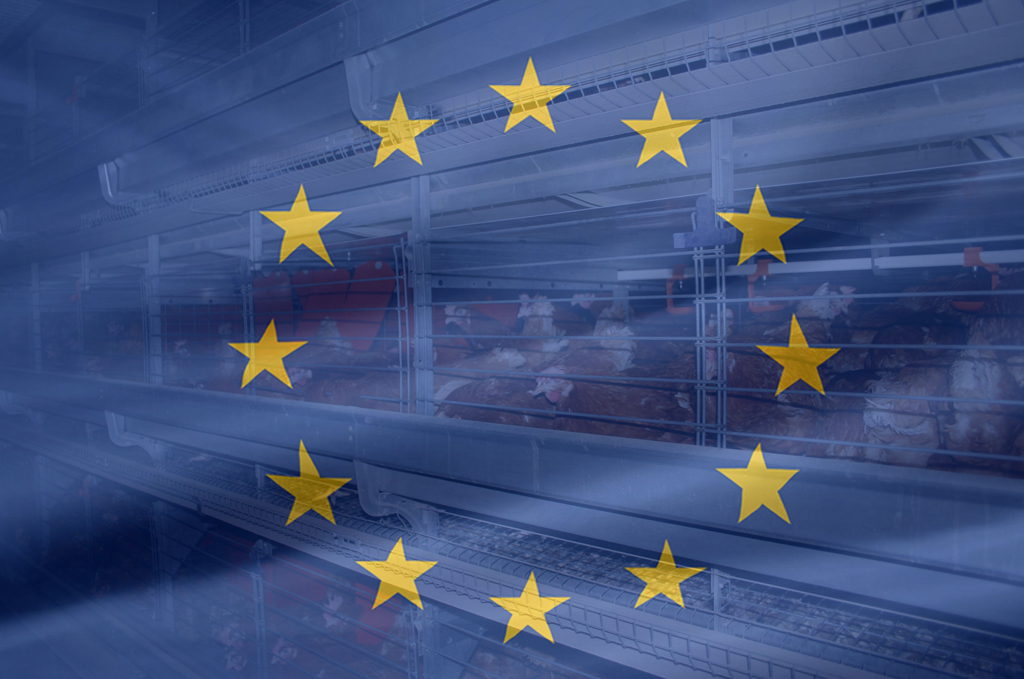
A Grim Lesson from the EU Commission

Terrible news affecting billions of animals was received last week.
Two years after EU policymakers declared the most ambitious plan ever by any government to phase out some of the cruelest practices in factory farming, this legislation, along with a suite of other reforms that would reduce the suffering of potentially billions of farmed animals, have been dropped.

A leak from earlier this year outlined the EU Commission’s plans for the world’s most comprehensive farm animal welfare reforms to date. In addition to legislation to phase out cages for farmed animals across the EU’s 27 member states, the Commission planned to put a ban on the routine mutilation of hundreds of millions of animals every year such as piglet castration, to stop some of the currently common and legal murder methods of about a billion farmed fishes, shortening the transport of live animals, to stop the practice of slaughtering day-old chicks, to stop the sale and production of fur, to reduce the crowdedness in the chicken industry, and stopping chickens from growing at such rates that essentially they can’t stand up because their legs can’t support their own weight.

Such a reform in EU would have possibly induced and bolstered momentum for similar changes in other countries as well. That is especially so considering that both animal advocates and farmers have been pushing for the new standards to also apply to food imported from outside the EU, which could reduce the suffering of hundreds of billions of animals all over the world.

Regardless of your personal views on welfare reforms, considering our general views and what we think animal activists should do with their precious time, the crucial point we want to make here is more about the reasons such legislation has failed, and about the lesson we think should be learned from the fact that a unique process has initiated this act and yet it failed.

Commission officials admitted that the legislation had been dropped due to pressure from the powerful European meat lobby, and concerns over rising food costs due to inflation, extreme weather, and Russia’s invasion of Ukraine.

Again it is made so clear how a handful of powerful key players in the human political game can so tremendously affect the lives of billions of sentient nonhuman animals.
As always, the fate of billions of sentient beings is determined by economic and political interests, not ethics.

And this story also has a depressing aspect from supposedly democratic sense.
This legislation proposal came about as a result of what’s called a European Citizens’ Initiative, in which EU citizens can propose a policy directly to the Commission so long as they collect at least 1 million signatures in support of it. The Commission doesn’t have to adopt the proposal, but it at least has to formally respond to it. A coalition of animal groups has managed to gather more than the required million signatures, and so the Commission agreed to craft the legislation.

Olga Kikou, Head of Compassion in World Farming EU and substitute representative of the ‘End the Cage Age’ European Citizens’ Initiative said that “After years of strong citizen engagement and clear-cut commitments, the Commission is now betraying EU citizens who believed in what was promised in 2020,” and added that The farm animal revolution that everyone was expecting would have diminished the suffering of hundreds of millions of animals every year. It has fallen victim to political games and those who espouse business as usual.

Obviously this is far from being our main concern here, however this should function as an important reminder of how the world really works.
Even when something that may turn at least some parts of the lives of at least some animals into at least a little bit less horrifying, it is being trampled by factors and motives that has nothing to do with the victims themselves, who as always, are treated as pawns in a cruel game where their lives are being absolutely controlled by others.

Activists must not confuse accepting reality for what it is and acknowledging reality for what it is. This is our world and us activists are the last who should paint a prettier picture. We are also the last who should accept it. We can choose to keep fighting to marginally scrape the edges of this exploitative world, only to see how one political move after another revokes all the little gains we have made, or we can choose to fight all the maladies at once by looking for ways to destroy it.

Another Breaking Breakthrough

Fish farming, usually euphemized as aquaculture, is already the most rapidly growing exploitative industry, and the consumption of factory farmed fishes already exceeds the one of caught fishes, and it is about to get worse.

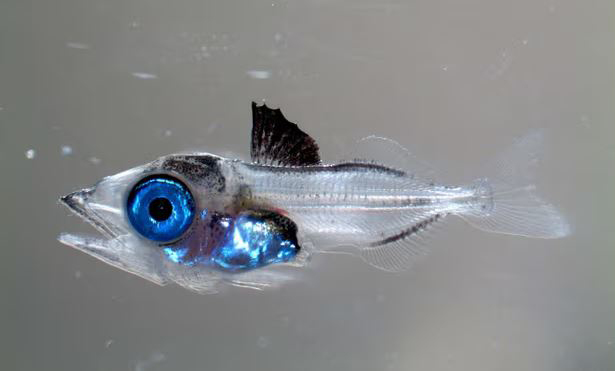
An unfortunate breakthrough was achieved at a Spanish government-run research center, where the first successful breeding of Atlantic Bluefin Tuna took place. Up to now, farming of Atlantic Bluefin Tuna has relied on catching young wild fishes and fattening them in open-sea cages, but now that the inhibiting dependencies have been removed, this industry can expand.

The breeding facility will supply fertilized eggs and juvenile Tuna to the newly created commercial firms, which will either continue the breeding cycle on land, or use a combination of land-based tanks and sea cages.
At least two companies already plan to build an industrial farm of land-bred Tuna, and they would be the first to use only tank-bred Atlantic Bluefin stocks of fertilized eggs or young Tuna.
One of the companies plans to establish its own breeding program and sell young fish to “grow-out” farms for fattening and sale, next year, with the goal of selling about 45 tonnes of juvenile Atlantic Bluefin Tuna by 2025, and 1,200 tonnes by 2028. The other one aims at producing fishes by late 2024. And they would probably be followed by other companies soon.

The Bluefin Tuna is a highly migratory species with complex behaviors and migration patterns. Farming these fishes so intensively would cause many welfare issues such as high stress, frustration, disease, and, ultimately, poor immunity.

And not only that more Tuna fishes are going to suffer, and to suffer even more than they do now, an increase in farmed Tuna would mean more fishes being caught from the oceans to feed them.

Usually “solutions” offered by humans end up hurting more animals or hurting animals more severely, and in many cases both. One of these cases is fish farming.
In a former post we discussed how as a consequence of the reduction in marine animals capture from the oceans in the last few decades, humans hurt marine animals even more severely by intensively farming billions of them. A lifetime of dense confinement in waste filled water, exposure to diseases and other bodily harms due to genetic manipulation are forced upon the fishes as a direct result of the decision to switch to farming. The other, less known, result is widening the scope of abuse even further. As a consequence of farming fishes, many of which are of carnivorous species, even more fishes are captured from the oceans, to feed the fishes confined in the farms.

It is estimated that every year between 450 billion and one trillion fishes are purposely caught specifically to be grind up into fishmeal and fish oil, which are mostly used as food for other animals humans rear for food, mainly farmed fishes.

Virtually any fish or shellfish in the sea can be grind up into fishmeal and fish oil, but they are usually produced from small marine fishes that are considered not suitable for direct human consumption.

These sentient beings, hundreds of billions of them, are even more invisible than the hundreds of billions of sentient beings that humans directly consume.

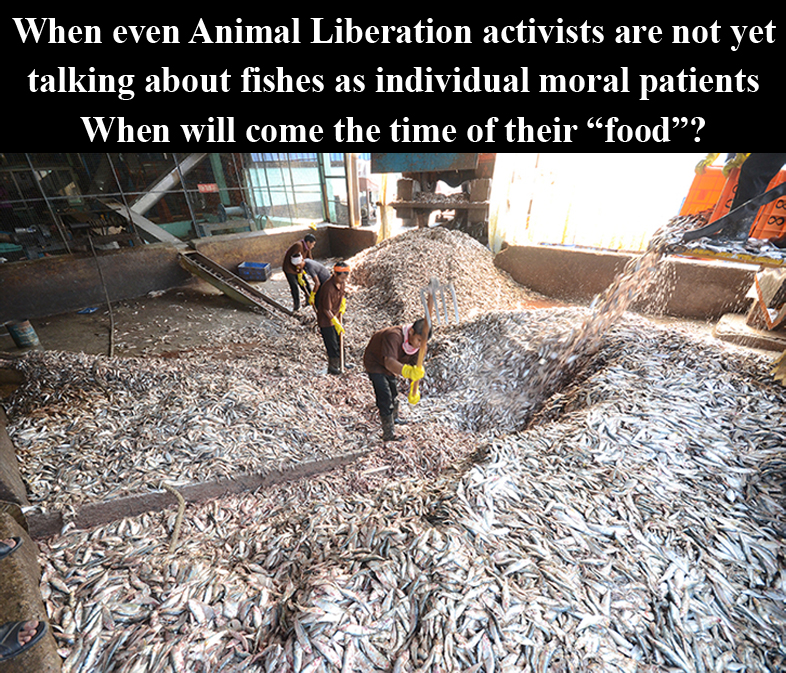
If fishes that humans consume are not even counted by the industry as single “items” but in kilograms and tones, and even among the animal liberation movement their misery is rather concealed, probably because activists know how little empathy fishes raise among humans, when will come the time of the fishes that are eaten by the fishes humans eat?

This horrible development is another example of how economic decisions such as trade agreements, which we wrote about in some former posts, and technological “advances” are much more significant in terms of animals’ suffering than the movement’s efforts.
Despite what might seem as a strengthening of the movement in the last couple of years, along with the much greater increase in the number of consumers and the much greater increase in the consumption of each consumer (which by far exceeds the increase in the number of vegans and in the consumption of vegan products by none vegans), internal changes in the industry also make the world a worse place all the time.

Ending Speciesism

On the occasion of the tenth World Day for the End of Speciesism held today, we wish to republish our post about this day from 8 years ago, as it is relevant today as it was then.

Marches, rallies, and protests took place yesterday in several locations around the world calling to end speciesism. However, unfortunately, what seemed on the face of it as a more radical version of advocacy (especially in light of the rise of consumer oriented approaches, and the notorious reductionism trend) was found to be not much more than more of the same.
As usual, activists are asking humans to stop consuming animal derived products, and “urge parliaments and the courts to create and enforce a new legal status for animals that stops them from being considered as property and recognising them as sentient beings whose interests must be protected by the law”.
As we broadly explained in the posts Non-Violence Approach and Reclaiming the Power We Should Have Never Given to Humans, the mere position of asking the abusers to stop abusing is in itself speciesist. It’s perpetuating the speciesist reality in which one species makes all the calls for all the other species, especially when the case is of systemically exploiting them. The self-evident frame of thought is that it is humans’ decision how to treat the rest of the species. And when humans leave the conversation about their abuse and choose to keep abusing, as most humans do, that’s what will happen. Merely asking them to stop abusing is letting them continue to torture.
The fact that some AR activists are calling what they do ‘demanding’ and not asking, doesn’t change the speciesist status of this twisted scenario, since as long as it’s the abusers’ choice, saying that we are demanding the end of the torture is meaningless. In that sense demanding is just an angrier version of asking. There is no “or else…”. When humans choose to abuse all they get is a sad or an angry face from the “demanders”. And that is in the better case. In the worst case it is a smiley suggestion that they would at least consider reducing some of their torture.

While asking to at least consider reducing some of their torture is not the case with the World Day for the End of Speciesism, as shortly explained above and broadly here and here, speciesism is inherent to all advocacy. And it is particularly upsetting when the speciesist advocacy comes from those who named their project the End of Speciesism.

Again, it is a bolder message compared to the ‘morally reductionist’ messages out there. But what the movement needs is not to be bolder but to restart.

This post is about speciesism and not about the World Day for the End of Speciesism. We use this initiative only to point out some of the reasons for the acute need for the whole movement to restart, and how some of the “end speciesism” measures and most importantly even the aims themselves, are speciesist.

For example the reliance and emphasis on the legal system is in itself speciesist. That is since besides that laws and rights are power based, discriminatory in their nature, and virtually are “the law of the strongest” in a civilized suite, as long as the legal system is human, it is bound to be speciesist. The suggestion that “animals’ interests must be represented before the law by animal defence societies, prosecutors specializing in animal issues or guardians other than their owners” is missing the whole point of ending speciesism. Clearly, the very situation of humans representing animals’ interests in a human court room, where humans judge whether actions done to nonhumans are in accordance with the laws humans have shaped, is in itself utterly speciesist.
Even if you overcome the inherent problem of human groups making rules which are applied on individual humans, who have never agreed upon nor participated in shaping them, there can never be equality when one group decides everything for all the other groups.
Humans and humans alone have the power to make laws. Humans are using an unfair advantage they have on nonhumans, which is their political power, to make rules that suite their own interests. Inequality is inherent to an interspecies system where only one species makes all the rules.

It is not only that humans are cruel masters, it is the fact that they are the masters and always will be. A history of thousands of years is more than enough to realize that this is not merely a theoretical built-in injustice, but a built-in power structure that practically allows humans to torment trillions of sentient beings for thousands of years, with no sign of it ever ending.
And even if every law that regards humans was made relevant to nonhumans just as much (can you even read this sentence seriously?), it can never encircle all the interests of all the nonhumans. It can never encircle all the offences against them as the law was made by humans for humans and from humans’ point of view.

Like many other AR initiatives this one also falsely relies on the common notion that injustices of the past such as slavery have been abolished. “They too were so embedded in the collective consciousness that they were thought to be eternal”. We can’t make the claim that slavery is eternal, it would be ridiculous to do so, as at least theoretically social ideas can change. However if we can learn from history something about slavery it is that it does seem to be eternal practically. Evidently, despite that there is not even one country in the world today where slavery is legal, there is not even one country where slavery doesn’t exist.

As we broadly explain in the post 10 Reasons Why Human Slavery and Animal Institutionalized Exploitation Are Incomparable, we disagree that the two exploitation institutions are comparable, however since there are more slaves today than ever before in history, if there is anything to learn from that false comparison is rather that speciesism cannot be ended.

And even if slavery is eradicated someday, a scenario that is hard even to imagine based on the current state of affairs, ending animal discrimination is not only hard to imagine, it is impossible to implement.

Mission impossible

Things go way beyond the stands and the demands of one organization, reflective of the rest of the movement as it may be.
Even if all the campaign’s requests are fully accepted, speciesism wouldn’t be ended. And that is not only because the activists are not calling for the end of every form of speciesism, but since ending every form of speciesism is impossible.
It is not the huge gaps between ending speciesism and the demands of this particular campaign that we find so important, but the huge gaps between ending speciesism and the reality on planet earth.

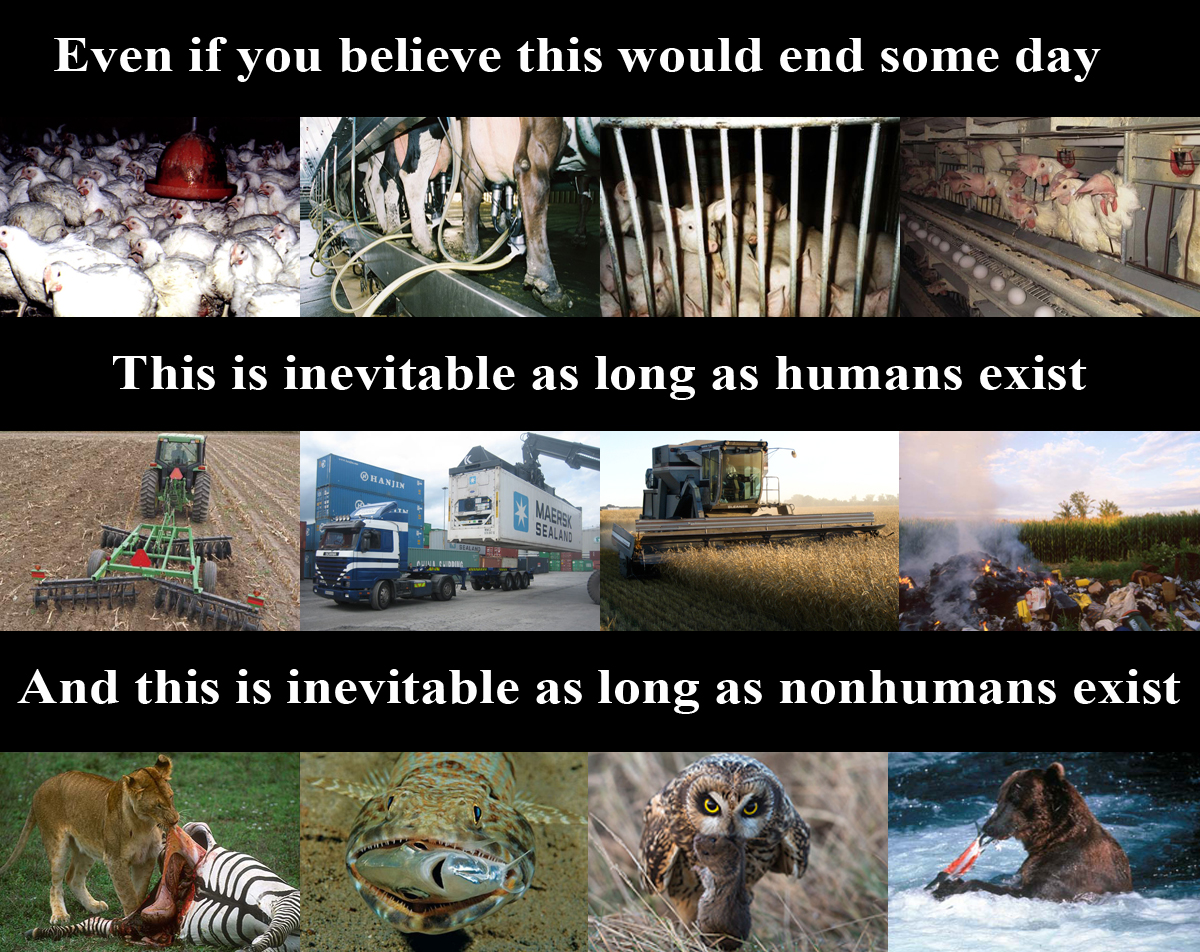
Speciesism is everywhere and in everything. Every aspect of humans’ lives is bound with the discrimination of nonhumans. Not just factory farming but any type of farming is speciesist. The levels of discrimination obviously largely differ, but excluding nonhumans from a particular area, tearing out the native vegetation and planting ones that suite humans’ desires and not necessarily the needs of the native residents of the region, fencing the area, constantly poisoning nonhumans in it, changing the composition of the soil, dividing the nearby lands with roads to the farms, plundering water from other habitats, making noises with heavy machinery, crushing nonhumans with heavy machinery, polluting the area with humans’ waste of many kinds and etc. are all unquestionably forms of discrimination.

Everything in life is on someone else’s expense. All clothes are speciesist, not only leather, fur, wool, silk and down. Houses are speciesist. Cities are speciesist. Electricity is speciesist. Fireworks are speciesist. Lawns are speciesist. Veganism is speciesist. Animal advocacy is speciesist. And it is speciesist to ignore all of this speciesism.

Taking the interests of each sentient being into account as if they were our own doesn’t end with turning each human vegan. And it shouldn’t even begin there, but with turning each one back to living like any other ape in the forests and savannahs. Obviously that is not the world we wish and advocate for, but at least it would be more coherent and consistent with the presented moral guidelines of the call to end speciesism (as it would reverse many elements of the occupation on this planet).
But nobody is advocating for that. The systematical, industrial exploitation of animals in the form of factory farms is by far the worst embodiment of speciesism in history, however it is also far from being the only one.

If to follow Joan Dunayer’s definition of speciesism in her book named after the term, speciesism is “a failure, in attitude or practice, to accord any nonhuman being equal consideration and respect.” A vegan world is far from being an equal one.

How is an extremely industrial and technological civilization of more than 7 billion humans, that dominates and impacts practically every inch on earth can ever accord any nonhuman being equal consideration and respect?

In this world the mere concept of rights for all nonhuman animals is an oxymoron. Everything is on someone else’s expense. Humans’ global occupation is so vast and absolute that civilization became self-evident. But it mustn’t be. Speciesism is inherent to every human activity. Even if you insist that a vegan world may be possible one day, you can’t seriously think that humans would be convinced to voluntarily go back to living like any other species, limited to a relatively bounded geographical area, living off the surrounding, and include several million members only. That would be much closer to ending speciesism, and it is not even close to what is being demanded of humans and thought of by activists.

For the End of the Species

Ending speciesism is not synonymous with veganism. It’s speciesist to think that speciesism’s boundaries are within this range alone. It is not just a matter of degree (and factory farms are by no doubt the worst embodiment of speciesism), it is a matter of kind. And so a different kind of thinking is needed from activists to end speciesism. Currently activists focus on the worst degree harms that humans are doing to other species, and on what humans might, theoretically only, agree to stop doing. But a truly non-speciesist perspective must look at what is done to the discriminated beings and what can be done to stop it regardless of humans’ willingness or “opinions”.
The end of speciesism shouldn’t be about humans as discriminators but about nonhumans as discriminated against. Hence speciesism doesn’t end with factory farms and animal experiments and etc., it doesn’t even end with humans. The vast majority of the interspecies relationships on earth are basically speciesist, in the sense that they are anything but “equal consideration and respect”. “Nature” is full of discriminations based on species. In fact, interspecies violence is so abundant and so inherent that it is not even perceived as discrimination.

Therefore stating that all sentient beings are equal is utterly absurd. All sentient beings can’t be equal since they constantly fight over resources and in many cases they are each other’s resources. Speciesism will end when there is only one species on earth and even then individuals would be discriminated against based on parameters other than their species.

The World Day for the End of Speciesism website states “it is in the center of the interests of every sentient not to be hurt, not to suffer, not being a victim of violence”. But the fact that this world is inherently based on that sentient beings are constantly being hurt by one another, suffer constantly, and are often victims of violence, is another fundamental reason why speciesism can never end. How can all the sentient beings be included within the circle of moral consideration, when their very existence comes at the expense of others?

Activists focusing on factory farms, justly thinking that they are the greatest atrocities on earth, are postponing the inevitable. At some point they are bound to realize that discrimination and suffering is everywhere and in everything. If we want to end speciesism, we mustn’t focus on its most acute manifestation but on its most deep-rooted one. And that is unfortunately not the legal or social status of sentient beings but their biological one. It is impossible to end speciesism by social means.

The world can never become non-speciesist, yet speciesism must be ceased. Speciesism is not less of an arbitrary discrimination, not less unjust, not less violent and not less cruel because it is even theoretically unabolishable. Speciesism must be ended by all means necessary. The only way to end speciesism is to end the species. And the only ones who will ever consider doing it are you.
Don’t make do with stating that you would push the button that will end it all, and try to make one.

Beyond Hope

Earlier this month some disappointing news was published.
Beyond Meat’s latest financial report revealed that its net revenue dropped by 30.5 percent in the second quarter of 2023. Compared to the same period in 2022, revenue decreased from $147 million to $102.1 million. And in the US, the largest economy in the world, Beyond saw year-on-year sales fall by 40 percent. The following morning, Beyond Meat’s stock dipped by more than 20 percent.
This report was followed by media coverage suggesting that plant based “meat” was just a trend.

Although indeed this news is a bit concerning, it is a different publication which should make us really worried. Just a few days after the news about Beyond Meat, an article titled: “Price-, Taste-, and Convenience-Competitive Plant-Based Meat Would Not Currently Replace Meat” was published by Rethink Priorities, and it has some extremely depressing well based statements.

The articles’ main argument goes as follows:
Plant-based and cultivated meat are both a major, maybe even the greatest, source of optimism for reducing, and according to some even ending, animal farming.
These hopes rely on the assumption that what primarily drive food choices are price, taste, and convenience. Therefore, the price, taste, and convenience (PTC) hypothesis assumes that if plant-based meat is competitive with animal-based meat on these three criteria, the large majority of current consumers would replace animal-based meat with plant-based meat as there would be no remaining reason for them not to. However, price, taste, and convenience do not mainly determine food choices of current consumers; social and psychological factors also play important roles. Therefore a majority of current consumers would continue eating primarily animal-based meat even if plant-based meats were PTC-competitive.

Obviously, the article doesn’t suggest that price, taste, and convenience don’t play a role in food choices, but that these are not the only or even the primary factors:
“Of course, there is no dispute that PTC are important factors in people’s food choices, but research in food psychology demonstrates these are not the sole or primary factors. Intuitively, this fact is apparent when considering basic consumer behavior: any given grocery store likely offers thousands of cheap, tasty, and convenient products, and yet, consumers decide to purchase only some of these products, without gathering any information on the large majority of them. Presumably, consumers do so by relying on factors well beyond PTC. Indeed, the psychological literature has identified myriad influences of food choice spanning psychological, biological, physiological, situational, and socio-cultural factors in addition to product characteristics (Köster, 2009). Furthermore, a rich literature on the psychology of meat consumption has identified factors particular to the consumption of meat and animal products. For example, people feel a peculiar personal attachment to meat (Graça et al., 2015), believe that meat is necessary for health, feel that meat consumption is socially normative, and perceive meat as a nice and natural component of a healthy diet (Piazza et al., 2015).”

The reason this article is rather convincing despite counter-arguing a rather intuitive hypothesis, is that it is well research based. Author Jacob R. Peacock, counter each assumed primary factor in humans’ food choices with studies that suggest differently. He starts with the Price factor and argues that according to the two existing cross-price elasticity studies of plant-based meat sold in US grocery stores, one found that plant-based meat acts as a complement for cows’ and pigs’ flesh and a substitute for chicken flesh, while the other found basically the opposite, with plant-based meat acting as a substitute for cows’ and pigs’ flesh but a complement for chicken flesh, but more importantly and relevantly is that both found that any effects of changes in plant-based meat prices seem to have only very small effects on animal-based meat sales.

Peacock also argues regarding the price factor that: “a lower price may lead some consumers to treat plant-based meats as inferior goods—or cheap substitutes—rather than a better deal. This effect might contribute to the lower popularity of margarine, which was designed as a substitute for butter at the time of its development in the 1880s (Dupré, 1999). Alternatively, consumers simply may not treat the two products as substitutes.”

Regarding the Taste factor, Peacock argues that it seems that in order for plant-based meat to be considered “the exact same product” and “indistinguishable”, it needs to pass a blinded taste test of some sort.
However, he argues, “blind taste tests may lack external validity, as, outside an experimental setting, plant-based meat consumers will never be blinded. Instead, consumers will be informed of what it is they are eating, as is necessitated by food labeling laws, allergies, dietary restrictions, and ethical norms.”
And then he mentions several studies showing that even plant- and animal-based meats which are indistinguishable in a blind taste test might still be experienced differently in an informed test: “In Sogari et al. (2023), 175 American consumers were randomized to blind and informed conditions, tasted four burgers (Beyond Burger, called “pea protein”; Impossible Burger, called “animal-like protein”; “hybrid meatmushroom” burger; and “100% beef” burger), and then ranked their preference for each burger. Informing participants of the burgers’ identities (for example, “pea protein burger”) caused a statistically significant drop in the Beyond Burger’s rank from third to fourth most liked, while the Impossible Burger remained first. In Caputo et al. (2022), 86 American consumers were randomized to blind and informed conditions, tasted four burgers (Beyond, Impossible, hybrid meat-mushroom, and 100% beef burger), and then participated in an experiment to measure willingness-to-pay for the burgers. Differences in willingness-to-pay between conditions did not reach significance given the small sample size; however, the point estimates suggest information caused willingness-to-pay to increase for the Impossible Burger by $0.91 and decrease for the Beyond Burger by $0.22 and the beef burger by $0.77. In Martin et al. (2021), 102 French consumers sampled both an animal and plant-based sausage, first blinded and then with packaging information, and marked the strength of their preference on a scale ranging from animal-based (−10) to plant-based (10). After seeing the packaging, a statistically significant shift in preferences in favor of the plant-based sausage was detected (from −6.2 to −4.3), although consumers still strongly preferred the animal-based sausage.”

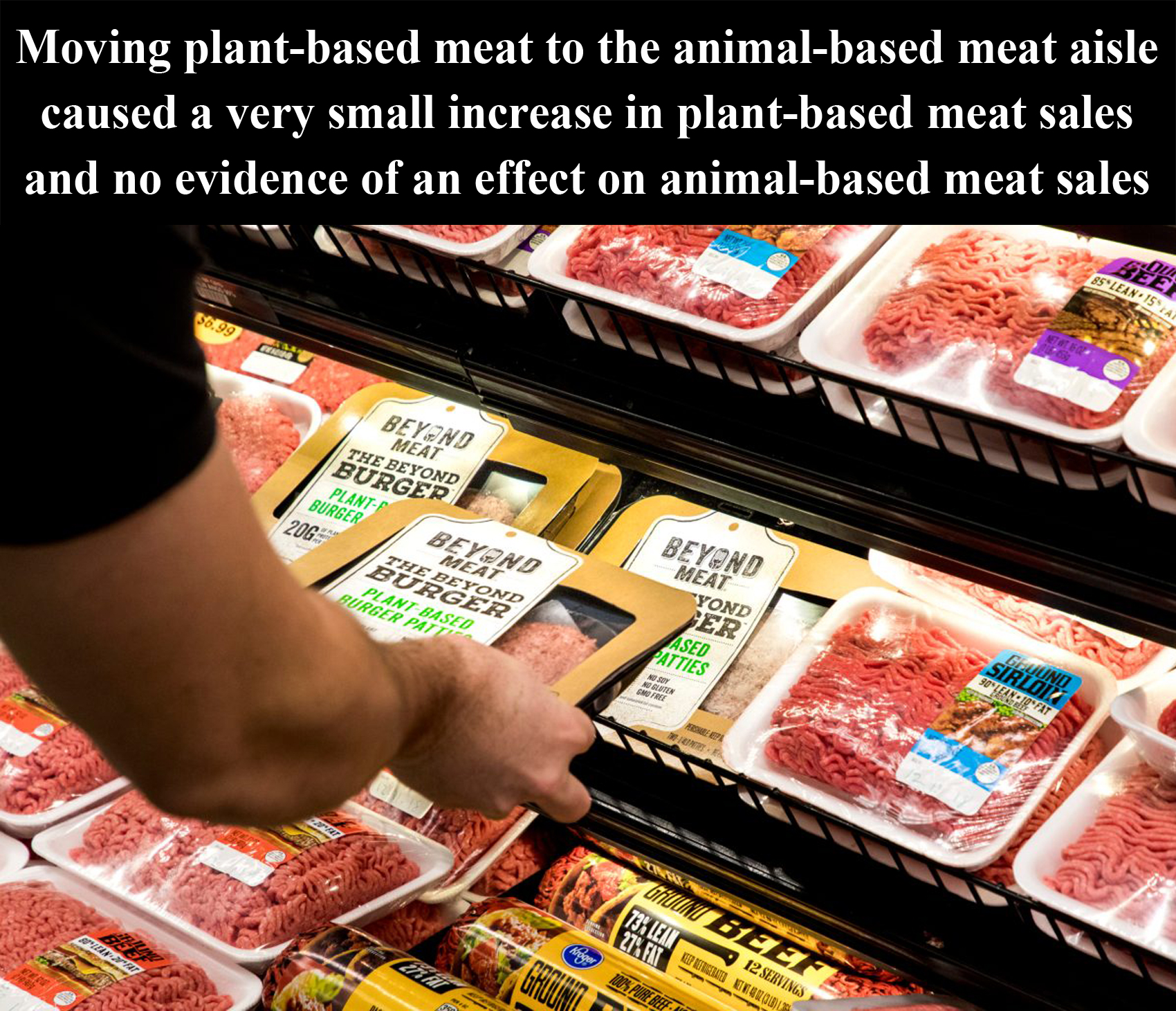
Regarding convenience he argues that there is a lack of clarity on what exactly constitutes convenience equivalence, and the little evidence that might be relevant does not find a meaningful impact of increased convenience on animal-based meat usage. The little evidence he refers to is the following two studies: “Some work has focused on availability within grocery stores, moving plant-based meats to the (animal-based) meat aisle from devoted ‘vegan’ aisles. A non-randomized study of 108 grocery stores found the move increased sales of plant-based meat but did not decrease sales of animal-based meat (Piernas et al., 2021). Another smaller non-randomized study of nine stores found a very small increase in plant-based meat sales and no evidence of an effect on animal-based meat sales (Vandenbroele et al., 2019).”
Peacock mentions another kind of studies that according to him weaken the PTC hypothesis and these are Hypothetical discrete choice experiments, which are studies in which the participants are asked to imagine hypothetically picking a plant- or animal-based burger from a menu. One of them, conducted across 27 countries, asked its 27,000 meat-eating participants to assume plant-based meat and animal-based meat “tasted equally good, had equal nutritional value and cost the same”, and yet most of them preferred the animal based burger. As disappointing as these findings are as it is, Peacock claims that it is actually worse since according to him “the design of this study likely increases these estimates: the addition of “equal nutritional value” likely increases the attractiveness of the plant-based meat; the environmental framing and questions used earlier in the survey might increase social desirability bias; using a text description rather than pictures of the possible items and broad non-specific question wording might elicit more hypothetical bias; and participants are forced to choose one or the other of animal-based meat or plant-based meat.”
In addition, he argues that “Hypothetical choice and self-reports of diet change likely tend to exaggerate the extent of meat reduction: one comparison found that in a hypothetical choice, 59% of meals selected were meat-free, while in actuality, sales data found only 36% of meals to be meat-free (Brachem et al., 2019, p. 22).”

Peacock argues that: “The strongest evidence of actual behavioral impacts of PTC-equivalent plant-based meats likely comes from a study introducing Impossible Foods’ plant-based ground beef to a University of California Los Angeles dining hall (Malan et al., 2022). In this study impossible ground beef was introduced at two stations in the dining hall. On Thursdays, students had the option of receiving prepared burritos with either Impossible ground beef, animal-based steak, or veggies, while the build-your-own entree line offered Impossible ground beef every day alongside animal-based ground beef.
In this study, price is entirely equivalent since students pay for dining hall access for the entire semester, not individual meals. With regards to taste, Impossible ground beef specifically has not been subjected to any public taste tests. However, as reviewed above, the Impossible Burger, which is made of similar ingredients, has been found to taste equivalent in some studies. Convenience is likely equivalent as well since the burritos are prepared for students by dining hall staff, and the build-your-own entree line is self-serve for both animal- and plant-based ground beef.

The study measured how many beef-containing meals were distributed at the intervention dining hall, where the Impossible ground beef was available, as well as distribution at two other dining halls as controls. In addition to making plant-based meat available, the study employed several co-interventions designed to reduce meat consumption (Malan, 2020). These included environmental education, low carbon footprint labels on menus, and an advertising campaign to promote the new product, all of which have some evidence demonstrating their effectiveness (Bianchi, Dorsel, et al., 2018, p. 11; Brunner et al., 2018; Jalil et al., 2019; Osman & Thornton, 2019). Thus, the study’s results cannot be entirely attributed to the addition of plant-based meat options to the intervention dining hall’s menu.

In the ten weeks after adding the Impossible burrito to the intervention dining hall’s menu, 26% of burrito purchasers chose the Impossible, 7% the veggie, and the remaining 67% the steak burrito (Malan, 2020, Table 12). Consistent with previous results, in a scenario that ensures price, convenience, and potentially taste competitiveness, the portion of consumers selecting the plant-based meat option remains modest.”

These are very disappointing and worrying results. And it gets worse. The veggie burrito comprises 15% of selections in the absence of the Impossible burrito and with the Impossible burrito available, this share declines to 7%, suggesting the Impossible burrito partially replaced the demand for veggie burritos rather than animal-based beef.

Another crucial factor to consider is that this study was conducted with college students, and at the University of California, meaning among those who are more likely than average to select plant-based meats, so among the general population these results are likely to be even worse.

In addition argues Peacock, “many, if not most, of the reviewed studies likely included numerous and sometimes extensive additional co-interventions also designed to increase sales of plant-based meat and/or decrease sales of animal-based meat, like promotions, ad campaigns, and environmental information. These will presumably reduce in intensity over time, as might their effects.”
And he adds that “these early studies may represent novelty effects and tap into consumers’ curiosity to try something new. One survey identified “I like to try new foods” and “I’ve been hearing a lot about them and was curious” as the two most popular factors in a self-report of why customers tried plant-based meats (A Consumer Survey on Plant Alternatives to Animal Meat, 2020, p. 5). This effect would also be expected to fade over time. Indeed, this decline may already have been observed. In 2019, sales of the Beyond Taco at the fast-food chain Del Taco declined from 6% to 4% of the sales mix (Maze, 2019), and across two samples of Burger King stores, sales of the Impossible Burger declined from 30 per day per store to 20, and from 32 to 28, in the weeks following introduction (Shanker & Patton, 2020).”

Peacock concludes his article with the following inference:
“Collectively, these results show that the PTC hypothesis, in its current form, is likely false. The underlying premise of PTC as key determinants of food choice is not supported by evidence from cross-sectional surveys on consumers’ self-reported determinants. The little available evidence thus far suggests PTC do not individually significantly reduce animal-based meat usage. HDCEs find that a minority of consumers select PTC-competitive plant-based meats instead of animal-based meats. (Miller (2021) adduces two countries where plant-based meat selection nears two-thirds when health equivalence is also assured. However, the study design is especially subject to hypothetical and social desirability biases and likely yields estimates that unrealistically favor plant-based meats.) Data from introducing plant-based meats at particular restaurants suggests that they draw only a modest portion of customers. Finally, a controlled experiment introducing high-quality plant-based meat to a dining hall—at equal price and convenience to animal-based meat—shows that most participants did not choose plant-based meat. Across six lines of evidence, it is clear that the empirical evidence opposes the PTC hypothesis.”

Considering that plant-based meat is a great source of optimism among activists, but that these hopes rely on the assumption that what primarily drives food choices are price, taste, and convenience and this assumption is false, this optimism is actually very questionable.

Beyond Reach

All these findings further prove that rationality can’t beat motivation. Given that animal based food is directly linked to public health complications as the animal agriculture industry is interconnected with foodborne illness, diet-related diseases, antibiotic resistance, and infectious diseases; and given that animal agriculture plays a major part in environmental destruction including pollution, land use, water use, deforestation, and greenhouse gas emissions; and of course given that animal agriculture is the cruelest thing ever in history, there is nothing more rational than ending it, let alone once humans can enjoy the same taste at the same price and the same convince. But humans are not rational, and they are not ethical.

Some activists have decided to give up on turning to humans’ moral fiber and appeal to their taste buds instead, believing that the best way to get humans to eat less animals is by giving them what they want, meaning juicy delicious burgers, sausages, ground “meat”, and more, without the exploitation. Never before did humans need “to give up” so little in order to not actively support industrial animal abuse, but still, the utterly vast majority maintain their violent and oppressive habits.
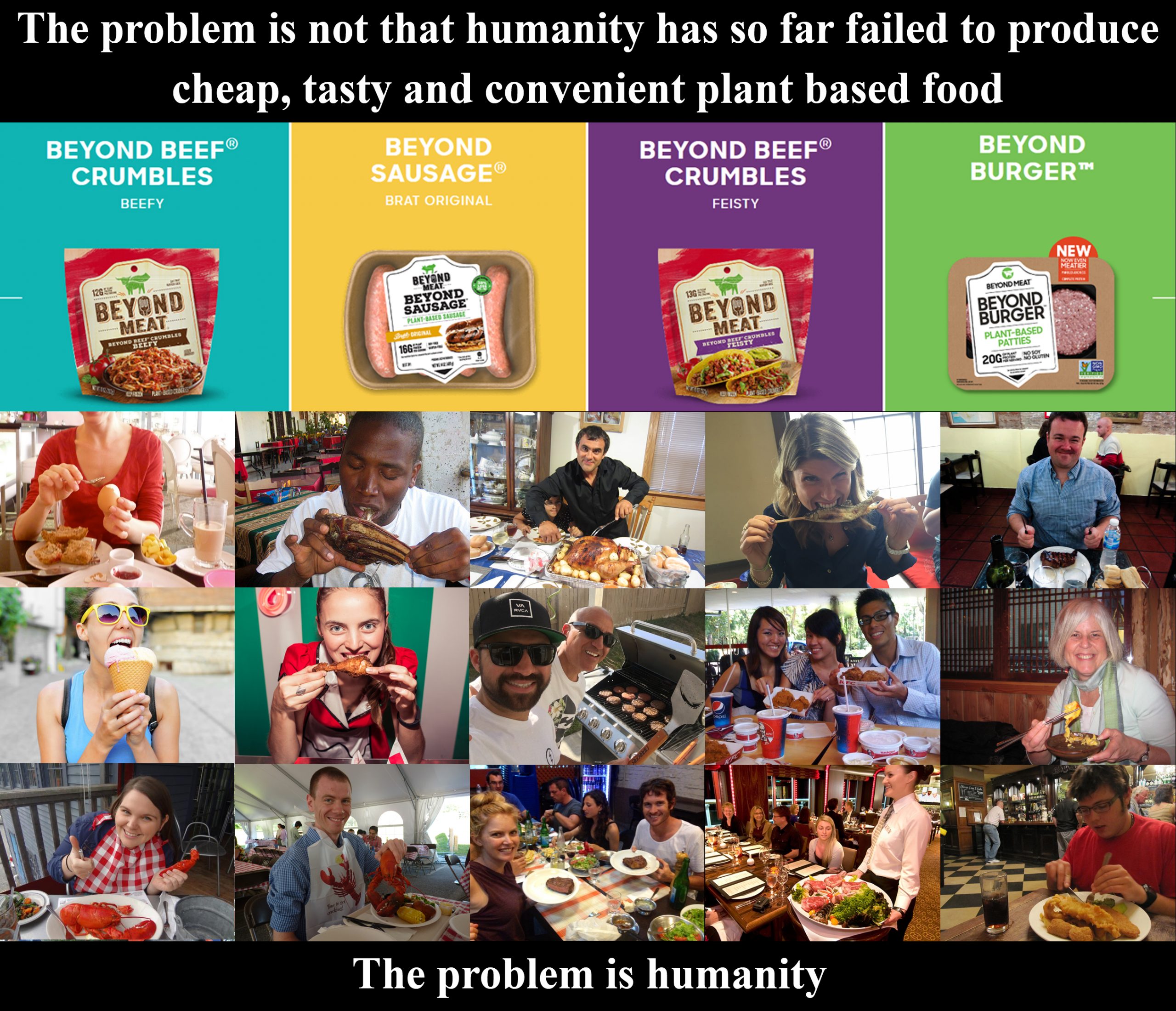
Not the enormous food waste, not the enormous water waste, not the enormous pollution, not climate change, not obesity, not diabetes, and not the risk of a heart attack or cancer, and now not even when it is the same product with the same look, texture and taste, have made veganism mainstream.

Every new plant based product that successfully imitates an animal derived one, doesn’t prove that there is no culinary need for any animal based product, but the opposite. It is not by chance that the most popular plant based burgers are also the ones who “bleed”. And it is not by chance that many humans want their food to bleed, or that they find plant based “meat” products disgusting before they have even tasted, smelled or seen them. It is what these products symbolize that disgust them, and it is what animals’ flesh symbolizes that attracts many of them.

Meat is not a mere gastronomical preference and food in general is definitely not a mere energy source. It is deeply imprinted in human society and culture, so just asking humans to switch the animal derived raw materials of their food to a plant based one, even if it has the same look, texture and of course taste, for many it is not enough.
If eating meat was only a preferable energy source, then it would have been much easier to convince humans to simply change it, especially once there are culinary equivalent options. But no matter how many times vegans are telling humans that converting their diets into a vegan one is only a raw-material swap, clearly it is not at all just that. It is a much more profound and deep change, for most a self-determination one. Veganism is not a raw-material swap since food is not fuel. Humans eat for great many reasons, for reasons of community, rituals, family, expressing their identity by eating that and not this, and of course for pleasure.

For billions of humans food is comfort, a gesture, entertainment, an enemy, a profession, a hobby, a weapon, it can break barriers, it takes so much TV screen time and so much space on book stores shelves, it defines cultures, and in many cases the last mean of mothers to get in touch with their children. It involves so many taboos and determinations of who belongs to the group and who does not, it unifies and distinguishes between ethnic groups and cultures. Unfortunately food is much more than taste and nutrition.
And meat particularly, is very unique among foods. All along history meat has been and still is very highly valued by humans, by almost every single culture. Meat’s value is incomparable to any other food, and in no proportion to its nutritional significance, therefore, in his book Meat: A Natural Symbol the anthropologist Nick Fiddes suggests that this special status of meat results from the fact that it embodies humans’ dominance over nature and the other animals. Animals symbolize power and nature, and so eating other animals is the ultimate symbol of humans’ power, of their superiority over other animals, and their triumph over nature.
Meat is a dominance and power symbol and humans take pleasure in the power and the predominance, as well as in the taste. Obviously nowadays they can get the same taste from equivalent plant based products, and they can most definitely get the required nutrients from other sources, but the social aspects of meat eating are much stronger and much more significant than its nutritional values, and even its taste.
Meat’s symbolism is far from being the only reason humans eat meat, but it is definitely a significant one, and so it is highly important to acknowledge that.
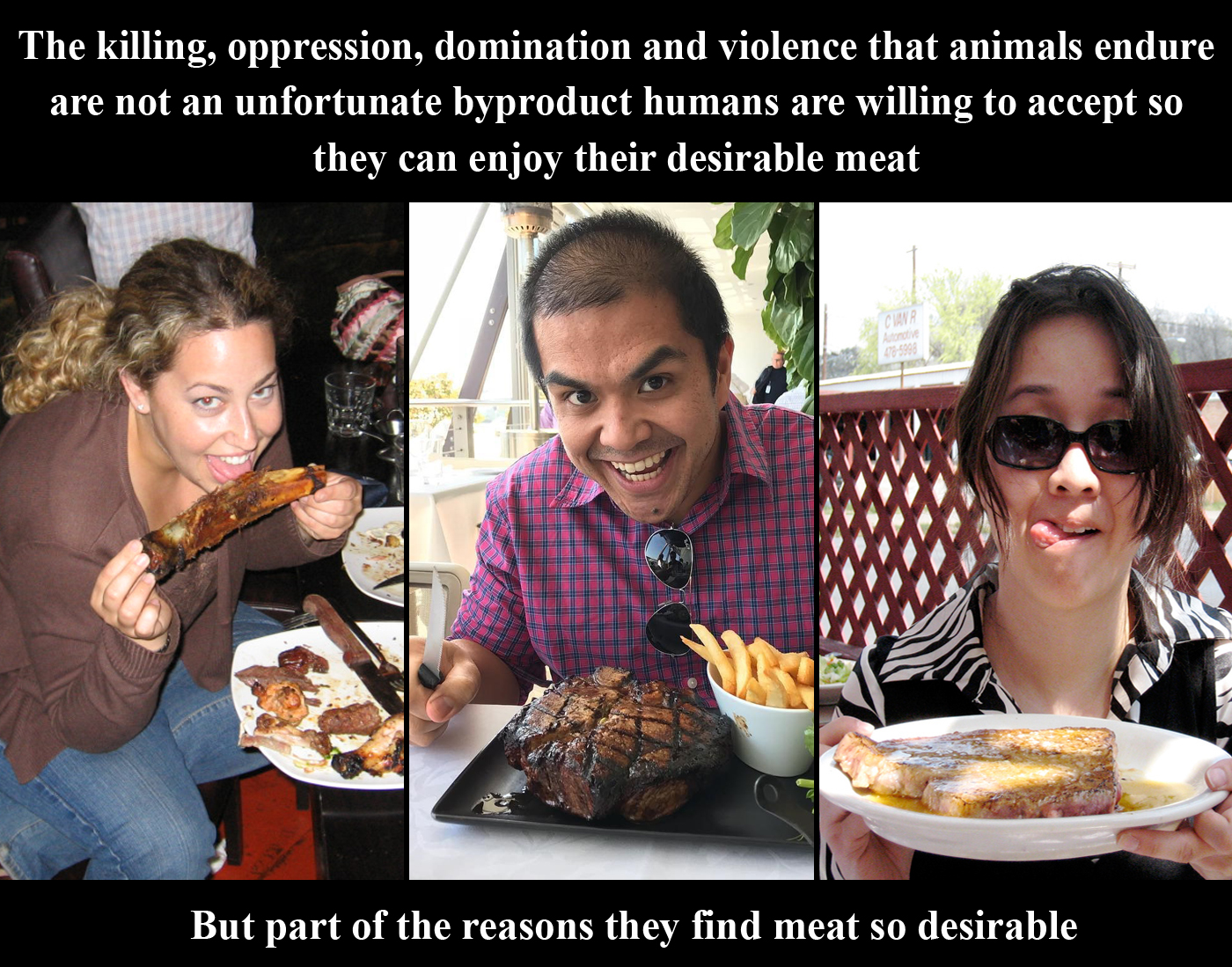
The fact that humans have never had to “give up” less than they do now thanks to the abundant plant based products, which are amazingly identical to animal based products, but they still choose the violent versions, and even more so, the fact that most are not willing to try the plant-based option over the torture based option despite that it tastes the same, costs the same and is as available, is extremely worrying.

When humans run out of excuses as to why they don’t stop consuming animal based products but they still consume animal based products, activists run out of excuses as to why they still insist on trying to convince them to stop instead of making them stop.

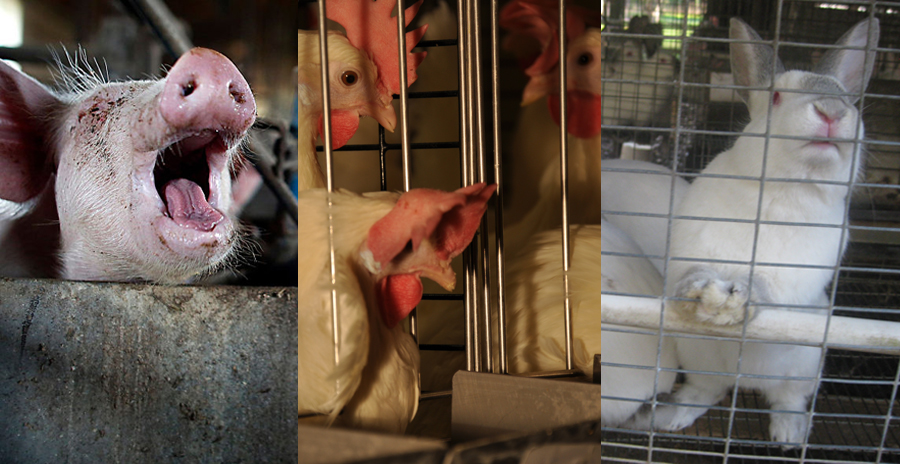
One Dimensional Dualism

Today is International Dog Day, a day humans celebrate their supposed love for supposedly their best friend.
Today is also the National Burger Day in the UK, a day humans celebrate their undoubted love for surly one of their most favorite foods.
Seemingly, this co-occurrence is a classic example of humanity’s schizoid relationship with animals – celebrating their love for some kinds of animals while celebrating their love of devouring other kinds in a bun. However, things are more complicated than that.

The utilization and emphasis of this supposed inconsistency in humanity’s relation to different species, by many animal rights activists, is understandable and rather intuitive, but nevertheless it misses something very fundamental about humans and about humans’ relationships with other animals, a relationship which is first and foremost functional.

Different animals are classified differently, mostly according to the function they serve for humans. That includes dogs who along history and among different cultures were and still are considered as food, labor force, experimental subjects, hunting animals, guarding animals, and even as pests. In fact dogs were on the ‘exploited list’ in the whole world for a much longer time than they are on the ‘loved list’. And in most of the world they are not objects of love but of labor, guarding, filth, or flesh.

Simply loving is far from being an accurate and comprehensive description of the way humans relate to dogs. There are plenty of other aspects of this relationship. Thousands of dogs are experimented on every year. Who knows how many are tied to one place, which is also where they eat, shit and sleep, because humans force them to protect their property. Millions are still forced to serve humans in the military, the police, various emergency services, guiding for blind humans and so on. Thousands of dogs are forced to fight each other for humans’ entertainment and gambling, and hundreds of thousands are forced to race each other for humans’ entertainment and gambling. And of course, in south East Asia dogs are also eaten, just like cows.

There are also very high costs to humans’ “love” of dogs even in the cases they are not being used to fill more explicit functions for humans but for example to keep them company and greet them when they come home. Hundreds of millions are left alone in humans’ houses for long hours which seem like an eternity for such social animals. An issue which is very common and practically unavoidable. Other issues are even more inherent. Humans’ love for the cute and infant like, has produced dog breeds in which full-grown dogs resemble perpetual puppies. On the physical level, the babyish snouts of dogs such as Pugs and the French Bulldogs lead to severe respiratory problems. And on the psychological level, by breeding dogs for Neoteny (retention of juvenile features), humans have created emotionally immature dogs who are prone to neuroses.

The fact that tens of millions of dogs are killed or doomed to live in crummy cages every year because humans don’t adopt them, while puppy mills are so common, is also a strong indication of a more complex relations than simply loving.

And even the loving relations alone can be regarded as functional. The following are some common examples of academic observations on the relations of humans and “pets” such as dogs.
Clinical psychologists believe that humans live with “pets” because they make them feel loved and needed.
And anthrozoologists have offered a wide variety of explanations for the human-animal bond:
“Pets” teach kindness and responsibility to children.
“Pets” provide “ontological security” in a postmodern age in which traditional values and social networks have broken down.
Like ornamental gardens, “pets” are an expression of the human need to dominate nature.
“Pets” allow the middle class to pretend they are rich.
“Pets” substitute for human friends.

While some of it may sound a bit too cynical, it is a little naïve and romantic to present dogs as those who humans simply love. Far more often than not, dogs are affection providers in an emotionally alienated world, in which humans can find comfort in someone who loves them without judgments, envy, competition, ego and the rest of the complexities bound with humans’ relations with other humans.
So humans’ relation with dogs is actually one of the evidences for humans’ functional relation with other animals. And given that humans’ relation with other animals is functional, pointing at humanity’s inconsistent relation to different species, doesn’t function the way many animal rights activists hope that it will on the practical level. Even for most of the humans who don’t explicitly and directly exploit dogs, dogs still function as animals for affection; and for most humans in general, cows’ function as animals for consumption. Most humans don’t connect the dots because they see neither dogs nor cows as different kinds of animals, but as different kinds of functions for humans. That’s why being confronted with the similarity between dogs and cows in the most relevant aspect – both kinds of animals have feelings, preferences, and the ability to suffer – doesn’t do the trick. It is because when it comes to the vast majority, humans’ view of nonhumans is humane, not animalistic. Humans don’t view nonhumans for what they are, but for what they are for humans. And for the vast majority, dogs are in the better case amusement vessels, and cows are simply living hamburger vessels.