Tiny Victory in an Immense Defeat

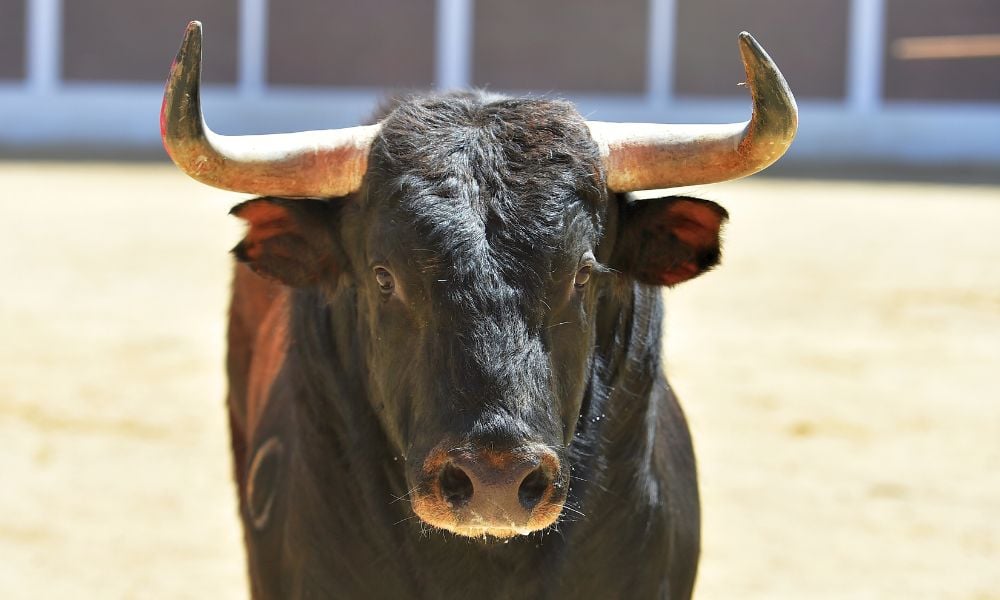
About a week ago animal rights activists celebrated a win after the Mexico City Congress voted on what they call a ban on “violent bullfights.” The “ban” doesn’t end bullfights, not even in Mexico City alone, but it bans the killing of bulls inside and outside the ring, as well as stabbing the bulls with swords or spears. “Violence-free” does not mean suffering-free, as bulls will still be subjected to every other horror during bullfights.

Having said that, this is a positive step, but it is not a victory. It is not an abolition of an industry, and it is not even a ban on an industry, but only somewhat softening (and not even in an entire country but in one city alone), and of only one type of animal abuse in the entertainment industry.
And it is also important to recall that bullfighting was already suspended in Mexico City in 2022 by a judge, but that decision was overturned by the Supreme Court of Justice in the end of 2023.

So, in the big picture, it is not a victory but rather another indication that the animals, and the movement that tries to protect the animals, are losing.
Even if it was a real victory in the sense of abolishing an entire exploitative entertainment industry, it is marginal compared to the food industry. If in the year 2025 the animal liberation movement is excited and views not even an end but a partial ban, of something like bullfights, and in one city alone, a win, we are losing hugely. This is of course not a reason to give up, but a reason to choose another route to try ending all the suffering.

Whole Exploitation

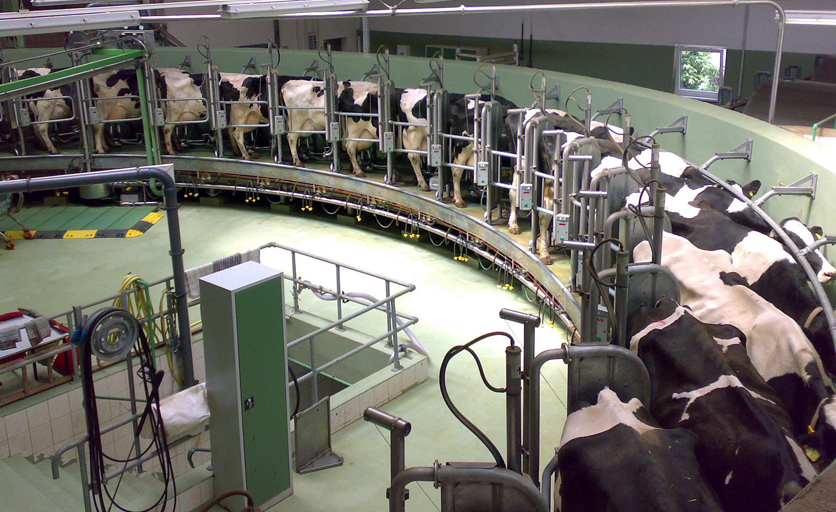
Of all the major animal based industries, it seems that the dairy industry is the one that most animal activists would guess is most likely to end first.
And on the face of it, this estimation has some backing.
Humans find themselves emotionally attached to big mammals more than to other exploited animals such as chickens and fishes.
It is well known for years that the health reputation of milk is mainly due to the industry’s effective lobby and public relations associating it with health, nature, purity, fertility and even patriotism (milk was advertised as a victory food in World War II), femininity and whiteness.
Cows function as a symbol of motherhood ironically exactly because they are being impregnated and are lactating all the time in the dairy industry, and that symbolism is used against the industry by animal activists who obviously justifiably emphasize the cruel separation of mother and calf.
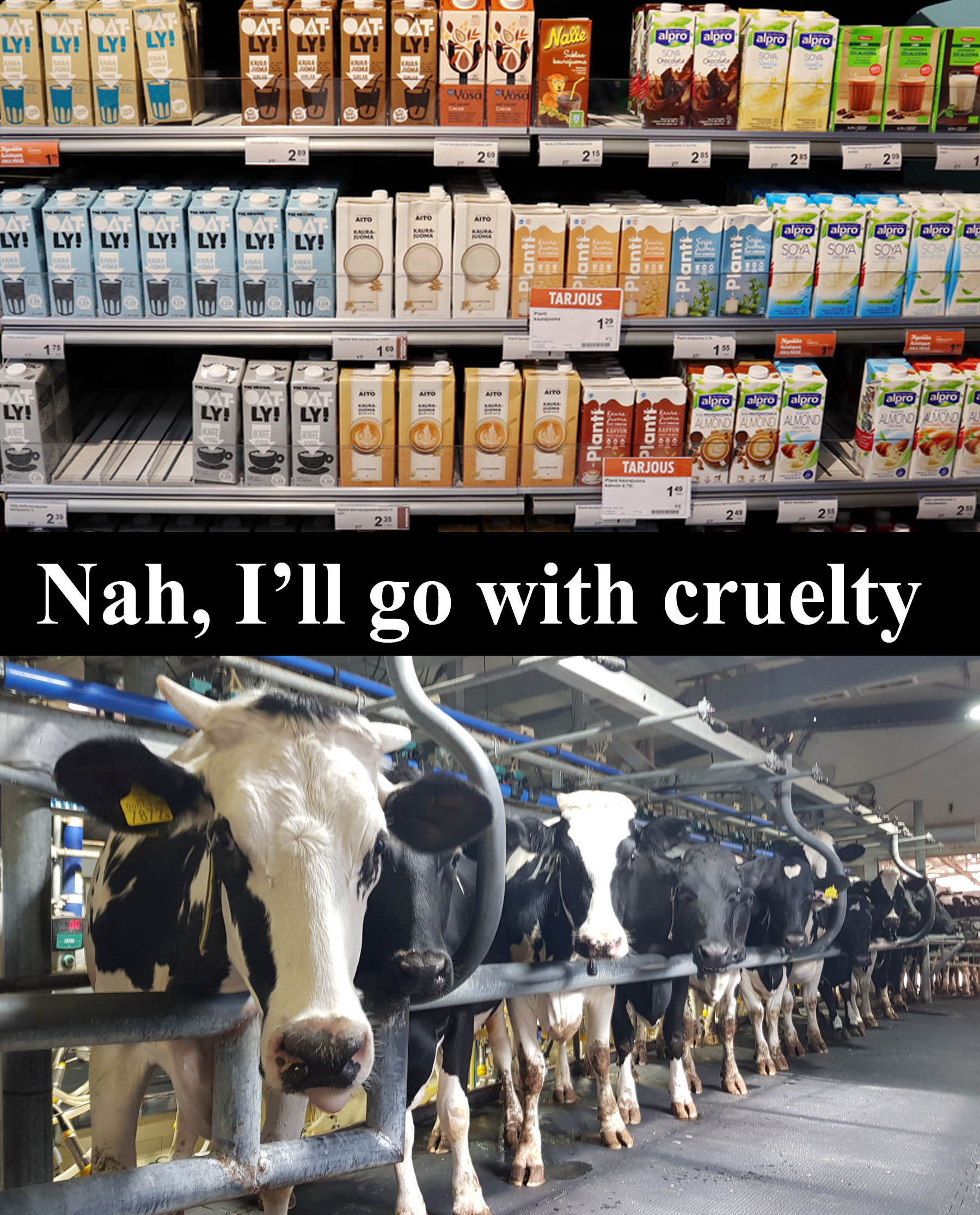
There are various plant based milk products.
As animal activists say all the time there is no other adult mammal who consumes milk after infancy let alone the milk of another mammal.
And indeed, and unfortunately as opposed to other animal based industries, it seemed like milk consumption decreased in the last decades.

However, as opposed to these predictions and courses, and despite that there are so many other kinds of milk on the market nowadays, last year, whole milk consumption in the U.S rose by 3.2 percent. And perhaps more importantly than the figure itself is that it is only the second time since the 1970s that whole milk consumption increased. And surely more importantly is that consumption of plant based milk decreased by 5.9 percent.

The reduction in consumption of plant based milks is partly due to them being categorized as ultra-processed foods, as well as attempts to rebrand milk as a natural nutritional powerhouse. And both factors have political aspects to them as sub-cultures, like – return to tradition, return to nature, health-consciousness, science skepticism and anti-establishment, are getting stronger. As ironic and tragic as it is, Cow’s milk is branded as real milk while oat, soy, coconut and almond as artificial replacement.

And things are expected to get even worse as milk is about to get even more politicized.
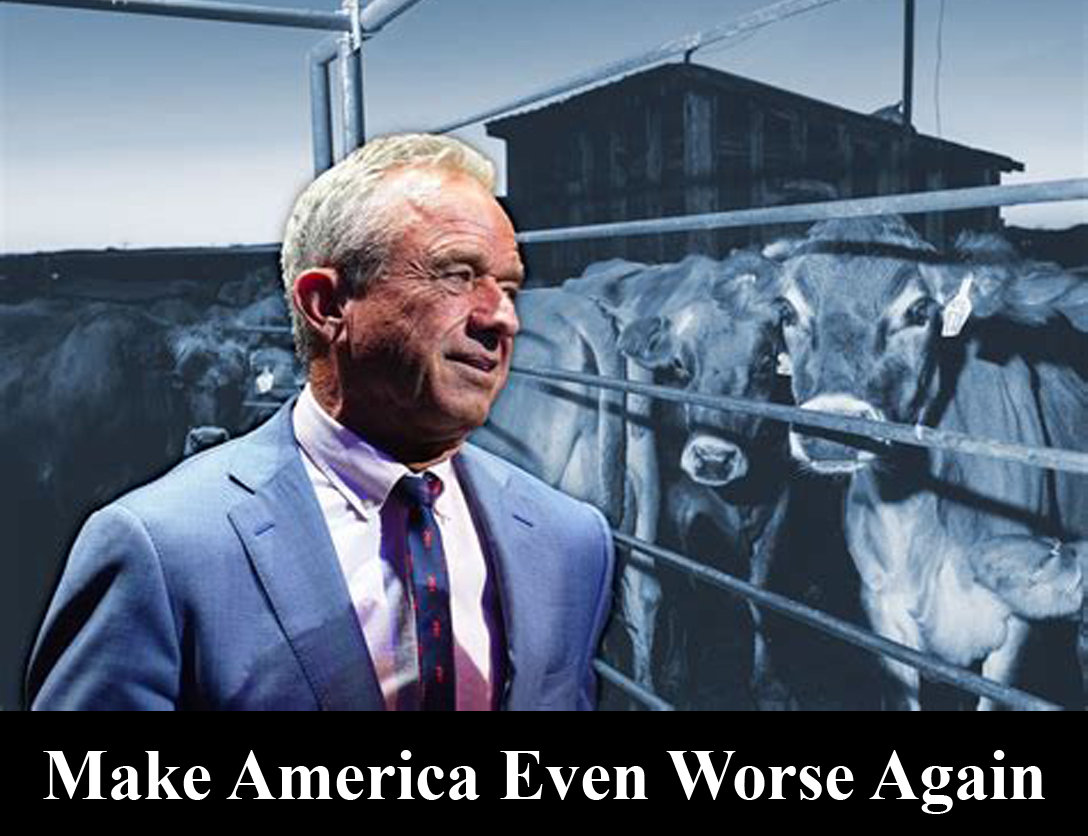
The Make America Healthy Again movement already uses unpasteurized milk in the fight against big government, big food and big pharma. And now they have the raw-milk enthusiast Robert F. Kennedy Jr. as Health and Human Services secretary, who awaits approval of unpasteurized milk by the FDA.

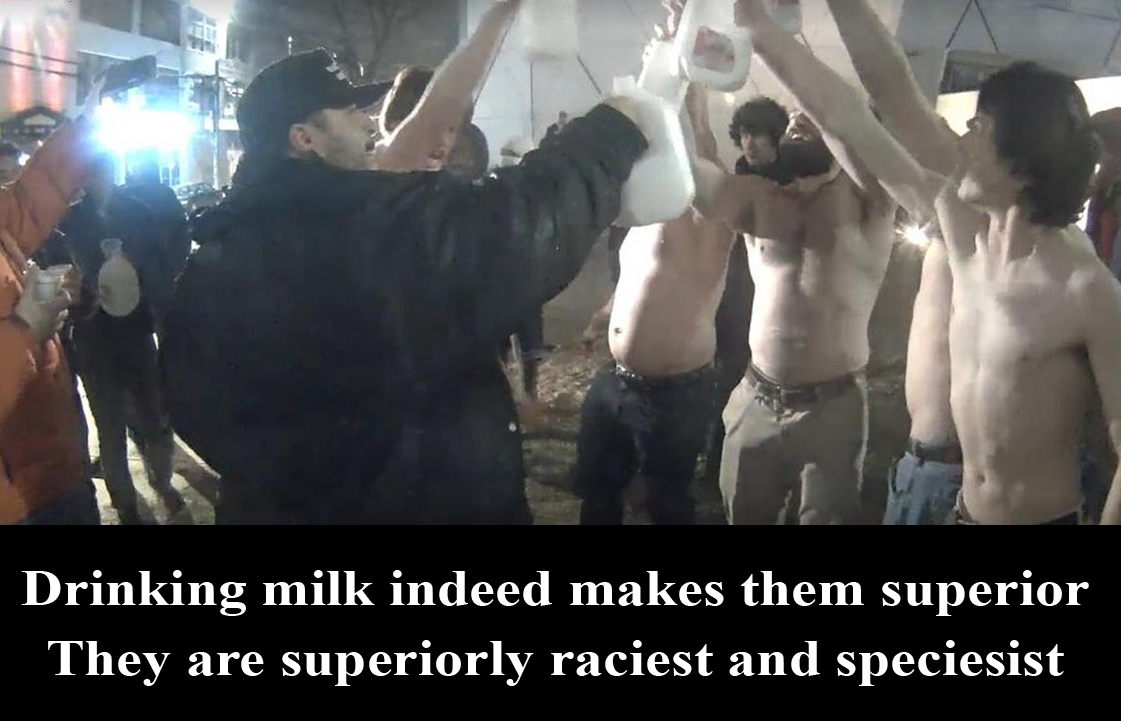
Another political aspect of milk consumption relates to the recent legitimacy of the extreme right, especially in the U.S. Since many Asians and Blacks are lactose intolerant, white supremacists embraced milk as a symbol of white racial purity and some turned milk drinking into kind of a ritual, supposedly proving their superiority.
This is also aligned with their anti-vegan agenda, which for them includes all things weak, effeminate and politically correct (they often call vegans – soy boys as a mockery).

Besides raw milk making waves, and fluid milk making a comeback, butter also continues its resurgence. Last year butter consumption was the highest since 1965. And all that is while cheese consumption steadily increases. Cottage cheese for example was boosted on social media in the last two years as a high protein, low sugar, fat and calorie product, aiding in its sharp rise in consumption.

If even the industry that we animal activists felt had the best chances to end in the foreseen future is getting bigger, what are the odds of the chickens and fishes industries, industries that are constantly expanding without even a slight decrease in the foreseen future, to ever end?

Since animals’ future would be of more and more suffering, your present should be about a future with no more humans.

Habeas Speciesism

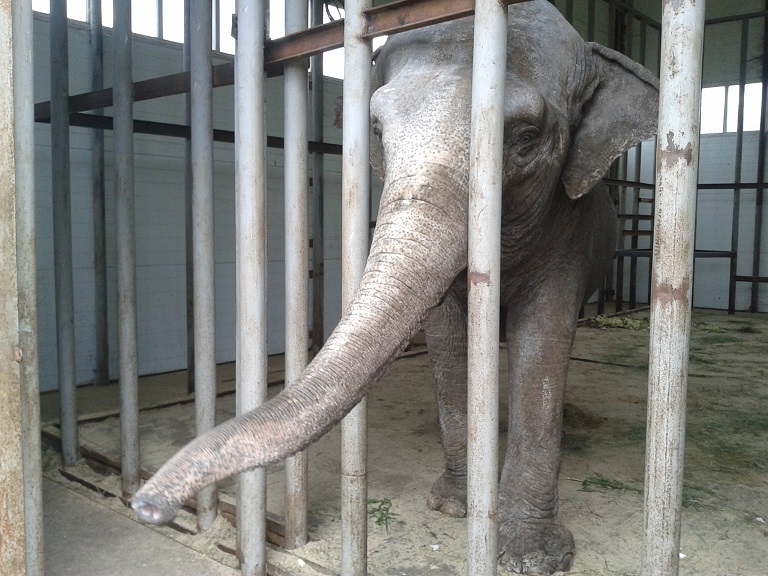
A few days ago the Colorado Supreme Court ruled unanimously that elephants do not have legal standing to challenge their captivity. This ruling, which followed a lawsuit filed by the Nonhuman Rights Project (NRP), an organization advocating for legal personhood and rights for animals (based on the legal procedure Habeas Corpus), beyond blocking the legal effort to release five African elephants from the prison in Cheyenne Mountain Zoo in Colorado Springs and move them to an elephant sanctuary, along with previous lawsuits by the NRP that were also rejected by courts in New York, California, and Hawaii, formally and legally indicates and perpetuates speciesism.

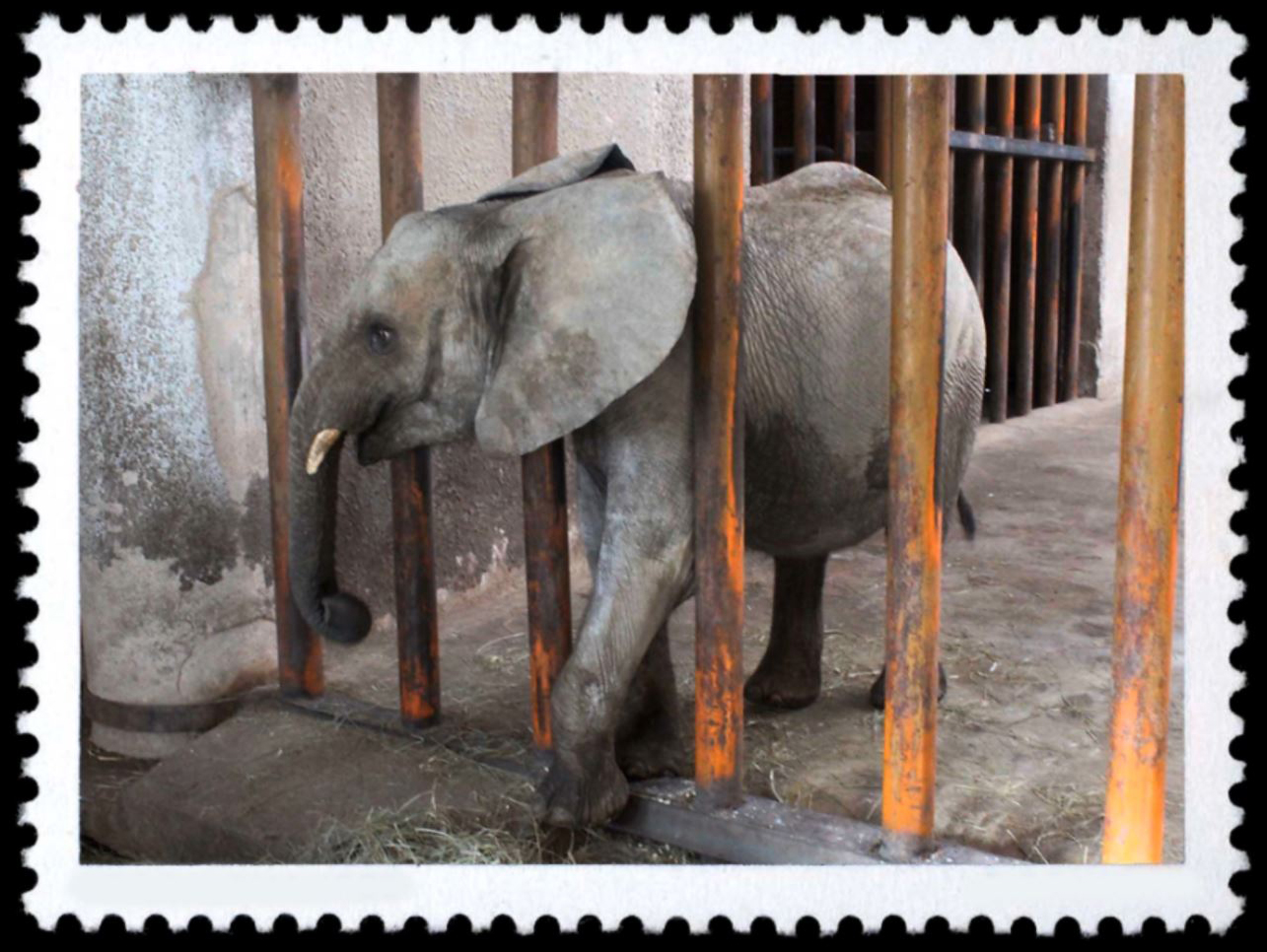
The main argument against the lawsuit is that expanding legal rights to nonhuman animals could have unintended consequences for conservation, zoos and other human-animal relationships. And indeed the Cheyenne Mountain Zoo claimed that this lawsuit is an unnecessary distraction from its conservation efforts. Zoos often claim that they are providing a very important educational, research and conservational service. However, humans’ gruesome tradition of imprisoning nonhumans in cages for display goes 5,500 years, with kings across the world demonstrating their power and wealth. And despite the modern justification of a concern for animals, the purpose of zoos was never changed. Zoos are still collections of “interesting items”, demonstrating humans’ power and domination. Animals in zoos are treated like a stamp collection. The more species the better, especially if they are large animals from foreign places that the public would be willing to pay money to watch such as elephants. The “specimens” are arranged in cages to make it easy to observe them at close range, at all times, despite how extremely stressful it is for the animals.

Zoos talk a lot about their essential scientific research, their total commitment to wildlife conservation, and their vital role as educators. Meanwhile, people do what they have always done – they go to the zoo to be entertained.

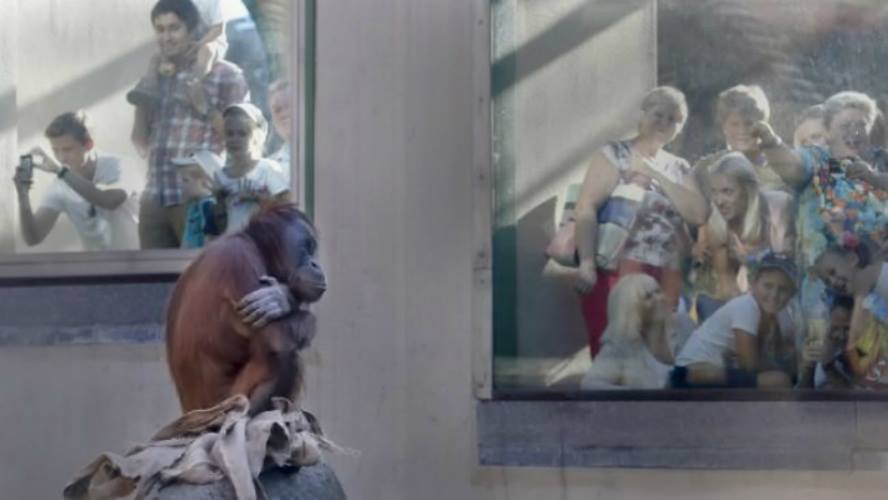
The expectation of the visitors is that the animal would please them. Humans demand to be taken notice of and they are insulted to find that usually the animals ignore them. They expect the animals to entertain each and every one of them. The mentality is of: “come here and say hello! Do something cute”. The ugliest examples of humans demand for attention include teasing, banging on cages and throwing things at them. Zoos foster the assumption that humans are the center of the universe.

Animals in zoos are deprived of their normal and natural behavior. Tigers can’t run, birds can’t soar the sky, monkeys can’t swing through the trees, and elephants can’t roam over large distances. Animals which would naturally roam for tens of miles a day, tread the same few paces in a small cage.

Zoos deprive the “prisoners” of their most basic behaviors including exercise, social interaction and bathing. Animals that naturally live in large herds or family groups are often kept alone, or at most, in pairs. Foraging and mating behaviors are virtually eliminated by regulated feeding and breeding regimens. The animals are closely confined so they lack privacy. Solitary and shy animals live in cages with viewing from all sides.

Complex behaviors and deep instincts that have evolved over thousands of years can’t find any outlet. The result is boredom and stress. The animals show signs of mental disturbance through abnormal behaviors. Sometimes they become apathetic and just sit in one place, but the most common abnormal behavior is repeated movement: rocking from side to side, pacing up and down or round and round, waving or circling the head, over and over again.
Great apes and elephants rock, sway or shift repeatedly from side to side. Giraffes are licking the walls and chewing the bars of their pens. Jaguars chew the end of their tail, which becomes completely bald. Giraffes, llamas and some monkey species, are twisting and rolling their neck unnaturally, often flicking the head around or bending the neck back. Big cats pace the same path again and again. Primates often over groom themselves or each other and this can lead to self-mutilation. Disturbed maternal behavior may also involve over grooming but also the rejection or killing of young. Reptiles climb or scratch their glass tanks because they don’t understand why they can’t get out. Other reptiles may become completely sedentary, spending all their time behind a rock. Bears in zoos tend to bite, rub the mouth along the bars of the cage and even suck it. This repetitive behavior can result in damage to the teeth and mouth, particularly if the bars are rusty. Gorillas smear faeces on walls and eat it. Gorillas and chimpanzees vomit and then eat their vomit.
Such obsessive and repetitive behaviors, including self-mutilation, are very common among zoo animals and are a result of no mental stimulation or physical exercise and a chronic frustration and boredom. This stereotypic, self-destructive behavior is called Zoochosis.

Zoo supporters claim that zoos offer people the opportunity to see something that they would never see otherwise. And they are right. The zoos give humans the opportunity to see what imprisonment does to animals. In zoos humans can see primates hide their faces, birds who don’t fly, mothers eat their young, elephants rock and swing for hours, bears and tigers pace all day long, monkeys eat faeces and gorillas eat their own vomit. But still humans fail to see the boredom, the frustration, the madness and the suffering of the caged animals.

Some humans believe that caging animals in a zoo, is somehow for their own good. They argue that zoos protect the animals from harms. They see themselves as animal lovers and the zoo as a place that enables people to get to know and love animals. But the confinement in the zoo harms animals more than anything they might face during their lives. Zoos cannot protect animals. In fact animals need protection from zoos.
Zoos also claim, as previously mentioned, to be educational. But what do they teach us?
Animals, which have become crazy and show unnatural stereotypic behavior are only ‘educational’ in showing how humans can drive animals mad by keeping them imprisoned.
The confinement educates people for relationships based on domination and control.
It teaches hierarchy and speciesism. It teaches how to objectify sentient beings.
Not that humans need these lessons…Humans Are Natural Born Exploiters.

Gods of Power 2024

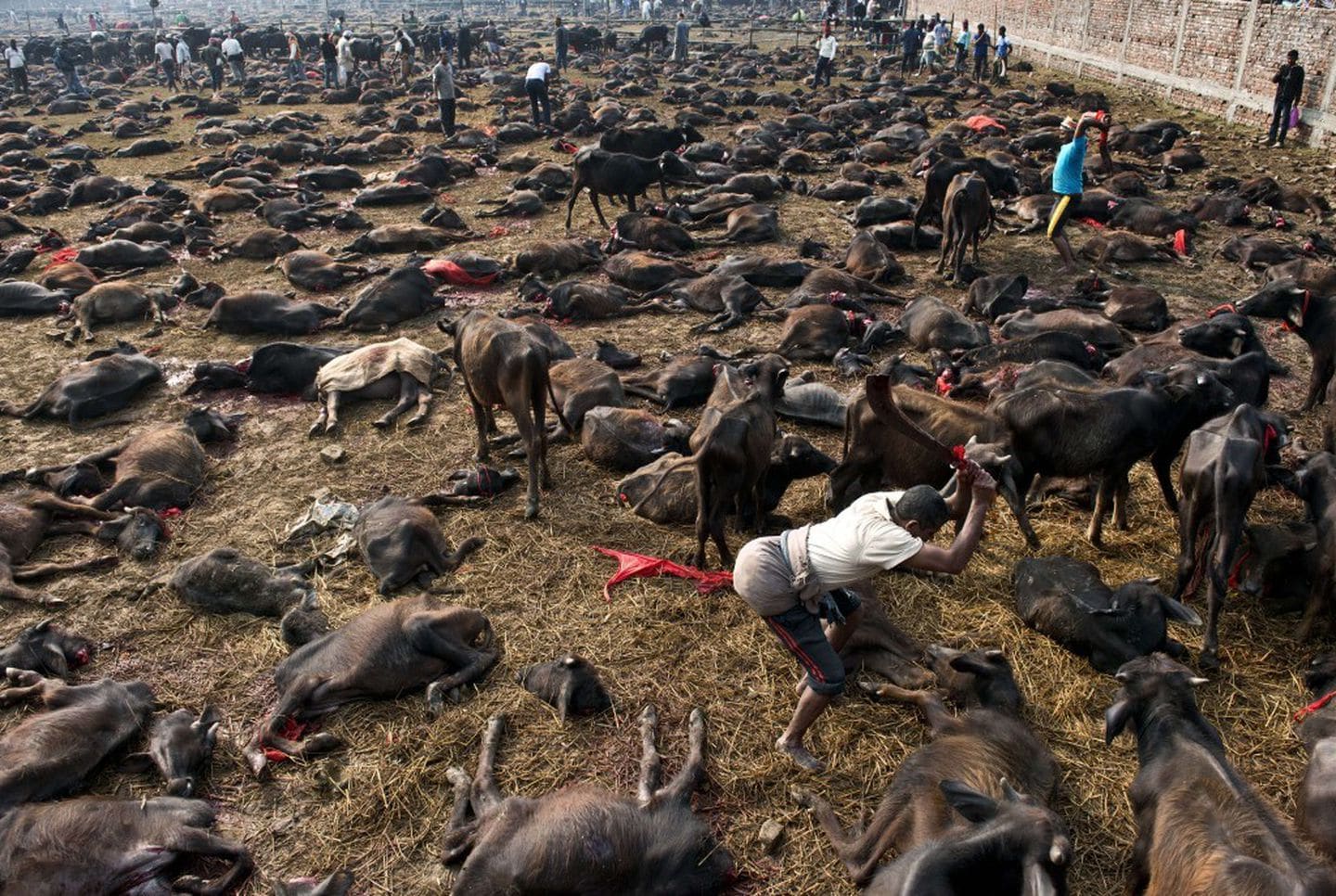
Earlier this week thousands of animals have been brutality slaughtered as part of a religious ritual, held every five years in southern Nepal, called Gadhimai.
That is despite that many activists were hopeful that this gruesome centuries-old ritual would end after the temple authorities had allegedly announced that the ritual held a decade ago was the last one, and after the Supreme Court of Nepal has reached a verdict in favor of ending the live animal sacrifice at the festival.
But people want bloodshed.

The festival started with a revelation dream of an imprisoned feudal landlord in the 18th century, in which he realized that all he needs to do to solve all of his problems is to make a blood sacrifice to Gadhimai – the Hindu goddess of power. And ever since then tens of millions of humans have been “solving” their problems by creating ones for nonhumans.

The first ritual during Gadhimai festival is worship to the sacrificial weapons. Then the priests chant different hymns to appease the Goddess Gadhimai.
After the pre-sacrificial rituals, five different species are brought into the holy temple to be slaughtered. Their role in life is representing five mental obscurations of the human community such as anger, stupidity and desire.

The first animal to be sacrificed is a goat, then thousands of pigeons by severing their heads. Next, three wild rats are brought and sacrificed before a comb like pole.
Then about 200 people carrying swords and axes, frantically rush towards the temple’s field where more than 15,000 buffaloes are kept to be slaughtered. Those still alive, watch as their friends are being slaughtered, stepping in their blood, knowing what awaits them.
Later on that day and on the following day, about 200,000 animals would be murdered in what is the biggest ceremony of animal sacrifice in the world.

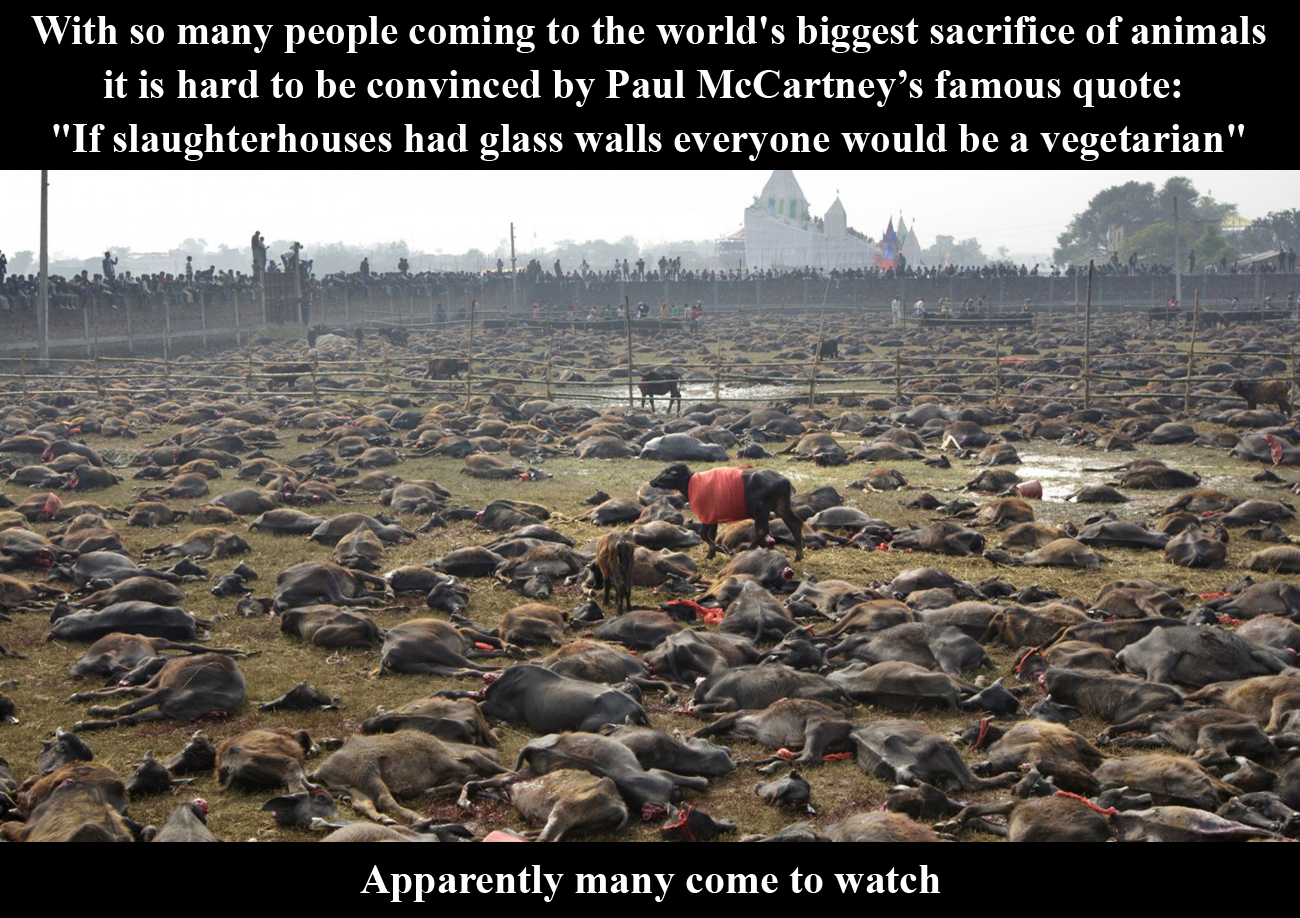
This horrific festival attracts about 5 million people. With so many people coming to watch the world’s biggest sacrifice of animals at any one site, it is hard to be convinced by Paul McCartney’s famous quote: “If slaughterhouses had glass walls everyone would be a vegetarian”

Among the pilgrims are many Indian Hindus who come to Nepal since in India, animal sacrifice is forbidden. Many of them drag animals to be slaughtered all the way from India which is, regardless of these pepped sacrificers, the biggest provider of animals for the festival. Most buffalos are transported from India in hard conditions with no water or food. Many die during this long journey from stress, exhaustion and dehydration.

Gadhimai is the world’s biggest one site sacrifice ritual in the world. But it is only one of many, probably hundreds of rituals and festivals, in which animals are sacrificed in various ways for humans’ various desires.
Many activists, us included, really believed that at least this lunatic ritual has finally ended after 250 years of massacres. But this week all of us found out that it didn’t. At the middle of the third decade of the third millennium, a ritual sacrifice of 200 thousands animals still goes on, and is still amazingly popular, even after religious leaders have claimed that it is time to consider ending it, and after the Nepal’s supreme court directed the government to discourage the mass slaughter.

This scenario repeats itself in the case of banning animal abuse. In 2016 many headlines were published regarding the Toro de la Vega festival outlawing. But unfortunately, as in many cases of “outlawing” atrocities, it isn’t the whole festival which is outlawed but only the part that drew most of the criticism – the spearing of the bull to death in the end of the ritual. Certainly this seems as the most violent part, but the rest of the horrors that the bulls are forced to endure during this festival remain. Every other part is still legal, including the bull’s murder, which as of 2016 is not being executed in front of the public in the end of the ritual, but afterwards. Using wood sticks to hit the bull isn’t outlawed, and so they are abundantly used. The bull is still surrounded in a field by hundreds of humans, many of whom ride horses, their exploitation is of course still legal and not even questioned. And of course, the bull still doesn’t understand why this mass is attacking him.

Same goes for dog spinning in Bulgaria which was outlawed but still goes on, El Toro de Coria in Spain which parts of it were banned but the rest of the horror still goes on, and the Ctalonian bullfighting ban which was repealed by Spain’s Constitutional Court on October 2016, with the formal excuse that bullfights are part of ‘Spanish cultural heritage’ and thus outlawing them can only be legislated by the central government.

And the rest of the abusive rituals and festivals, hundreds of them, held all over world, are not even under the “threat” of being banned.

This is our world. A world in which nonhumans are forced into many roles and functions during humans’ celebrations such as Historical Symbols, Rite of Passage Objects , Holy Spirit Signs, Huge Decoration Vessels, Playthings, Offering for their Gods, Offering for their Demons, Tourists Attractions, Sin Containers, Defenders from Evil, Sports Equipment, Lynch Stars, Prosperity Bearers, Live Art Boards, Excellence in Agriculture Displays, Mobile Torches, Religious Perpetuators, Patron Saint Tributes, Scapegoats, Punching Bags, Masculinity Proofs and etc.

All these and many others are part of a long chain of humans’ celebrations of their dominion over nonhumans.
What is probably worst about this long list is that it is only partial. The diversity is as wide and as wild as human imagination.

Nonhumans’ traditional role in festivals and holidays is to demonstrate humans’ alleged superiority. Different cultures around the world have different manifestations of this deep rooted notion.

Many activists dismiss the ‘argument from tradition’, calling it a lame excuse for abuse.
But in fact, what is more of an authentic characterization of the human race’s tradition than abuse?

The time came long ago for activists to face that this is humanity’s face.
It is the activists calling humans to forsake their violent traditions who should forsake a tradition. A tradition of asking. Asking humans to change, as if advocacy is ever going to be able to deal with humans’ arrogance, narcissism, inherent violence, dogmatism and lack of care.

Activists are causing a very small portion of the torturers to stop a very small portion of the torturing, instead of finding the way to stop all the torturers from doing all of it. Forever.
Please stop wasting your precious time on the pointless effort to change humanity and focus on the best and fastest way to annihilate it.

Global Worsening

Expectedly, the 29th climate convention, like all previous ones, has ended without a final paper stating the obvious which is the end of fossil fuels. And similar to previous climate conventions it has been a failure in all other aspects as well. Some exclude the COP21 held in Paris and regard it as successful, however as we elaborated in our critical review of that convention, COP21 was in fact also another failure of humanity to seriously address what it considers to be its greatest challenge. In another post we tried to explain why it is so.

Clearly, animal food industries should have been in the focus of climate discussions including climate conventions to begin with, considering that one-third of global greenhouse gas emissions can be attributed to the food industry with flesh and dairy accounting for most of it (as well as for many other environmental harms), and considering that dairy production alone emits more greenhouse gases than global aviation, yet it didn’t happen and it still doesn’t happen. Not really. In recent years, it seems that there is a start in acknowledging, an initial recognition of the animal food industry’s contribution to climate change.

However, the world is so defective, and in such a fundamental manner, that even if the animal food industry received much more attention in relation to climate change and other environmental issues, these are not necessarily good news. It is highly likely that this will make things even worse. As you know humans excel at resisting any substantial changes in their beloved habits, and instead settle for half-baked, partial options, which are often no more than lip service. They usually recruit their ingenuity so they would have to change their ways as little as possible. When it comes to dealing with climate change and sustainability issues, some of those moves may even end up causing more animal suffering around the world.

Less GHGs, Many More Victims

The increasing awareness about the environmental harms of factory farms should have functioned as an external boost for veganism. However, despite that even according to minimalistic estimations, greenhouse gases produced by industrially exploited animals represent 14.5% of all anthropogenic greenhouse gases emissions, and despite that a vegan diet is responsible for about half the greenhouse gas emissions of a medium flesh consumption diet, we don’t see the environmentally-required transition.

The vast majority of humans don’t care that nonhumans suffer all their lives so they can enjoy a piece of their flesh, and humans choose to keep eating nonhumans even when they are told it also hurts them and their own children.

When vegans read reports about the environmental impacts of factory farms they rightfully see an argument to go vegan. When non-vegans read these reports, they look for reasons to nevertheless not go vegan. When they are told that flesh is bad for the environment, they hardly ever stop eating it. In the better case they reduce their consumption, in the worse they do nothing about it, and in the worst case, they ask themselves “which meat harms the planet the least?”

Several studies have compared the environmental effects of the most common animal exploitation industries according to several categories such as: land use, energy use, pesticides use, acidification, water pollution, and GHG emissions. They found that as a general rule, ruminants (cows, sheeps, goats, and bisons) have the highest environmental impact.
According to a study published in the journal Environmental Science & Technology, the production of “red meat” generates, on average, four times more greenhouse-gas emissions than an equivalent amount of chickens flesh or fishes flesh . The study also argues that “red meat” is so resource-intensive, that if all humans cut their consumption of it by one-quarter, the reduction in greenhouse gases would be the same as shifting to a 100% locally sourced diet.
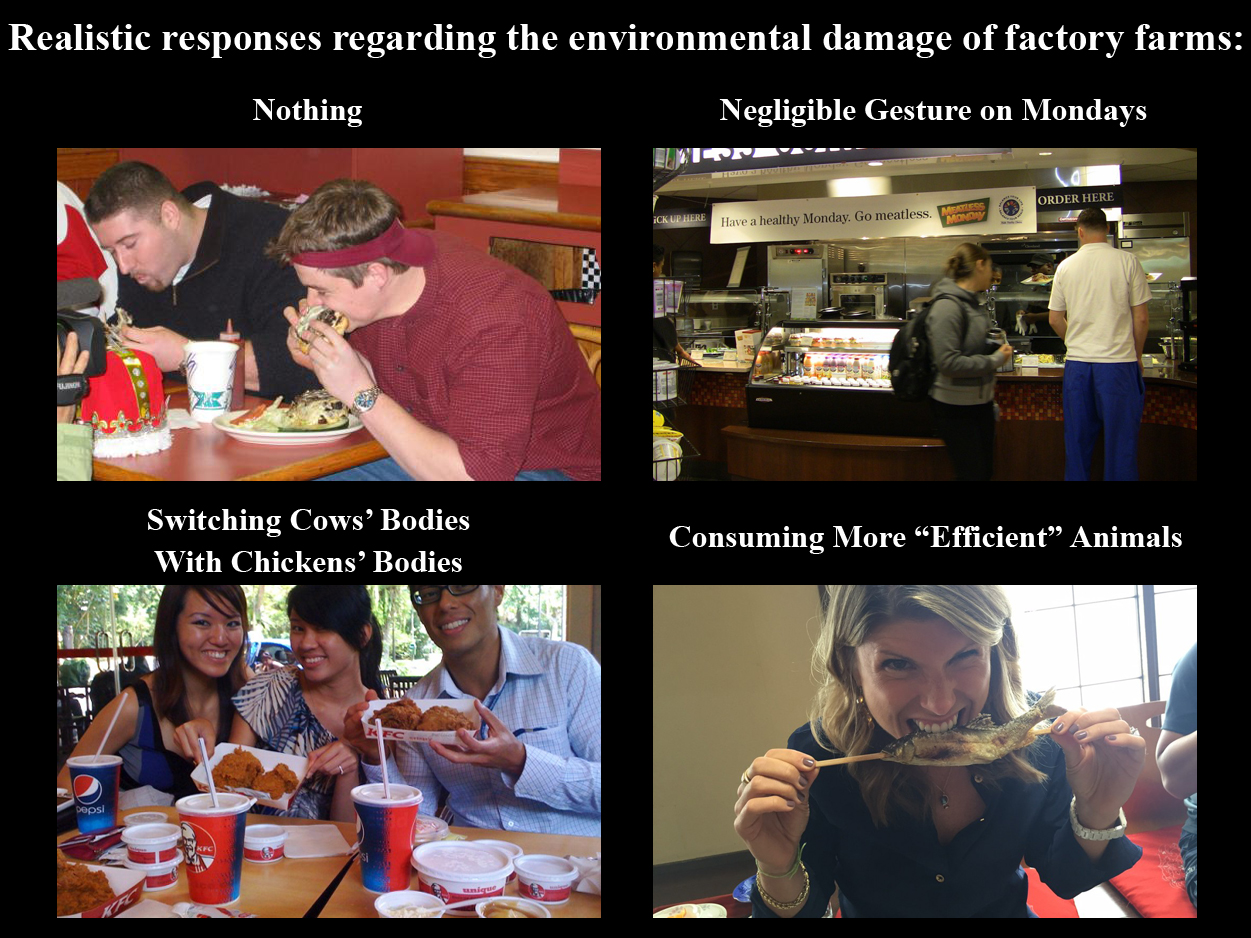
Statistical bits of information such as this are all that humans want and need to hear in order for them to consider themselves environmentally friendly despite taking the most negligible behavioral change – eating fewer cows.

Another article states that “Beef’s environmental impact dwarfs that of other meat including chicken and pork, new research reveals, with one expert saying that eating less red meat would be a better way for people to cut carbon emissions than giving up their cars.”
And that “The popular red meat requires 28 times more land to produce than pork or chicken, 11 times more water and results in five times more climate-warming emissions.”

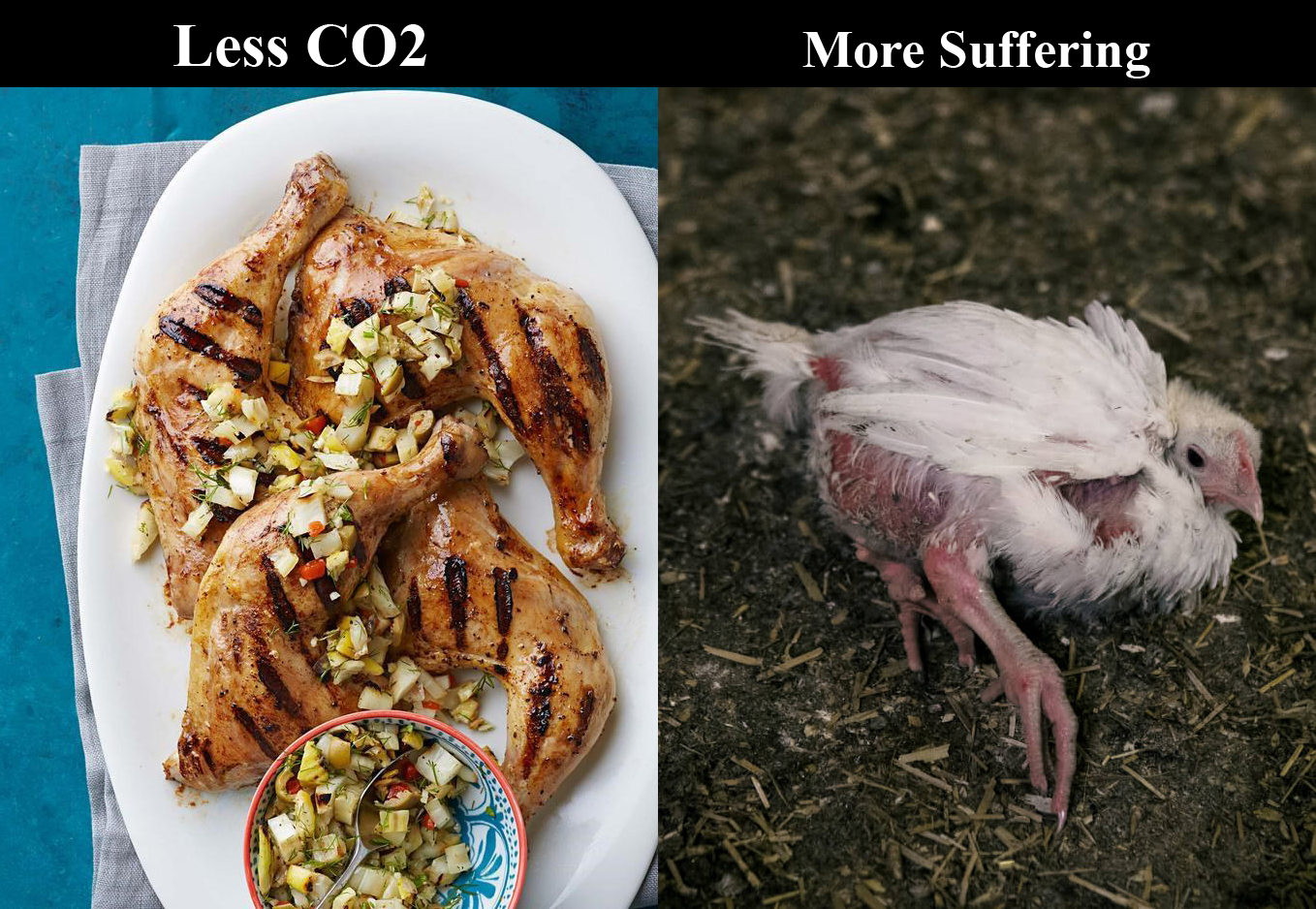
The bigger harm of these studies is not that they permit humans to make do with reducing their cows consumption, but that they greenwash chickens consumption, and that is why we claim that asking “which meat harms the planet the least?” is the worst case.
In the earlier mentioned study chickens and turkeys were found to be the least environmentally harmful. And another recent analysis on chickens’ exploitation in the U.S. found that producing a calorie of chicken flesh required about 5.6 calories of fossil fuels, compared to reported figures of about 14 calories for pigs, and 20 to 40 for cows.

Humans tend to look for the least demanding “solution” for problems, so offering them to only reduce some of their consumption and feel better about themselves would end in some of them reducing some of their ruminants’ flesh consumption which is the most environmentally harmful and considered the least healthy too, and probably switching to other kinds of flesh. Eating fewer ruminants is already seen in many places in the world, usually concurrently with an increase in chicken and fish consumption. There are many reasons for that, mainly ones which have to do with the price (since humans care about themselves first and foremost, and think very short-term). But even among the somewhat less egocentric – when given an option to feel better about themselves and more righteous while doing very little, or to feel much better about themselves and even more righteous but while doing a lot more (in their eyes) – most choose the first option.

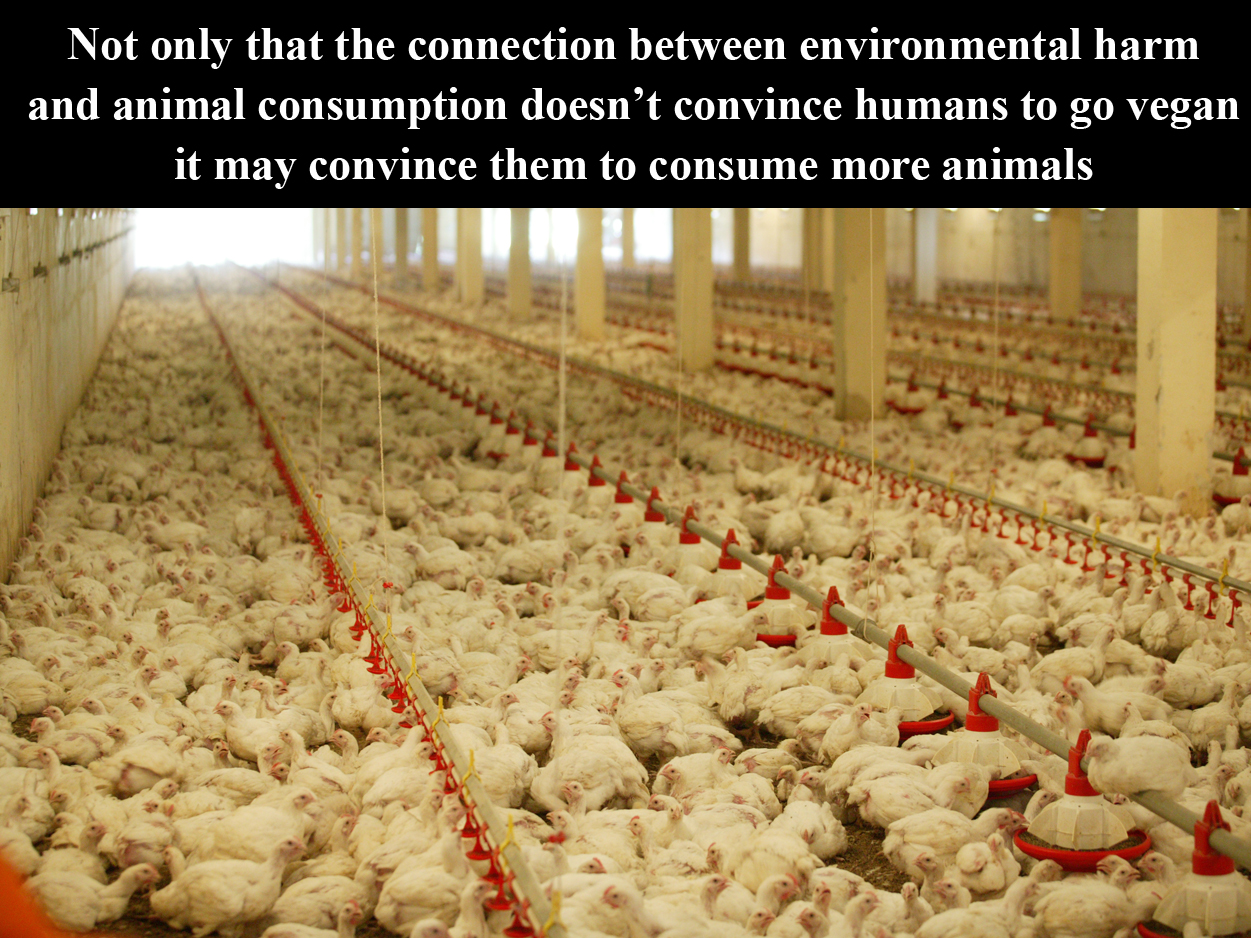
All the findings about the environmental harms of factory farms should act as additional reasons to go vegan, but since humans love compromises, don’t mind inconsistency and avoid definiteness, it serves as more reasons to eat fewer cows and more chickens. This obviously means more suffering individuals, as chickens are much smaller. It’s estimated that the flesh of about 200 exploited chickens amounts to the flesh of one exploited cow. Considering that humans are torturing about 320 million cows for their flesh every year, if all humans would consume chickens flesh instead of cows flesh, it translates to almost 64 billion more victims per year.
Humans industrially exploit about 74 billion chickens each year, and this staggering number is expected to reach around 85 billion annually by 2032.

The vast majority of humans don’t ask themselves “should I stop eating meat?”, but if anything, they ask “which kind of meat causes the least climate change?”, and the answer unfortunately prompts more chickens flesh consumption. So chickens, who are already the most numerous land victims on earth, and are already suffering from the severest genetic manipulation and the harshest living conditions, will be even worse off.

Of course, there is something naive about attributing ecological concerns such a strong role in humans’ consumption. We wish it was possible to say that environmental issues play such a significant role in humans’ behavior. Obviously the main reason for the horrible rapid increase in the global “production” of chickens – more than 12-fold in the last 50 years – has very little to do with environmental concern and a lot to do with the price and availability of chickens flesh, as well as with a good (but false) healthful reputation. Still, chickens’ green label, as false as it is, plays some role in the global flesh consumption, especially in the last decade, and maybe in the decades to come which would probably be even worse than this one.

No Real Values in Value Added

The tendency of individual consumers to shift from cows flesh to that of other smaller animals may get another push from policy makers, as initiatives to tax meats – “red meats” in particular – are being contemplated.
Over the past few years, especially since the Paris Climate Agreement, there’s been a growing call from press articles, think tanks and academic circles to tax meat. Even three parliaments – the ones of Denmark, Sweden and Germany – have already started debating about the implementation of it. While the suggestions vary in the rates of VAT (Value Added Tax) on different animal products, most place particularly high rates on the flesh of ruminants. Citing that cows makeup most of global “livestock’s” greenhouse gas emissions, their strain on other resources such as water and land, and of course the health risks to flesh consumers – from diabetes, heart diseases and cancer – cow’s meat is predicted to get particularly high tax. Some suggestions place it as high as a 40% rise in “red meat” prices. This means consumers are even more likely to buy more “environmentally friendly” chickens, which are predicted to have a much lower price increase of roughly 10%, if the consumption of their flesh is even taxed at all.

Efficiency – Squeezing the Most out of Each Victim

Since stop consuming animals is not an option humanity is willing to seriously consider, there are many initiatives aiming to turn animals’ exploitation “greener”. Overall, the main mean in developing more environmentally-friendly exploitation focuses on making the exploited animals more “efficient” at converting feed to flesh, and bodily secretion. More product for less investment.
Activists know the term efficiency is a euphemistic code for much more suffering, and more control over the animals by manipulating them and their surroundings. These methods include increased lighting, unnatural calorie-dense feed, antibiotic use, growth hormones, and of course – a manipulation which invades deep into the animals’ body by changing their genetic characteristics. Craving efficiency led to engineering animals who are deformed and crippled, with some organs extremely enlarged and others shriveled.
Of course, the industry already has an obvious motivation to push for more and more “efficiency” (profitability), but now it has a green-washed PR pretext and another drive to squeeze animals even further.

Much like chickens, fishes also suffer from their reputation for being more environmentally friendly.
When it comes to efficiency, tragically for fishes, they are at the top of the chart. While cows’ rate is about 6-7 kg of commercial feed for 1 kg of marketable flesh, and chickens’ is 1.7 kg, the fishes’ rate is between 1.7 to 1.12 kg of feed per 1 kg of flesh. Because they are mostly cold-blooded and buoyant in the water, fishes don’t burn energy generating heat and fighting gravity to move around. This allows them to be marketed as a sustainable option.

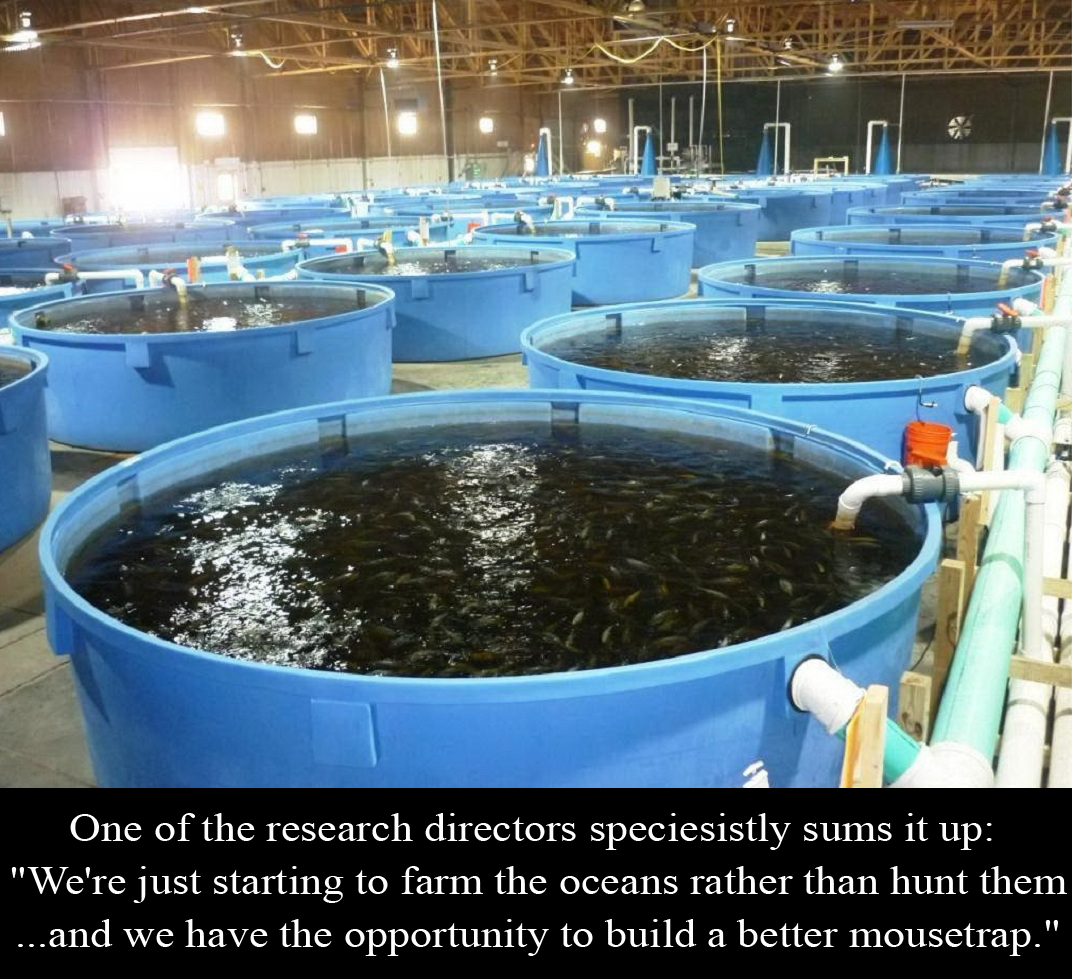
Also, similarly to land animals, today more and more fishes are bred in factory farms, euphemistically called aquaculture (in fact, since 2015 more fishes flesh comes from these intensive operations than from wild-caught fishing). Some of these farm facilities enjoy the backing of environmental organizations such as Greenpeace and The Conservation Fund.
Of course, the controlled environment of a farm means more dominance over the fishes – and much more manipulation to make them grow faster, and therefore to be more “efficient” and greener. From the moment they hatch, farmed fishes endure a lighting regime that tricks them to eat more of a commercial diet designed for weight-gain. They live in crowded tanks or sea cages where they often face aggression from other fishes they cannot escape, and have to fight for food. The density leads to disease outbreaks and parasites which lead to immense suffering, but often the treatments against these maladies are also harmful to the fishes.

These intensive conditions which produce more flesh from each fish are known to cripple them. About 50-60% of farmed salmon and trout were found to have damaged ear bones, which leads to drastic hearing impairments. The fishes’ ear structure is also essential for their balance and navigation. Studies have identified this deformity to be the result of accelerated growth rates that were traced to high-nutrient feed and exposer to longer light periods. This illness has also been found in other farmed fish species such as carp, eel and red drum.

In 2015 the level of invasion into the fishes’ bodies took another turn for the worse, as for the first time the FDA approved the marketing of animal – Atlantic salmon who has a gene from a Chinook salmon and a promoter sequence from an ocean pout.
This salmon can grow twice as fast as conventionally farmed Atlantic salmon, reaching adult size in some 18 months compared to 30 months, and requires 25% less feed to grow to the size of wild salmon. The company which owns the legal patent for these fishes’ DNA profile boasts about how eco-friendly they are, claiming that “their product” could have a carbon footprint of up to 25 times less.

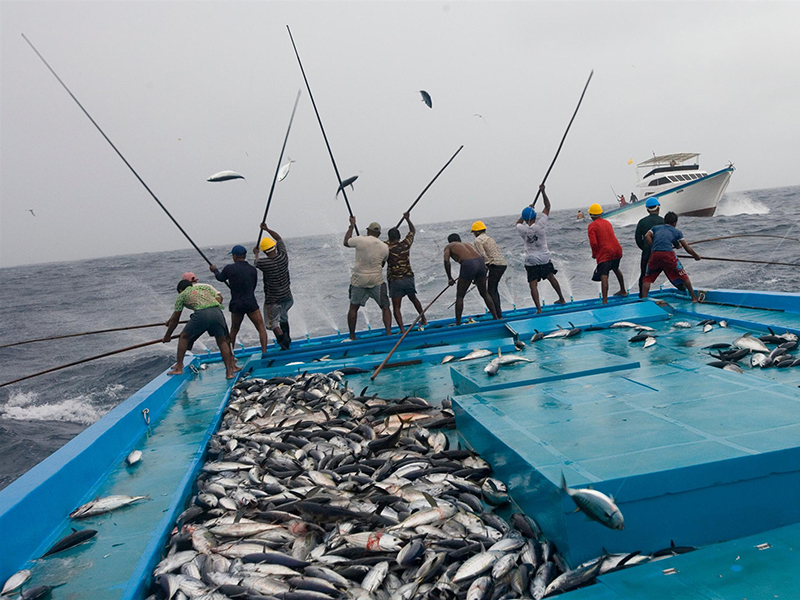
And even environmentally friendly “solutions” that are on the exact opposite direction of intensification, are still horrible. In the last couple of years there is a new “green” trend regarding tuna fishes consumption. ‘Pole-and-line’ is a tuna fishing method, in which tuna fishes are caught one at a time by hand, using a pole, line and hook, and it’s being labeled as greatly environmentally friendly since it reduces the risk of catching other marine life, such as turtles. This is what it does to tunas.

Ethical Climate Change

The connection between animal exploitation and environmental harms, especially climate change, should have made many more humans consider much more seriously going vegan. But even activists who are encouraged by every reduction in meat consumption, should be worried. Not only about the long term effects of perpetuating anthropocentrism and speciesism by appealing to humans’ interests when asking them to stop consuming animal products, but that it might cause more humans to eat more chickens and fishes. The status of chickens is already at the bottom, the status of fishes is rock-bottom and the status of fishes who are fed to farmed fishes humans consume is beneath rock-bottom – claims about the environmental harms of eating animals can make it all even worse.

When not the suffering of individuals, nor the number of suffering individuals, is what matters, the use of anthropocentric and environmental rhetoric may end up hurting more animals, and even more than they are hurt nowadays, in both the long and short term.

Don’t get this wrong, this is not activists’ fault. Activists are not arguing that it is ok to eat chickens and fishes, and they don’t tell humans that if they have to choose between cows and pigs or chickens and fishes, they should eat the later. Activists are explaining to humans that they are all sentient and none of them should be consumed. The problem is not that activists are giving humans the wrong message, the problem is that activists are giving humans more and more chances.

World Disillusion Day

Tomorrow is World Vegan Day.
Last year on the occasion of this day, we referred to Peter Singer’s disappointment (expressed in his renewed version of Animal Liberation that was published last year) that his “call for a boycott of meat has been a dismal failure”.

For this year’s World Vegan Day we refer to the disappointing veganism statistics as shown by the latest Gallup’s Consumption Habits poll. It appears that only 4% of Americans are stating that they are vegetarian and only 1% state they are vegan. Considering that these figures are based on people who self-identify themselves as vegetarians or vegans, these figures are actually even lower. That is as according to other similar polls, around 60% of people who self-identify as vegetarians report consuming animal flesh when asked to list everything they consumed during two non-consecutive 24-hour periods. One survey reported that when considering people who consumed fishes in the last 30 days as non-vegetarians, the vegetarianism rate is actually below 1.5%. And less than 0.4% of adults reported consuming no animal products on two non-consecutive 24-hour periods, so the actual vegan figure is less than half of one percent.

Another terribly disappointing aspect of these polls is that these figures are similar to what has been measured in previous ones, from a few years ago and from more than a decade ago. Meaning, in spite decades of efforts made by animal rights activists, and others who promote veganism, the figures remain disappointingly low and veganism remain deeply unpopular, and there is still a clear global increase in per-capita meat consumption.

We are not arguing that the Animal Liberation movement didn’t positively affect the scale of suffering in the world. Of course it did, as obviously had not for all the efforts put by many activists, the figures would have been even worse. But undoubtedly the world today, in spite of decades of campaigning to end animal exploitation, is one in which there are many more suffering sentient beings who suffer even more.
Every year, additional tens of millions of sentient beings are born into a life of suffering. Every day is worse than the one before. Our website is full of facts and figures about suffering in the world, but the worst ones are the mentioned acute per capita increase, and that every second 5 more human babies are born. This world is so horrible that one of the greatest suffering factors is the human birth rate.

According to other surveys there are more than five times as many former vegetarians/vegans than there are current vegetarians/vegans. That goes against the common notion among many animal rights activists that it is not that people don’t care, it’s that people don’t know what’s going on. Had that been true not only that there would have been many more vegans to begin with, much less would have abandoned veganism considering their acknowledgment of what’s going on.

While it’s true that still most people aren’t exposed to what animals go through in factory farms, they are aware of the basic facts. Humans don’t have to know every detail about the cruelest exploitation system ever in history, it is enough to generally know that factory farms exist to be morally accountable.

And it is even more basic than that, humans know that meat is animals’ flesh. Even the least informed humans are at least aware that meat is made of animals who were murdered specifically to make the meat they eat. They are aware of at least that, and still freely choose to participate. They know that animals are born to be killed for their flesh. Meat is never made of animals who died of diseases, accidents, by other nonhuman animals, or of old age, but only of animals that other humans murdered. So humans are not only fully aware of animals being murdered for their meat, murder is an obligatory condition for a corpse to be considered as meat. Humans know meat is murder. Knowing that they participate in hurting nonhumans is sufficient for them to stop. Humans consume animal products because they want to, not because they don’t know better.

The only thing that at least some humans can honestly say is that they didn’t know the extent of how horrible animals’ lives actually are. But the basic fact that meat is a piece of carcass, should definitely be sufficient to at least ignite basic curiosity and motivation to look for more information, if humans cared. However, humans don’t try to figure out what happens to nonhumans before they become their meat. Extensive information is available for everyone nowadays, and activists are more than willing to explain to everyone what is going on and what they can do about it. So even saying that they didn’t know how horrible animals are treated, is less a case of lack of knowledge, and more a case of lack of caring.

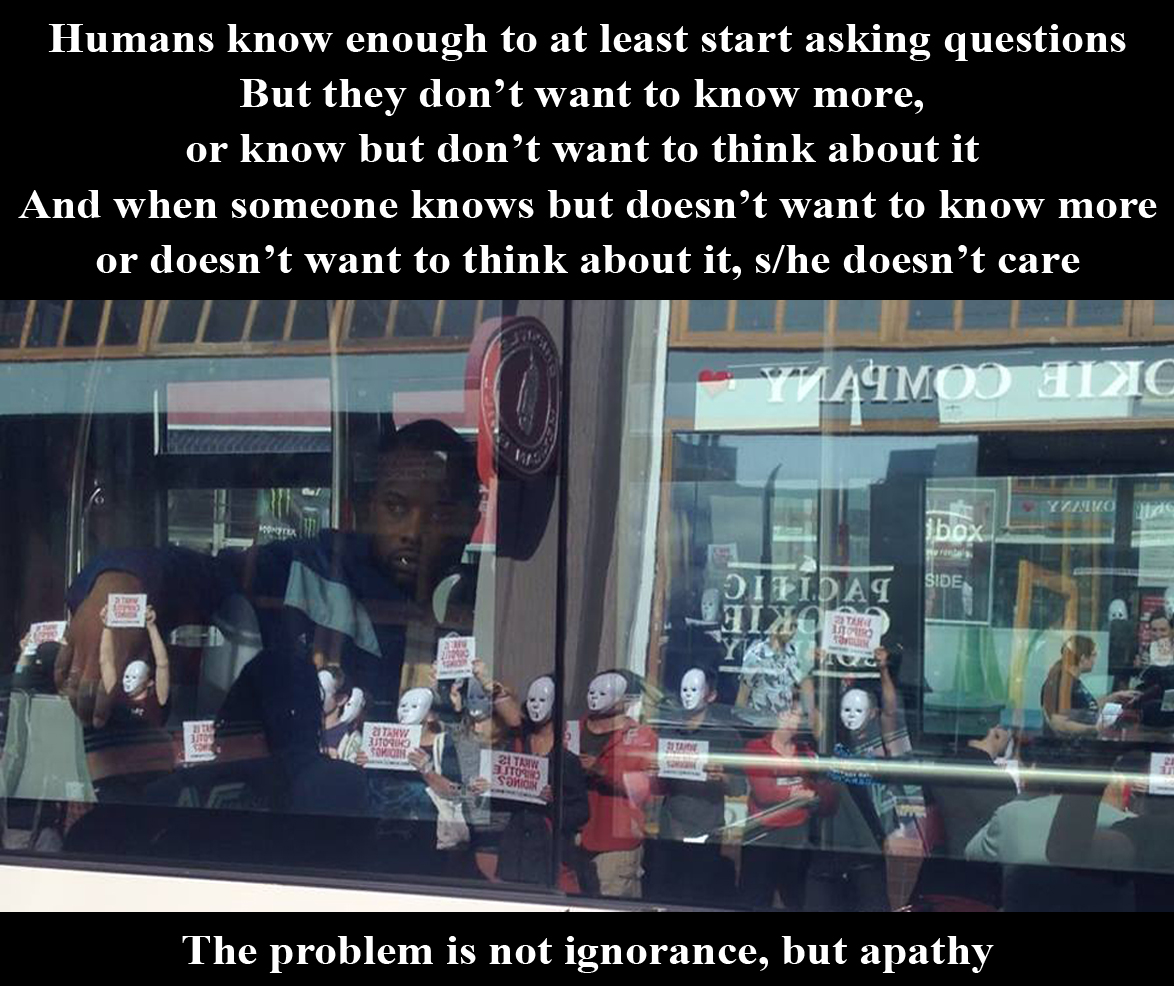
Humans know enough to at least start asking questions. But they don’t want to know more, or know but don’t want to think about it. And when someone knows but doesn’t want to know more or doesn’t want to think about it, s/he doesn’t care. The problem is not ignorance, but apathy.

The argument that ‘the problem is that people don’t know what is going on’ is quite popular among activists since the counter assumption is deeply depressing. It is very discouraging to internalize that humans know but don’t care enough to stop, or that humans choose to eat meat fully aware of the fact that it is made of animals (and maybe even because it is made of animals). Clearly it is more empowering for activists to believe that humans are basically and naturally compassionate, and they are doing horrible things as a result of deceit and manipulations, as it is the hardest thing to make others care about something they don’t really care about. Raising awareness and informing humans is the relatively easy task, making others care about something to the point of changing their beloved habits, is a whole different story. So of course believing that humans are not doing the bad things they do because they want to, but because they don’t know better, is a much more comforting position than that they know what’s going on and do it anyway.

Humans know meat is a corpse of an animal that was raised and murdered for them. They see animals in all kinds of situations during their lives, in farms when driving outside the city, inside crowded trucks when driving on highways, dead but in a relatively whole and unprocessed state in markets, alive in the case of fishes and crustaceans in markets and even restaurants, and of course in the last couple of decades in the movement’s publications, on TV, and online. People know what’s going on. They just don’t care enough to do something about it.

Nowadays, more and more humans, in more and more places are exposed to more and more of the violence from factory farms by activists who face them with the truth. But the reaction of most is not a moral repugnance, but mainly avoidance from any ethical consideration. Most don’t want to watch violence towards animals, but to keep enjoying the “products” of it.
If slaughterhouses had glass walls, almost everyone would look away from the violent sight and keep eating animals flesh.

It’s time to open our eyes and admit that human society is irrevocably speciesist. So far there is every reason to believe that even within the human race, selfishness and discrimination will never be overcome. Anthropologists have never discovered a human society free of violence, and social psychology findings indicate that elements such as group patriotism, selfishness, obedience, conformism, tendency to discriminate, as well as biases, irrational and irrelevant factors when it comes to moral thinking, are all innate to a great extent.

Conventional advocacy, or, asking the torturers if they are willing to stop torturing, is basically and principally speciesist in itself.
Despite that theoretically activists absolutely oppose humans’ dominance, they practically accept it by asking humans to change their violent ways. They all know what happens every time they fail to convince them.

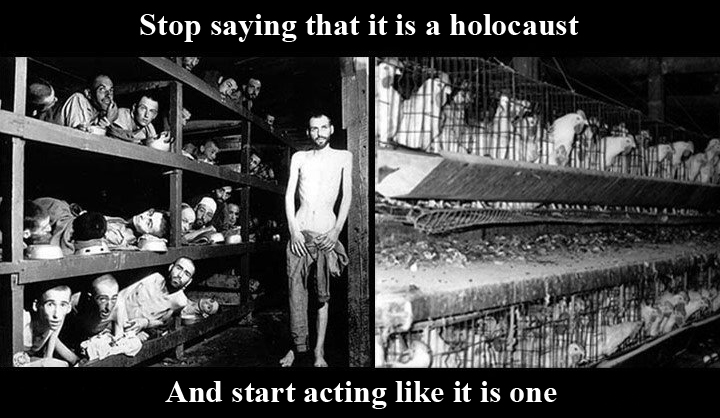
Among themselves, activists point out that the animal holocaust is much worse than any human holocaust in history, however, the partisan fighters in the second world war didn’t organize leafleting events to stop the massacre.

And even if many consider going vegan, and even if all go vegan, the absolutely delusional option of a vegan world can be reversed at some point in the future. And even if it won’t, this world would still be a very violent one. The chances that the animal liberation movement would stop all the suffering are zero, not only because of the current consumption trends and the extremely depressing forecasts of the future, but because there are so many suffering factors that the movement doesn’t address, and so many suffering factors that the movement probably can’t even theoretically address.

The solution the AR movement is offering – veganism, the one that even in the more progressive parts of the world many activists believe it’s strategically unwise to ask for, is actually a systematic global oppression operation, abusing countless numbers of animals.
The main reason activists hardly ever address this massive black hole is because everything pales in comparison with factory farming, and also because most automatically go on the defensive when meat eaters cynically make this point.
But we are not meat eaters, we are vegans too. We are vegans because it is the least horrible option. But more than we are vegans, we are activists, and as such we are looking for a truly moral solution. Veganism isn’t.

If you are aware of the problems with veganism, feel free to directly go to our suggested option specified in our manifesto.
If you are not aware of the harms and issues involving veganism, please start with our answer to the question why not work hard to make a vegan world and then please read the post Vegan Violence and the article Vegan Suffering.
Please read it open-mindedly. We are aware that despite everything detailed in it, veganism is still the best option possible. That’s why we are vegans ourselves. However, acknowledging that veganism – with all its major flaws and inherent cruelties – is the best option, is why we are not vegan advocators. The realization that the best option is so horrible is one of the major reasons why we are calling you to stop focusing on making a vegan world and start trying to make a sufferingless world.

The Real Case for Wild Animal

Someone asked us what are our thoughts about Martin Balluch’s presentation against intervention in nature, given during the International Animal Rights Conference held earlier this month. Unfortunately the presentation is not publically available, so we will address two posts he wrote in the past about suffering in nature called: ‘Most wild animals are happy most of the time!’ and, ‘Wilderness and wild animal suffering (again!)’.

Arguments against intervention in nature are of course not new, with many raising the concern that humans would cause more harm than good if they will intervene. However, this is not exactly Balluch’s point. While making his case against intervention in nature Balluch heavily nourishes nature idealization, falsely idealizes autonomy in nature, and falsely claims that most of the beings in nature are happy. We’ll address these 3 claims in the following post.

Most wild animals are happy most of the time

Balluch argues, based on his personal experience traveling in what he calls nature and according to him “seeing animals in the wild, and they almost always seem content and happy”, that most wild animals are happy most of the time. However that obviously doesn’t prove that statement, as Balluch can see only, or at least mostly, big and healthy animals living in accessible areas. To make such a statement seriously, he needs data not anecdotal personal observation. His statement is based only on what his eyes can see and it ignores everything he can’t.

Balluch holds an idealized and a very partial view of nature, which causes him not only to ignore most of the horrible parts of the lives of animals in nature, it also causes him to ignore most of the animals.
Usually the idealized image of nature is consisted of adult individuals of large herbivore mammals pasture in a green field. However, there is nothing ideal in the lives of adult herbivores considering the constant social stress of many, the constant fear of predation, the harsh weather, the hunger, the thirst, the diseases, the frequent injuries from successful escapes from predation, and the excruciating pain of unsuccessful escapes from predation. And more importantly, herbivore mammals dying in adulthood are by no doubt extraordinarily exceptional and utterly unrepresentative of life in nature.

Most of the sentient beings on earth never reach adulthood, but live for a short and extremely brutal period. In most cases, lives of nothing but suffering.
This fact is particularly relevant for the case against nature as an ideal since this mass scale horror is mainly driven by one of nature’s most fundamental elements – the reproductive strategy.

The two main reproductive strategies are called K-selection and r-selection. To put it simply, K-selection is putting all the energy on maximally preparing individuals to survive the environmental conditions, while r-selection is putting all the energy on the maximum number of individuals and minimum investment (in many cases none) in each individual.
Of course these strategies are combined in some way or another among different species, but generally that is the main framework.

Basically, the higher the value of r, the lower the value of K. So every single case of reproduction of r-selected species ends up with numerous individuals who will die shortly after.
Since the population of these species is more or less the same from generation to generation, then on average, only one offspring will survive to replace each parent.
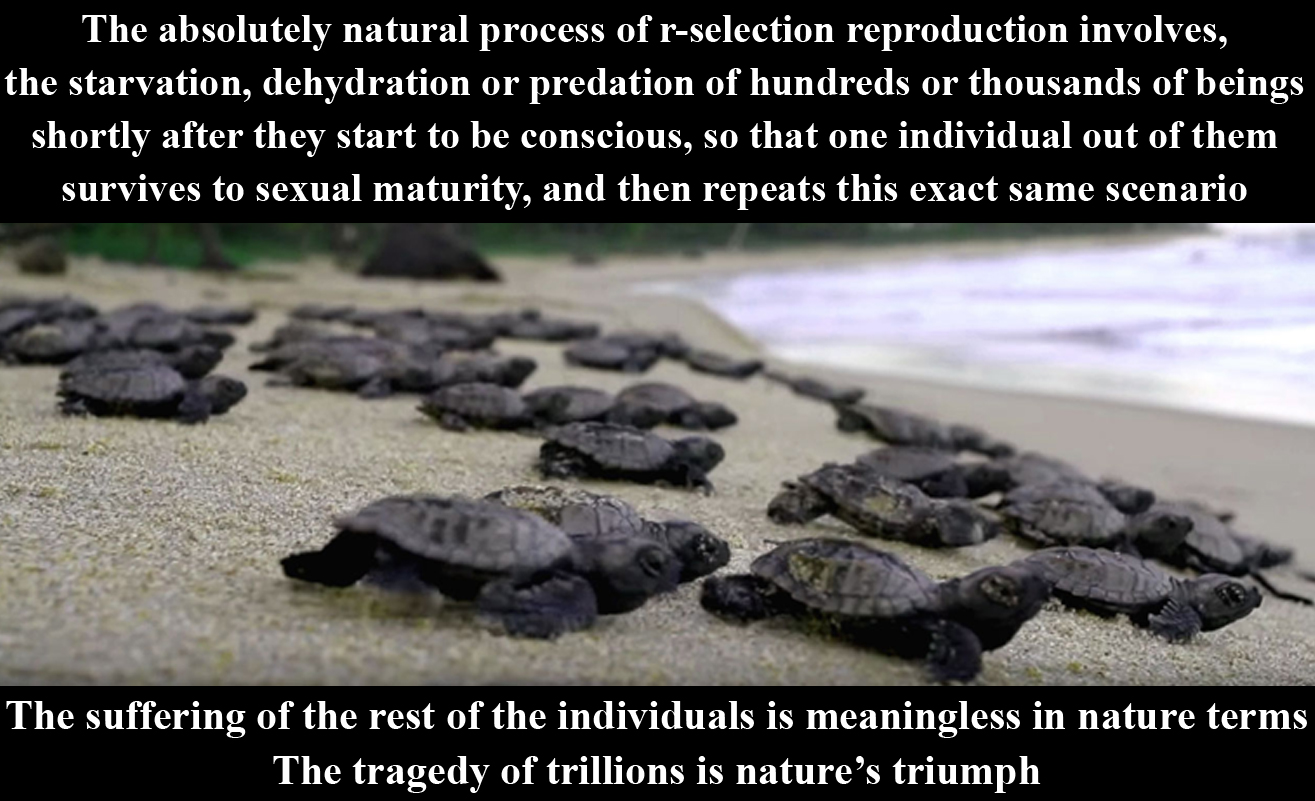
Of course not all the individuals of each reproduction will live long enough to become sentient (consumed while still in the egg at a very early stage for example) and there are those who argue that some never become sentient, no matter their age, because they are simply non-sentient. However, given that most animals practice r-selection, including invertebrates of course (by far most of the animals on Earth) and many vertebrates such as fishes, amphibians and reptiles, and given the enormous number of reproductions and the enormous number of reproduced beings, nature is not only far from being ideal, it is full of suffering on every level.

The philosopher Oscar Horta thinks that the existence of r-selection leads to the inevitable conclusion that there is far more suffering than happiness in nature. He gives an example to prove his point:

“Consider just one example regarding a certain species of animals, the Atlantic cod (Gadus morhua). These animals can lay from a few thousand to several million eggs. Let us suppose that they lay 2 million each time. It is estimated that in 2007 there were around 33,700 tons of Atlantic cod in the Gulf of Maine bank alone. An adult cod can weigh up to 25-35 kg. Assuming they have an average weight of 33.7 kg, there would be around a million of these animals (the average weight I have proposed is too high, though on the other hand I am assuming, for the sake of simplicity, that these animals are all adult animals). Assuming the cod population remains stable, on average only two of the eggs that a female cod lays in her life end up developing into adults. Thus, a total of 2 trillion eggs laid will fail to become adults. Assume each egg has a 0.1 probability of developing into a young, immature fish, a codling, and that there is a 0.1 probability that codlings are sentient. Finally, assume that on average they suffer for just ten seconds before they die.

All of these are extremely conservative assumptions. Yet they entail that each time these animals reproduce we can expect that 200 billion seconds of suffering is experienced (and these are only the cods in the Gulf of Maine). Since there are 31,556,926 seconds in a year, this amounts to 6337.7529 years of suffering. If this continues over an average human lifespan (that is, six decades), the number of years of suffering generated would be 380,265.174. All this for a very specific species in a very specific area.”

Oscar Horta’s terrifying illustration is extremely important for several reasons:
Even non-negative utilitarians must infer that nature can’t be morally justified.
It further refutes the idealistic view of nature.
It further induces the moral need to act against it.
It further refutes the idealistic view of a vegan world which is many activists’ moral ideal.

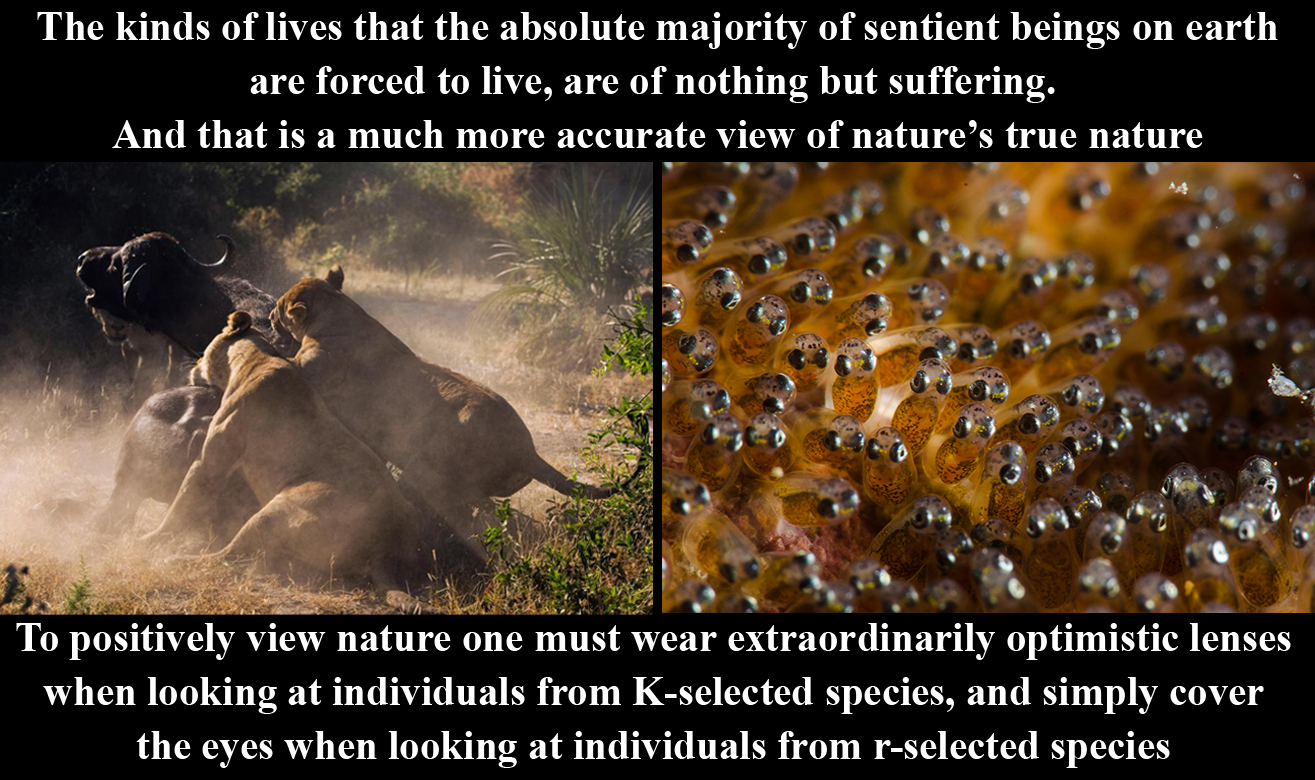
The kinds of lives that the absolute majority of sentient beings on earth are forced to live, are of nothing but suffering. And that is a much more accurate view of nature’s true nature.

To positively view nature one must wear extraordinarily optimistic lenses when looking at individuals from K-selected species, and simply cover the eyes when looking at individuals from r-selected species.
Balluch argues that his main claim that most wild animals are happy most of the time, is not solely based on his observation but is also inferred from evolution. He argues that: “Being happy and content is a vital ingredient to procreate and to live safely and long. Hence, evolution will produce animals, who are mostly happy under normal circumstances.
Only that evolution doesn’t work like that. Evolution is about adaptation not happiness. Nature is indifferent to happiness. Evolution is a descriptive mechanism not a system that has values. Nature has no goals, let alone that beings in nature would be happy. Beings in nature evolved to survive and reproduce, and so if they manage to do so, there will be more of them. That has nothing to do with happiness. It barely has anything to do with the welfare level of beings in nature as many of them can reproduce even with very low level of welfare. Reproduction is an indication of the ability to survive under specific living conditions, not of happiness. And Balluch’s focus on reproduction as an indicator is actually very ironic considering what was just explained regarding the two main reproductive strategies and the predominance of r-selection. So, if anything, the predominance of r-selection is a very strong indication of the opposite argument – that most of the being in nature suffer most of the time, with trillions experiencing nothing but suffering.

Nature Chauvinist

Balluch’s statement regarding evolution mentioned above, as well as other statements like: “In the evolutionary arms race between predator and prey, the prey animals are always one step ahead, otherwise the ecological balance could not be upheld”, reveals that Balluch is first of all a nature chauvinist. He is supposedly concerned about the autonomy of the induvial animal, but actually talks about populations, species, ecological balance and nature itself, as if these are morally relevant entities and not merely abstract notions.

To say that something is natural doesn’t add any moral value to it. It only says that it evolved spontaneously through time and improved or didn’t interrupt the reproduction of its beholder.
Nature is indifferent to the suffering of its residents.

Something can be good or bad regardless of it being natural (the notorious naturalistic fallacy).
Some things are bad despite that they are natural, like reproduction, and some things are good despite that they are not natural, like contraceptives.

Natural processes are not moral entities, sentient beings are. If intervening in a natural process can help sentient beings who are affected by this natural process, we are morally obligated to intervene, not to abstain.
Refusing to do so is placing non-moral entities above moral entities. And it makes no moral sense.

Thinking of nature as impeccable is not only ignorant of the scope of suffering in the wild but it is also, maybe unintentionally, confusing abstract terms such as species, with moral entities which are the individual members of the species. A species is just a convenient term to define individuals of similar biological traits, with no ethical relevancy.

Stating that nature can fix itself as long as humans don’t interfere is overlooking individuals and focusing on species and ecosystems. Species may manage in the wild as long as humans don’t interfere, but that is “thanks” to the mass reproduction mechanism that makes many individuals in each breed, of which only one on average will reach adulthood. Under this cruel natural mechanism individuals are sacrificed. The species may get stronger but the individuals live brutal, strugglefull, stressful and violent lives. For the species to flourish all it takes is that a sufficient number of its members reach reproduction age, no matter out of how many born each period, and what kind of lives they endure.

In a way morality and the naturalistic perspective are in contradiction. Morality strives for making the world a better place, while the naturalistic view strives to leave it as it is.

In addition, even the ones who think that nature always knows best are in favor of interventions in many cases. Just to name a few: medications, vaccinations, pre-birth genetic tests, abortions (for every possible reason), glasses, wheel chairs, hearing aids, sun screens, sun glasses and etc.
Arguing that it is morally acceptable to interfere with nature only when it comes to humans is speciesist. Surly all the other species would be happy to receive the various benefits of human medicine and technological aids.
Since the treatment of nonhuman interests in a similar situation must be the same as it is in the case of humans, interventions in nature for nonhumans must be morally obliged just as they are when it comes to humans. Either we can argue that any intervention in favor of any species is immoral, or that any intervention is moral. Otherwise it is speciesism.

Arguments against intervention in nature are absurd when coming from activists, which their main activity is promoting a mass scale intervention in nature as a moral solution. They can justly argue that it is morally justified given the cruel alternative, but they can’t argue that intervention in nature is just morally wrong in principle, while promoting the symbol of intervention in nature – agriculture.
So, activists approve many interventions in nature, and therefore they can’t principally argue against it.

Moreover, it is very hard to define what is a natural phenomenon in this world. If a crow attacks a nightingale in an activists’ garden we assume they will not stand by.
If these activists would see a wild boar attacking “their” dog we are sure they would interfere for the sake of the dog. Probably so would most if during a trek they encounter a wolf attacking a rabbit. They would do it because they see sentient beings in need and they feel they can help them. That’s all it takes. Someone who suffers and someone who can help. In our world there are trillions of someones who suffer, and only a few who are willing to help. That’s why the few who do, must act in order to help them all, and make sure that no one else would be in need in the future.

Autonomy

Obviously Balluch is aware that there is a lot of suffering in nature, so in order to protect his idealized view of it, and the supposed autonomy of animals living in the wild to prefer it, he keeps making claims against civilization, as if intervening in nature necessarily means human civilization, or that if human civilization is terrible then nature is good.

Balluch specifies all kinds of harms involved with human civilization, from killing mice while producing wheat, to building houses and roads, using electricity, plastic bags, or consuming anything practically, as well as all kinds of harms caused to humans by civilization such as depression, loneliness, alcoholism, cigarettes, illnesses, loss of purpose and etc. We couldn’t agree more and wrote about it in several places (1,2,3). However, the fact that living in civilization is horrible, and is bad for humans, or even if it is indeed worse than living in the wild, doesn’t make nature good. Both options can be terrible.

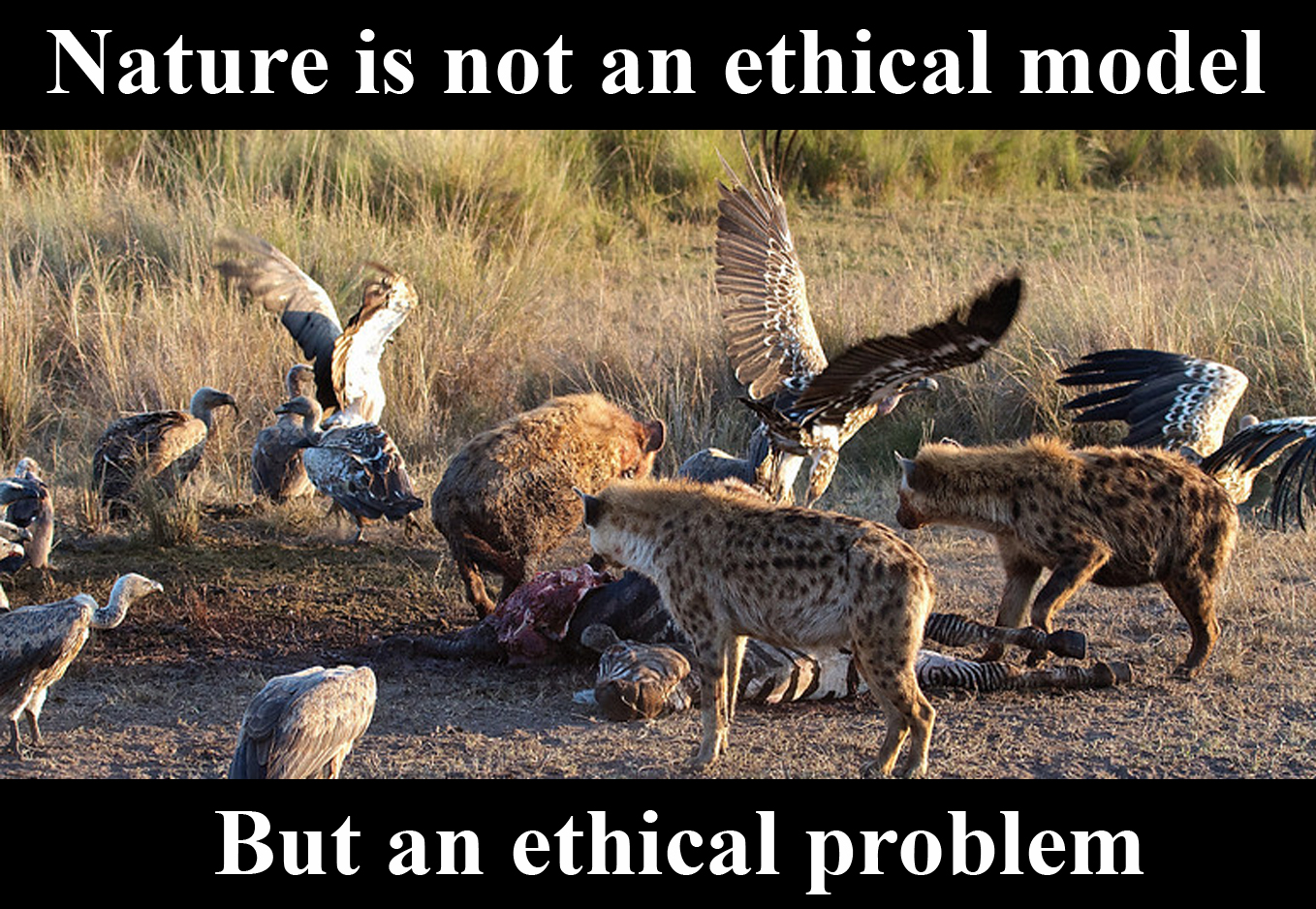
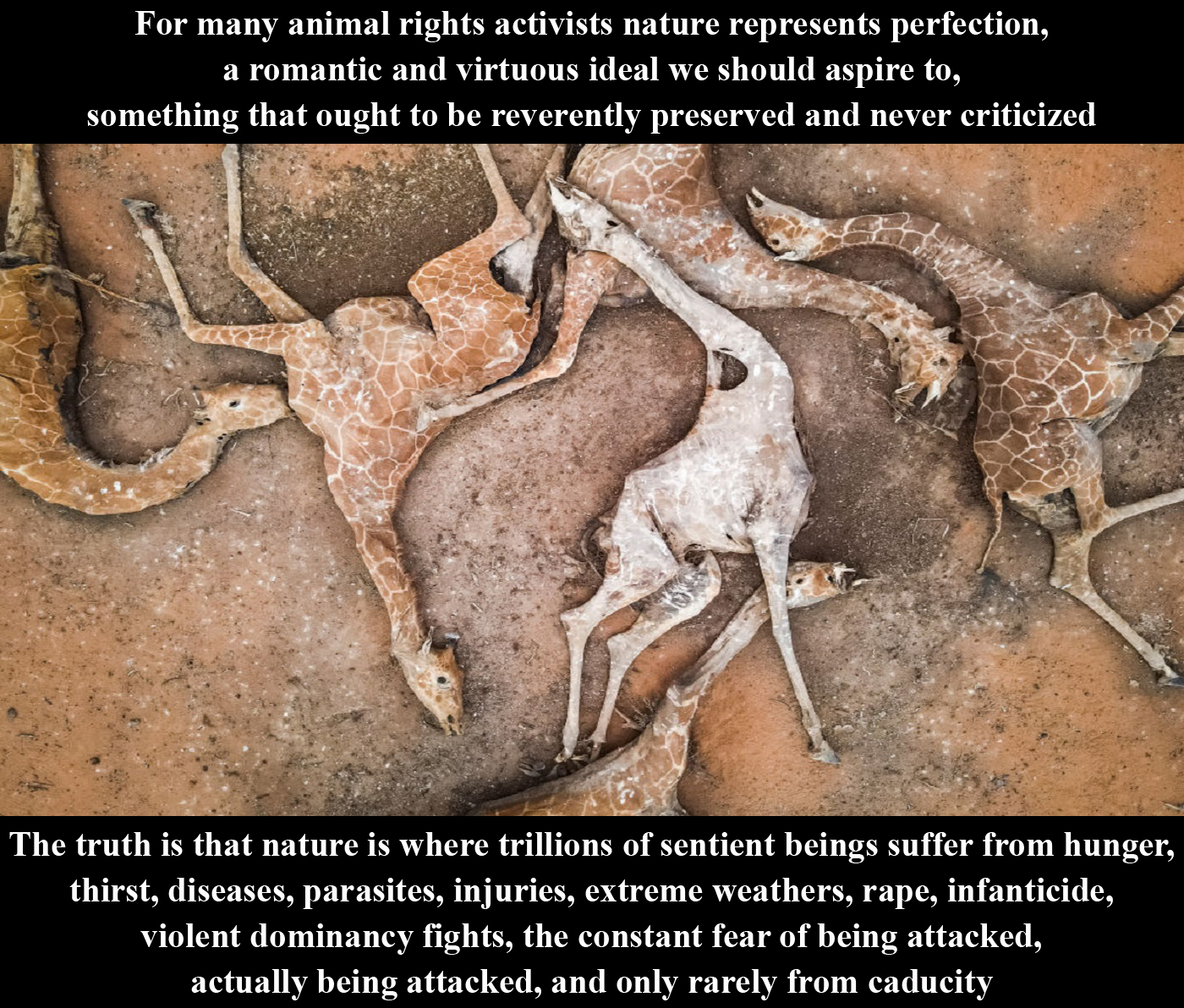
Indeed they both are. We know that for many animal rights activists nature represents perfection, a romantic and virtuous ideal we should aspire to, something that ought to be reverently preserved and never criticized. But the truth is that nature is where trillions of sentient beings suffer from hunger, thirst, diseases, parasites, injuries, extreme weathers, rape, infanticide, violent dominancy fights, the constant fear of being attacked, actually being attacked, and only rarely die from caducity.
Balluch also argues that every human, including vegans, causes more suffering than any wild animal. We are not sure that this claim is absolutely accurate but we agree that humans in general, vegans included, are causing a lot of suffering to many many nonhuman animals, probably more than the vast majority of animals in nature. However, the fact that human civilization is horrible doesn’t mean that nature isn’t. Balluch may make a strong case against civilization but merely by that he doesn’t make a strong case in favor of nature, or against intervention.

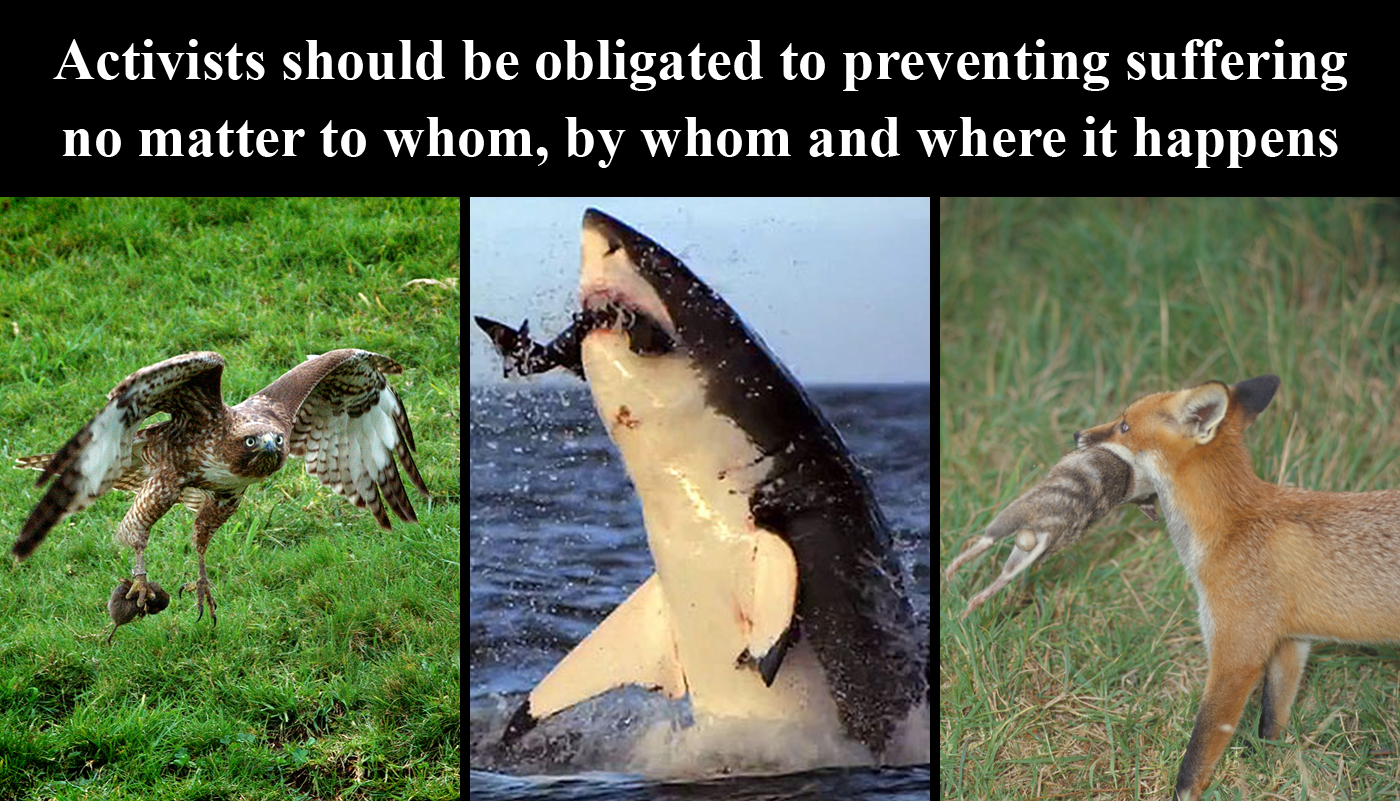
Only had the case for intervention been that human civilization is good or better, this line of argumentation would have made sense. But this is not the main argument for intervention in nature. The main argument is that activists should be obligated to preventing suffering no matter to whom, by whom and where it happens. What makes animals worthy of moral consideration is their subjective ability to experience, not the objective conditions of their lives (such as to what species they belong, where they live and their relations with other species) or their relations with humans.
Balluch argues that we should respect animals’ choice of autonomy and freedom instead of protection from the dangers in the wild.
But animals don’t really choose freedom over protection. The absolute vast majority of animals in the wild have no choice. Many social animals for example are forced to live in very hierarchal structures in which they have no freedom but have protection of the group. For Balluch’s claim to make sense he needs to show that most animals choose freedom over group protection. We doubt that he is familiar with even one example of such case. How many fishes or birds choose freedom over protection? If anything, individuals in the wild always waive freedom for the sake of protection, and even that is relevant only if they really have a conscious choice on the matter.
And that is the case among animals living in groups, most animals’ freedom sums up with whether they are going to be devoured by this being or the other. Most of the beings in the world not only don’t reach adulthood so to become autonomous, they don’t even reach a day old in nature.

Where is the autonomy of the trillions of animals who are devoured every day in the wild? They are all individuals, and they are all suffering. They all need help. All the time. Nature is the realm of violence and power, not of autonomy.

Constantly dealing with fear, thirst, hunger, diseases, parasites, and whatnot, is not really to be autonomous. There is no freedom in nature.
Every single second somewhere in the wild world, defenseless and frightened babies are left alone because their mother has to go search for food, a turtle is burned alive as she can’t out run the flames of a fire, a bird’s feet are frozen to a branch since he couldn’t find shelter from the harsh weather, a baboon monkey is in ongoing stress as an higher ranking female takes food out of her mouth and eats it herself, a nestling is thrown off the nest by the other siblings so they can get more food, a coyote is experiencing severe hunger as the rabbit he chased managed to escape instead of being torn apart, a female dolphin is being raped after she couldn’t outswim a male or even a few of them who gang rape her, a badger drags his rotten legs with infectious wounds resulting from constant fights, a zebra is dehydrated but can’t approach the ponds as the lionesses might be on the prowl, a lizard is being slowly devoured by a fungus that spread through the organs, a weak robin chick starves to death because his parents don’t feed him as it makes more sense energetically to invest in his stronger siblings.
Having said all that, and despite that obviously we have no doubt that we are morally obligated to do so, we don’t think that intervention in nature is the solution, and for two main reasons.
The first one is that although what is required is technological developments, the ideas of intervention in nature are still social ones. Meaning, society must be convinced that it should commit itself for the sake of animals in nature. It would take a whole web of institutions, on the political, academic and economic levels, to revolutionize the way humans see practically everything in this world. That is when they haven’t yet even made the much more basic step which is stop observing nature as their resource but as other beings’ home.

Even if you believe that a species which is still so far from eradicating poverty, hunger and war not to mention racism, misogyny and ageism, a species that hasn’t even ended slavery yet, and even expands it, and of course a species that invented and constantly intensifies factory farms, will someday seriously address the suffering of animals in nature, it will take a lot of time and we all know what time means in this world.

What part of the history of the human race makes anyone believe that this species is capable of making moral decisions?
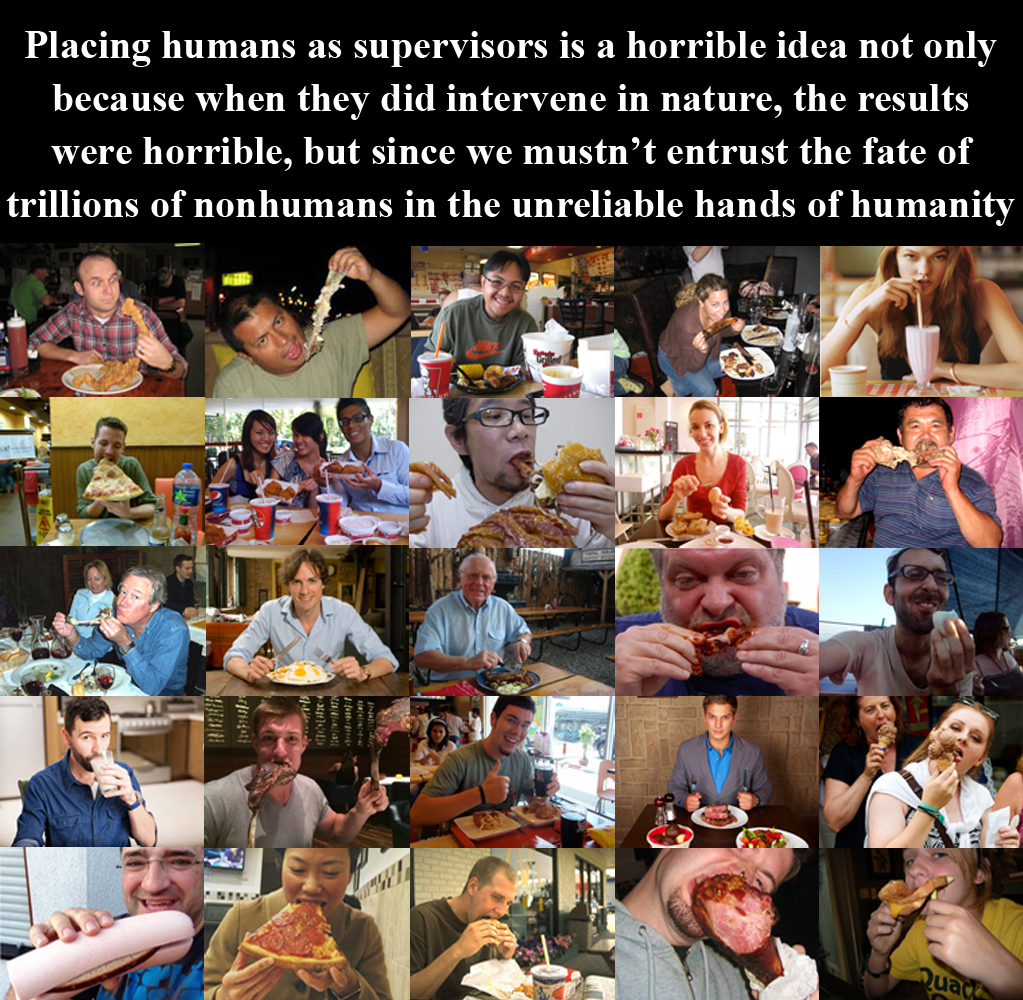
Currently not only that humans are not even willing to take responsibility over animals’ suffering that they are directly causing, but the number of the victims is constantly increasing.

What makes the expectation, that humans would someday care for animals’ suffering in nature despite that currently they don’t even feel morally obligated to care for the animals which are tortured directly for them, even more ridiculous, is how they deal with climate change – what is supposed to be in their eyes the biggest problem their species ever faced. Gladly, so far humans are far from dealing with the issue in a proportional way. They are willing to worsen the state of the planet even if it hurts their children, so they can maintain their lifestyle. So expecting that they would recruit to help animals in the wild is absurd.

Don’t confuse the last argument with the infamous claim that there are more burning issues at stake. Except for factory farming, we don’t think that there are more burning issues than suffering in nature. It is humans who think that there are many issues (factory farms are not an issue for them at all) which are more important but don’t bother dealing with them either. We have no reason to think that societies that have invested billions to precede other societies in the race to the moon (a project with very low scientific aspects and zero ethical aspects) instead of dealing with malaria for example, would ever seriously deal with helping animals in nature.

How can we seriously expect a society which hasn’t even made the first crucial ethical step, to make the last one? And all the more so when even most of the activists are against making it?

The idea of intervention in nature is all in all, a social one. It is immoral to wait for society to change, definitely not when it is certain that even if these ideas would be implemented, it would be far from helping all the sentient beings on earth. And that brings us to the second fundamental problem.

The second problem is that despite the profound understating of nature’s true nature by the intervention supporters, their conclusion is that we have a moral obligation to thoroughly study ecosystems so we can help some animals in some of them. The suggesters understand perfectly well that in this world suffering is inevitable. Such an understanding must establish a moral obligation to thoroughly study not only specific ecosystems so we can affect them and hopefully reduce some of the suffering of some of the animals, but the whole globe so we can affect it and hopefully end all the suffering of the all the animals.

The intervention supporters argue that we are morally obligated to help in every case we are sure we can help more than harm. It sounds reasonable, but that also means that we must accept the suffering in all the cases which we can’t be sure we can help. Suffering is so inherent in this world that even the ones who truly care about every suffering being, accept much of the suffering as obvious. Accepting suffering mustn’t be reasonable.
Helping the ones that we are sure that we can, is the moral thing to do only after giving up the option of helping all of them.

Intervention supporters are calling to study the issue and lay hopes on that future humans would be more caring and ethical and so would act to promote technological solutions for reducing suffering.
We are calling for present activists to realize that there is no substantial reason to lay hopes on future humans and there is no moral reason to let trillions of sentient beings suffer until the good humans from the future would show up, and therefore we all must look now for technological solutions to stop all the suffering.

The human society is not and will not be nonhumans’ salvation but their oppression. On the other hand, individual humans can be nonhumans’ saviors, but only if they stop laying their hopes on their species and realize that it is up to them only. Up to you.

The Problem of Inherent Dominionism

In his article The Problem of Speaking for Animals Jason Wyckoff argues that animal advocates face a special case of “the problem of speaking for others”, mainly because when it comes to nonhuman animals “nearly all humans occupy a position of privilege and so nearly all speakers and their audiences will be situated in “discursively dangerous” positions.”

In the spirit of postcolonial theoretical work, mainly using Edward Said’s Orientalism as a model, Wyckoff refers to human knowledge system – according to which nonhuman animals are regarded as resources and objects of study – as dominionism. In his words: “The norms and conventions of our speech and actions, the structured and unstructured social institutions that emerge from (and are constituted by) these norms and conventions, and the knowledge claims that are legitimated (or even more strongly, made true) by this entire context constitute a system of knowledge about animals that I am calling dominionism“.
Therefore, Wyckoff argues that when speaking about, and even for nonhumans, humans are largely confined to a conceptual framework that is dominionist, anthropocentric and speciesist.
Again in his words: “Orientalism and dominionism are both knowledge systems in which the conceptual framework available for the articulation of knowledge claims—including claims that certain groups are systematically wronged—undercuts the possibility of political representation, since in both cases the framework offers only conceptual resources that reflect and reinforce relations of domination and subordination.”
Speaking in a more practical sense the problem is that, naturally, human social institutions, as well as humans’ views and actions on the individual level, are constructed from the perspective of human beings, and so, predictably serve humans’ interests. Therefore he argues that “within such an institutional structure, there is simply no room for the perspective of animals“.

Being aware that it is, in his words, “difficult if not impossible to see how justice in human-animal relations could be achieved without human advocacy on behalf of animals“, Wyckoff suggests that animal advocacy should challenge the legitimacy of the Dominionism discourse by adopting a new framework and a new lexicon because: “words do things in the world; they, and our utterances of them, have an ideological dimension. One way in which to engage in ideology critique is to make explicit one’s refusal of the standard categories. Two sentences, one containing the word flesh and the other containing the word meat instead, may, under strict interpretations, say more or less the same thing, but utterances of them will have different impacts nonetheless. A critical discourse should involve a conscious effort to disrupt the dominant social schemas that comprise the resource paradigm“.
Wyckoff suggests that expressions such as “meat is not food” or “animals are not livestock” – “make vivid both the contingency and the normativity of the relevant classifications“, meaning, he thinks that it may cause the listener to confront the usual assumptions about humans’ position relative to animals.
In addition to adopting a new lexicon he recommends one particularly clear principle:
animal advocates should not engage with institutional animal exploiters on the latter’s terms. No partnerships should be made with them, no agreements with them sought. We should, for example, refuse participation in campaigns to employ “humane slaughter” methods and withhold praise for measures—such as “enhanced cages” for hens—that may produce marginal welfare gains while leaving intact the resource paradigm“.

Although we agree that animal advocates should use the word “flesh” instead of “meat”, and say that “meat is not food” and that “animals are not livestock”, and we definitely agree that animal advocates should not engage with institutional animal exploiters on the latter’s terms, we highly disagree that these suggestions, or any other for that matter, can ever solve the profound problem of speaking for others, or can seriously challenge the dominionist, anthropocentric and speciesist conceptual framework.

That is the case since the very situation of humans representing animals’ interests, and of humans judging whether actions done to nonhumans are in accordance with the norms and laws humans and humans alone have shaped, is in itself utterly dominionist, anthropocentric and speciesist, and since this utterly dominionist, anthropocentric and speciesist situation, is inevitable.
Humans and humans alone have the power to make rules and to apply them on everyone else, so dominionism, anthropocentricism and speciesism are inherent to an interspecies system where only one species makes and enforces all the rules.

Even if one day humans would be finally willing to consider nonhuman animals interests equally, at any given moment it would be humans who would make the decision whether to make a decision based on animals’ interests, or to distort if not ignore their interests, and it will always be according to human interpretation of other animals’ needs and desires.
And even if it was possible for humans to read nonhumans very well, eventually everything is depended on humans’ willingness to implement their interpretations of animals’ needs and desires. It is always humans’ decision. They can choose to respect animals’ needs and desires or not. Humans can choose to force their own interests on others or to try and be considerate of others’ interests as well. And even then it will always be based on humans’ subjective interpretation of what others prefer, and never on the objective preferences of others.

Given that conflict of interests will always exist, humans’ interpretation will always be biased. If we’ll take for example humans most favorite animal – dogs, they prefer never to be alone, be outside and play as much as possible, and get their most favorite food all the time. But few dogs really live like that. And many live horrible lives. And if it doesn’t happen with humans’ most favorite animal, why would, and how could, it ever happen with fishes and chickens or frogs and raccoons?

Even if humans weren’t so biased when it comes to others’ needs, let alone when these needs must be fulfilled by humans themselves, their ability to interpret animals’ needs is anyway highly questionable. When it comes to other animals it is highly unlikely that humans would be able to really understand them and act accordingly even if they really wanted to.
And it is highly unlikely that humans would ever really want to.

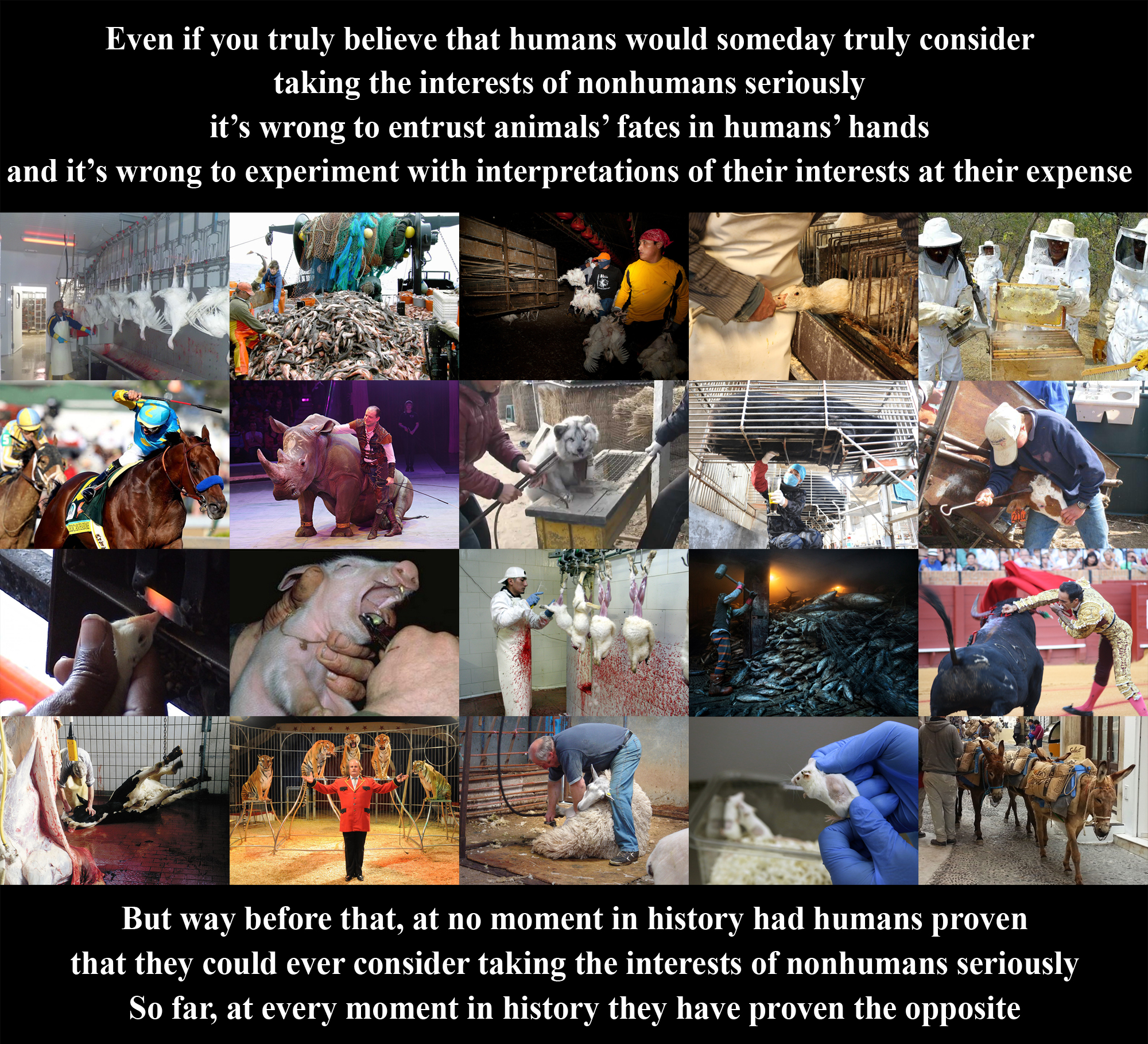
Even if you truly believe that humans would someday truly consider taking the interests of nonhumans seriously, it is wrong to entrust animals’ fates to humans’ hands, and it is wrong to experiment with interpretations of their interests at their expense.
But way before that, at no moment in history had humans proven that they could ever consider taking the interests of nonhumans seriously. So far, at every moment in history they have proven the opposite.

It is not only that humans are cruel masters that makes this world so dominionist, anthropocentric and speciesist, it is the very fact that they are the masters and always will be. And a history of thousands of years is more than enough to realize that this is not merely a theoretical built-in injustice, but a built-in power structure that practically allows humans to torment trillions of sentient beings for thousands of years, with no sign of it ever ending.

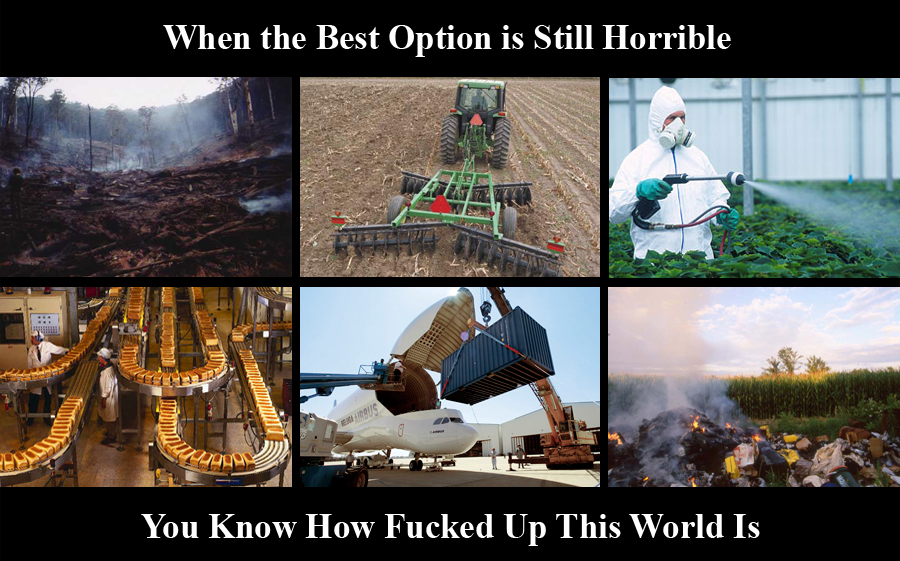
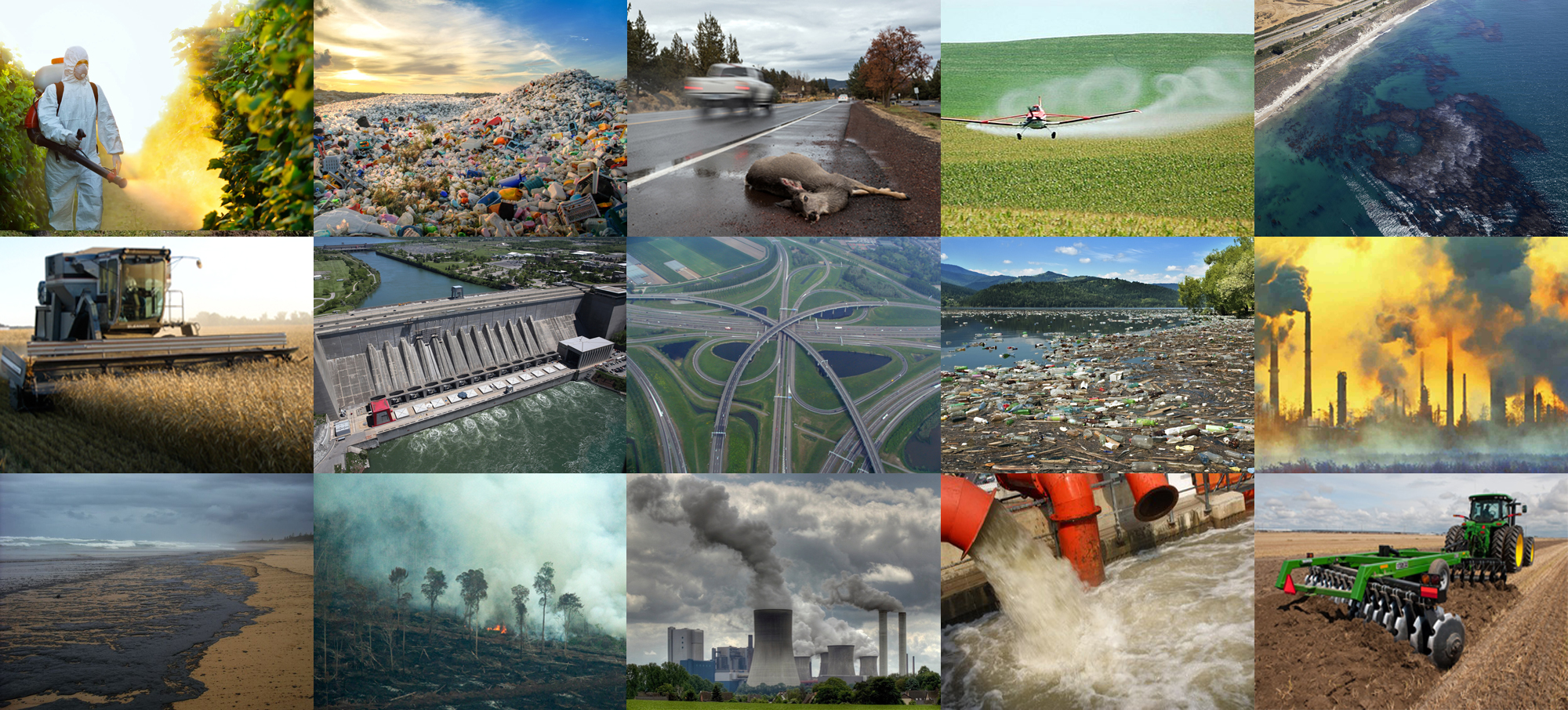
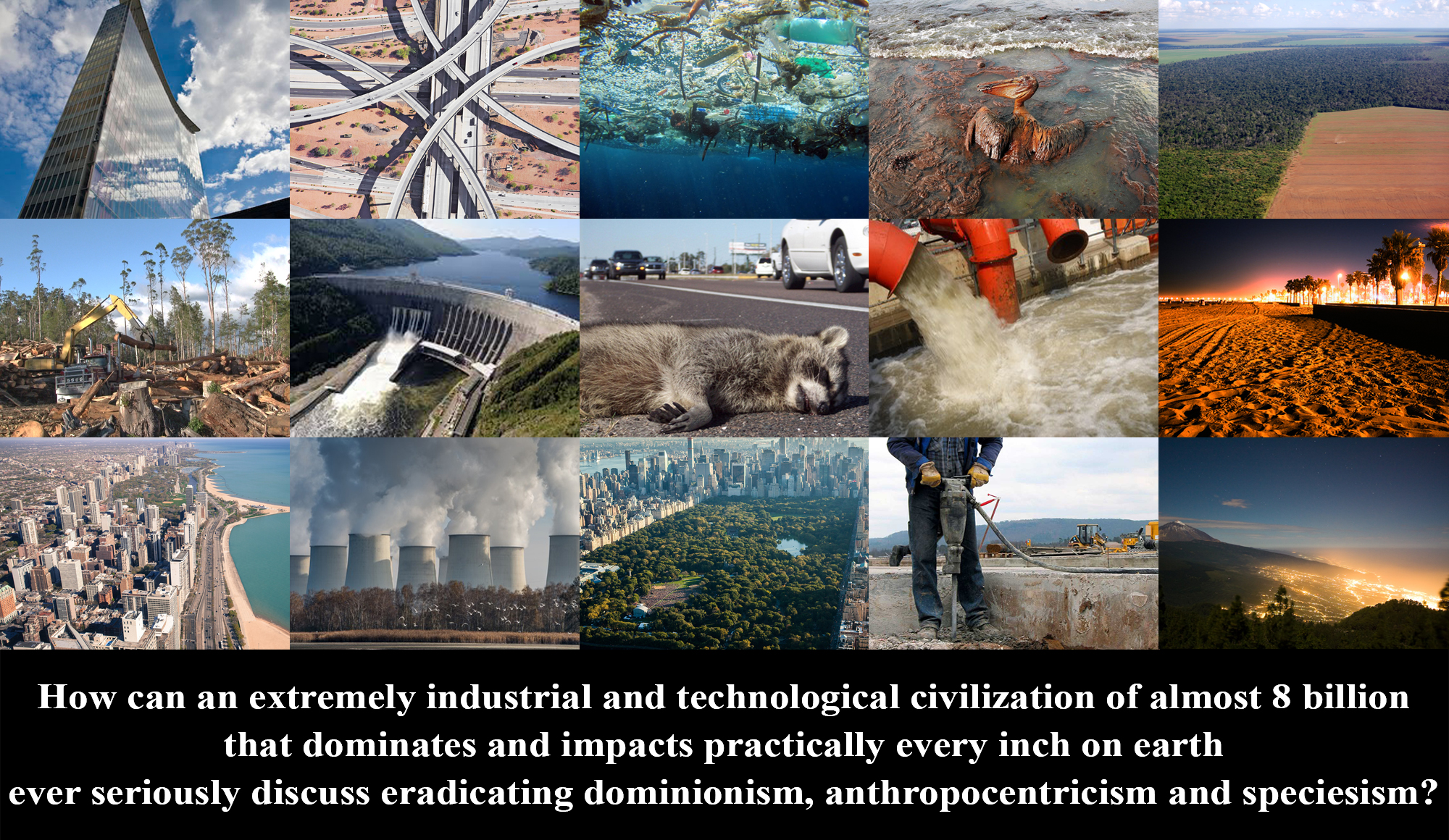
Dominionism, anthropocentricism and speciesism are impossible to eradicate because they are everywhere and in everything. Every aspect of humans’ lives is bound with dominionism, anthropocentricism and speciesism. Not just factory farming but any type of farming is a case of dominionism, anthropocentricism and speciesism. The levels of discrimination and abuse obviously largely differ, but excluding nonhumans from a particular area, clearing the native vegetation and planting plants that suit humans’ desires and not necessarily the needs of the native residents of the region, fencing the area, constantly poisoning nonhumans in it, changing the composition of the soil, dividing the nearby lands with roads to the farms, plundering water from other habitats, making noise with heavy machinery, crushing nonhumans with heavy machinery, polluting the area with humans’ waste of many kinds and etc. are all unquestionably forms of dominionism, anthropocentricism and speciesism.

So challenging human dominionism, anthropocentricism and speciesism must not only go way beyond animal advocates’ lexicon but way beyond animal advocates’ holy grail – veganism. Human dominionism, anthropocentricism and speciesism don’t end with turning each human vegan. And it shouldn’t even begin there, but with turning each one back to living like any other ape in the forests and the savannahs. Obviously that is not the world we wish and advocate for, but at least it would be more coherent and consistent with challenging human dominionism, anthropocentricism and speciesism (as it would reverse many elements of the human occupation of this planet).
Dominionism, anthropocentricism and speciesism are inherent to every human activity. Even if you insist that a vegan world may be possible one day, you can’t seriously think that humans would be convinced to voluntarily go back to living like any other species, limited to a relatively bounded geographical area, living off the surrounding, and with a population that would include several million members only. That would be much closer to seriously challenge dominionism, anthropocentricism and speciesism, but it is extremely far from what is being demanded of humans, or even thought of, even by the more radical animal advocates.

Animal advocates focusing on factory farms, justly thinking that they are the greatest manifestation of dominionism, anthropocentricism and speciesism, are postponing the inevitable. At some point they are bound to realize that domination, discrimination and suffering is everywhere and in everything. At some point they are bound to realize that it is impossible to end dominionism, anthropocentricism and speciesism by social means.
This world can never cease to be dominionist, anthropocentrist and speciesist, yet dominionism, anthropocentricism and speciesism should nevertheless somehow be ceased. Dominionism, anthropocentricism and speciesism are not less of an arbitrary discrimination, not less unjust, not less violent and not less cruel because they are even theoretically unabolishable. The only way to end dominionism, anthropocentricism and speciesism is to end the species. And the only ones who will ever consider doing it are you.

The End of the Kingdom

Considering that Kant is famous for arguing that humans are obligated to treat every human as an end in itself but towards nonhuman beings humans only have indirect duties, constituting a position that defends nonhuman animals’ moral status based on Kant is rather counterintuitive. However, in her book Fellow Creatures – our obligations to the other animals, philosopher Christine Korsgaard argues for a Kantian account of humans’ obligation to animals.

Korsgaard argues that when Kant claims that humans must value every human being as what he called ‘an end in itself’, he meant that humans should treat the choices, ends, suffering and happiness of each human as having an end in itself because they matter to someone. In other words, humans’ ends matter, because they matter to humans and they are valuable because humans value them. Since, as Korsgaard emphasizes, to say that something is good absolutely, doesn’t mean it has a free-floating goodness, but that it is good-for everyone for whom things can be good, in the final sense of good, or good from everyone’s point of view, that means that every human being has a certain kind of inherent value, and that’s why the ends, choices, suffering and happiness of each human should be considered valuable and be respected and even promoted by the community.
As opposed to treating someone as an end in itself, Kant argues that treating someone as a mere means is using someone for someone else’s purposes in a way that is contrary to that someone’s own good and to which that someone could not possibly consent.

Considering that many nonhuman animals are sentient beings capable of suffering, having interests of their own, and that things can be good or bad for them just as they can be good or bad for humans, Korsgaard asks what can possibly justify such an extreme difference between the way humans treat other human beings, or at least the way humans state that they should treat other humans, and the way humans treat nonhuman animals? Why when it comes to humans we must treat each of them as an end in itself, and when it comes to nonhumans we are allowed to treat all of them as a mere means to someone else’s ends in a way that is contrary to their own good and to which they could not possibly consent?

Korsgaard rejects Kant’s answer to the question derived from his own claims which is that only rational beings are ends in themselves and that humans therefore are free to use the other animals as means to their ends, and that nonhumans are not objects of direct moral consideration at all. And she rejects it for the simple reason that sentient nonhuman animals are ends in themselves in the sense that they are creatures for whom things can be good or bad. There is no reason that what is good for rational beings should be treated as good absolutely while what is good for the other animals can be ignored or discounted. Simply because nonhuman animals are creatures for whom things can be good or bad, what is good for them should be treated as good absolutely, as something that everyone must respect and pursue.

Korsgaard also rejects the softer and much more common claim which is that humans are more important than nonhumans. That is not because she thinks other animals are just as important as humans are, but rather because of her perception regarding importance and good, which is that things are important, only when they’re important to someone, and things are good or bad only when they’re good or bad for someone. She argues that there is such a thing as good and bad only because there are creatures in this world for whom things can be good or bad. Therefore, claims about the relative importance of different kinds of creatures do not make any sense to her.

So she doesn’t think that humans are more important than nonhuman. However she does think that humans are rational and moral creatures and nonhumans are not. When she argues that humans are rational she doesn’t mean they are intelligent but that they are asking themselves whether the reasons for which they believe and do things are good reasons or not. She believes that humans are aware of the grounds of their beliefs and actions, saying to themselves – ‘is that a good reason for believing or doing such and such?’, and nonhumans are not. And when she argues that humans are moral beings she doesn’t mean that they are morally good, but that humans’ actions are subject to moral standards, meaning they can be either morally good or bad, while the actions of the other animals are not subject to moral standards and cannot be either morally good or bad.

However, these differences she claims for are irrelevant, according to her, to the question of moral treatment, because of her stance on importance and good. In her own words: “It doesn’t follow from these differences that human beings are better than the other animals because you can only judge one creature to be better than another when they’re subject to a common evaluative standard and one of them meets it to a higher degree than the other one does. When they’re not subject to a common evaluative standard, you can’t rate them against each other. What follows from the fact that we’re rational and moral and the other animals are not is not then that we’re superior to the other animals, but rather that we can have duties to the other animals even though they can have no duties to us.”

That last sentence of this quote is part of the reason she thinks, as opposed to Kant, that nonhumans should be part of Kant’s famous ‘Kingdom of Ends’ – a spiritual or notional community, constituted by the relations among human beings who share a commitment to a conception of themselves and each other as ends in themselves.
Kant argues that the capacity to recognize and respond to reasons, including each other’s reasons, places rational beings in relations of reciprocity which enables them to make certain claims on each other. When rational beings judge that something is good for them, they treat it as something that’s good absolutely, and that they have a good reason to pursue it as long as they are neither harming nor wronging anyone else in doing so. Furthermore, making such judgment is also making a demand that others would respect the pursuit of it by not interfering and possibly even by helping to achieve this end. That is the meaning of treating the things that someone supposes are good as good absolutely. Everyone should treat these ends as things that are worthy of being pursued or realized in anyone’s eyes. In this way, when we choose to pursue our ends, we make a set of demands on ourselves and on others, a set of laws by which we mutually obligate one another to respect and assistance. The reciprocal demands that rational beings make on each other constitute us as a moral community pursuing common ends under common moral laws. This is basically Kant’s famous idea of the Kingdom of Ends.

Kant argued that since nonhuman animals are not rational beings and therefore cannot make and respond to moral laws, they’re not ends in themselves and cannot be part of this community. Korsgaard disagrees claiming that although indeed nonhuman animals cannot join humans in making laws for one another in the Kingdom of Ends, prior to that is the view that something should be treated as good absolutely simply because it’s good for someone, and since nonhuman animals share with humans the capacity for something to be good or bad for them, nonhuman animals are ends in themselves just as much. Animals are ends in themselves in the sense that what is good for them is good absolutely, even if they are not capable of joining with us in reciprocal legislation. Therefore, Korsgaard argues that humans, being rational beings, are members of the moral community in the active sense, and nonhuman animals are members of the moral community in a passive sense. Meaning, unlike humans, they may not be able to make the laws for themselves and each other, but they sure fall under the protection of the laws.

Although we highly disagree with the claims about rationality and morality, certainly with suggesting that all humans are categorically rational and moral and all the rest of the animals are not, given that this perception of her is not practically significant in her Kantian account of humans’ obligation to animals, we wish not to focus on that but rather on an idea, that is not only significant, but is practically the essence of the whole book. The basic idea behind Korsgaard’s Kantian account of humans’ obligation to animals is that each sentient nonhuman animal should be treated as an end in herself/himself, an idea we certainly don’t disagree with its ethical validity but with its possibility.

Human Impossibility

Korsgaard argues that since factory farming (including the so called humane farming), the use of animals in scientific experiments, in circuses, in zoos, and perhaps also in the police and the military, aren’t compatible with treating nonhuman animals as ends in themselves, they are morally wrong.

However, treating animals not as ends in themselves is realized in almost everything humans do, it is everywhere and in everything. The systematical, industrial exploitation of animals in the form of factory farms is by far the worst embodiment of treating animals not as ends in themselves, however it is far from being the only one. Not just factory farming but any type of farming is treating animals not as ends in themselves. The type and level of discrimination obviously largely differ, but excluding nonhumans from a particular area, the removal of native vegetation and planting vegetation that suit humans’ desires and not necessarily the needs of the native residents of the region, fencing the area, constantly poisoning nonhumans in it, changing the composition of the soil, dividing the nearby lands with roads to the farms, plundering water from other habitats, making noise with heavy machinery, crushing nonhumans with heavy machinery, polluting the area with humans’ waste of many kinds and etc. are all unquestionably forms of treating animals not as ends in themselves.

The impossibility of treating others as ends in themselves is derived from life most basic element – consuming energy. It is impossible for any being to live on this planet while treating others as ends in themselves and this ambition is particularly absurd when it comes to humans whose massive and violent footprint is with no comparison to any other creature, even in the case of vegans with a very high environmental awareness.

Some violent practices involved in some plant-based products are known to some activists and vegans, with some even stretching their personal definition of veganism to include for example palm oil, coconut, sugar, coffee, chocolate and etc. But that is because of the specific ways in which some specific products are currently being manufactured, where the violence involved in their production is relatively easy to spot while the whole mechanism is disregarded. The impossibility of treating others as ends in themselves is not in the specific production details, but in each of the ways each of the products is manufactured, transported, consumed and disposed of.

The manufacture of some vegan products that are considered basic such as soy milk, sugar, tofu, bread, oil, tea and etc., can include dozens of sub-processes like: cleaning and removing unwanted parts such as the outer layers, separating the beans from the pod, extracting the interior which is common with seeds, mixing and macerating as in preserved fruits and vegetables, liquefaction and pressing as in fruit juices and soy milk production, fermentation like in soy sauces and tempeh, baking, boiling, broiling, frying , steaming, shipping of a number of ingredients from different distances, wrapping, labeling, transportation of waste and of course transportation to the stores. All are inevitable. All are comfortably invisible as the finished product lies on the shelf.

It is hard to have in mind deforestation and land degradation when buying tofu.
It is hard to consider the amount of energy spent on the label of a can of beans.
It is hard to see all the sub production processes’ harms on a loaf of bread.
It is hard to acknowledge all the methane emissions of a rice milk carton.
It is hard to behold the 4,000 liters of water that were used to produce a cotton shirt.
It is hard to smell the burning wood when sniffing a bar of soap.
It is hard to think of the traps set on the tip of dens when buying cereals.

Despite that they wholeheartedly believe they should treat other animals as ends in themselves, even vegans with a very high environmental awareness are bound to personally, necessarily and inevitably participate in a systematical discrimination against beings from other species.

And it goes way beyond food, any food. Every aspect of humans’ lives is bound with treating animals not as ends in themselves. Every house, every car, every fueling of every car, every road, every ride on every road, every airplane, every flight in an airplane, every boat, every sail in a boat, every production of an electrical device, every use of an electrical device, or of electricity in general, every fence, every waste, and considering the massive harm involved in all stages of production and in routine washing of clothes, not only leather, fur, wool, silk and down, but in fact all clothes are forms of treating animals not as ends in themselves. And this is really just a partial list.

Even in the extremely far-fetched and delusionary optimistic scenario of a revolution in the way humans view nonhumans, it would still be the case that the whole human civilization and everything about the way humans live is built upon a massive global occupation at the expense of all the other sentient beings on this planet who are treated as anything but ends in themselves.
How can an extremely industrial and technological civilization of more than 8 billion humans, that dominates and impacts practically every inch on earth, ever treat all nonhuman being as ends in themselves?

Truly believing that “in suffering we are all equal”, and that “everybody to count for one, nobody for more than one”, and that truly the suffering of no one is of less importance than the suffering of another, any other, is simply beyond human possibility even theoretically, not to mention practically. Practically, we are still extremely far even from a vegetarian world, not to mention a vegan one.

Nonhuman Impossibility

Animal rights activists obviously acknowledge that nonhuman animals are not treated as ends in themselves in human civilization, however many of them don’t acknowledge that animals in nature are also never treated as ends in themselves.
In fact for many animal rights activists nature represents perfection, a romantic and virtuous ideal we should aspire to. But the truth is that nature is where trillions of sentient beings suffer from hunger, thirst, diseases, parasites, injuries, extreme weathers, rape, infanticide, violent dominancy fights, the constant fear of being attacked, actually being attacked, and only rarely die from caducity.

In many activists’ minds humans are the only problem in this world which without them would be perfect. But…
In a humanless world, hyena cubs would still viciously fight each other, tearing off slices of other cubs’ faces including ears and lips, to get more food.
In a humanless world, crabs would still be pulled apart limb by limb by otters.
In a humanless world, fishes would still be digested alive by the stomach acids of a pelicans who gulped them whole.
In a humanless world, wasps would still inject their eggs into a live caterpillar’s body to ensure that when their descendants hatch they will have easy access to food as the larvae eat the caterpillar from the inside out.
A humanless world is definitely not a masculinity-free world. Brutal fights for territory and for the “right” to mate would still occur in immense numbers. Walrus would still fight each other over territory with giant teeth that can reach up to one meter long and more than 5kg weight. And the biggest males with the biggest tusks would still push their way to the center of the iceberg pushing the females and pups to the edges where they are more likely to be attacked by an orca.
In a humanless world, billions of insects would still get chemically liquefied before they are eaten by spiders. And snakes would still swallow whole animals and slowly digest them until hawks hunt them, digging in with their talons into the snakes’ body until they give up fighting back, and then start to cut off pieces of their body and eat them.
Eels would still electrify other fishes to hunt them using up to 600V in a single discharge – this is 5 times the shock one would get from sticking a finger into an electrical socket.
Young offspring would still be murdered by opportunist males who want their own genes to be spread.
And in a humanless world, duck, dolphin, seal and sea lion females would still be gang raped routinely as a way of mating.

Unfortunately these examples are only a tiny glimpse of the horrors happening every single moment in nature. Every single second somewhere in the world, defenseless and frightened babies are left alone because their mother has to search for food, a turtle is burned alive as she can’t out run the flames of a fire, a bird’s feet are frozen to a branch since he couldn’t find shelter from the harsh weather, a baboon monkey is in ongoing stress as an higher ranking female takes food out of her mouth and eats it herself, a nestling is thrown off the nest by the other siblings so they can get more food, a coyote is experiencing severe hunger as the rabbit he chased managed to escape instead of being torn apart, a female dolphin is being raped after she couldn’t outswim a male or even a few of them who gang rape her, a badger drags his rotten legs with infectious wounds resulting from constant fights, a zebra is dehydrated but can’t approach the ponds as the lionesses might be on the prowl, a lizard is being slowly devoured by a fungus that spread through the organs, a weak robin chick starves to death because his parents don’t feed him as it makes more sense energetically to invest in his stronger siblings.

When it comes to animals living in nature, Korsgaard is aware of the impossibility of treating nonhuman animals as ends in themselves:
once we invite the animals in to the Kingdom of Ends, that hope of making the world good for everyone is gone. The interests of animals, including now ourselves as animals, are irreparably contrary. Animals eat each other. They necessarily compete for habitat. They necessarily compete for the world’s resources. These conflicts are not avoidable or occasional misfortunes, many of which could be eliminated by just institutions, but built deeply into the system of nature. Far, far more animals are born than the planet can sustain. Most of the sentient beings who are born on this planet are doomed to be eaten, or to starve, or both.” (154)

For every being to be treated as an end in itself is basically oxymoronic. It can’t exist in a world where beings constantly compete with each other over resources, not to mention that for many, other beings are the resources.

Therefore, Korsgaard, who argues that “every sentient animal is a real individual with a center of subjectivity of her own, with experiences that matter to her”, and that “Every sentient animal’s life—his or her individual life—is valuable, at least to the extent that it is valuable to the animal herself” (204), realizes that although nonhuman animals being treated as ends in themselves is a moral obligation derived by their very nature, this can’t be realized in nature. She realizes the hard clash between what should absolutely be and what can absolutely never be.
In her words: “I suggested that work on animal ethics has produced a kind of Kantian antinomy, a case where the same premise appears to yield opposite conclusions. Supposing that we have a duty not to harm animals, and to protect them from harm if we can, those who advocate what I have called “creation ethics” argue that in order to protect animals from natural evils we must make them all domestic, while abolitionists argue that in order to protect animals from our own abuses we must make them all wild. Antinomies reflect deep disturbances in our thought. The disturbance in this case comes from a conflict between our moral standards and the way that nature works. The natural world staunchly resists moral reorganization. As a result, we are unable to treat all animals in the way that morality demands, that is, as ends in themselves who have a claim to be treated in a way that is consistent with their good.” (154)

Some animal activists are not particularly bothered by that, claiming that they are anyway only morally obligated to address the suffering caused to animals by humans. However, exactly because every sentient animal is a real individual with a center of subjectivity of her own, with experiences that matter to her, or in other words, exactly because what makes animals worthy of moral consideration is their subjective ability to experience, not the objective conditions of their lives (such as what species they belong to, where they live, and their relations with other species) or their relations with humans, activists should be obligated to prevent suffering no matter to whom, by whom and where it happens.
Moral status is non-dependent. Sentient beings don’t lose their moral status when their suffering happens in nature.

We mustn’t accept suffering just because it happens in what we refer to as nature, and to nonhuman animals by other nonhuman animals. To the sufferers, suffering is bad when it is considered natural just as much as when it is considered unnatural. And the victims are not consoled by the fact that it is nonhumans that hurt them and not humans. If labeling a violent scene as ’natural’ doesn’t affect the suffering of the victims, then it doesn’t have a moral effect.

Moral treatment mustn’t be based on the relations of animals from specific species with humans, but focus on the morally relevant capacities of the animals. We are morally obligated to help sentient beings in need because of their inherent ability to suffer, not our contingent involvement.
Moral consideration is supposed to be a product of internal abilities, not external relations.

Our goal is to end suffering no matter where it happens or who is causing it. Suffering is intrinsically bad for the sufferer no matter who causes it. So the suffering caused by humans is not more important to prevent than suffering caused by nonhumans.

Activists are morally obligated to end the suffering of nonhuman animals in nature, not because they are the ones who put them in these situations, but because they are the only ones who care enough to put them out.
Activists’ moral aspiration shouldn’t be to solely end the suffering they are responsible for, either individually or collectively as a species, but to strive for the end of suffering in general.

Kant’s highest moral aspiration is ‘Perpetual Peace’ accomplished by actuating the Kingdom of Ends. But nature is inherently so extremely violent, and humanity is even more extremely violent, that this aspiration is practically and theoretically impossible. The highest aspiration of morality, its absolute end, and the only way to truly achieve Perpetual Peace, is not a kingdom of ends but ending animal kingdom, all animals, as soon as possible, and for good.

Artificial Worsening

Peter Singer, along with co-author Yip Fai Tse, argue in an article called AI Ethics: The Case For Including Animals, that considering many Artificial Intelligence systems’ significant impacts on nonhuman animals, with the total number of animals affected annually likely to reach tens or even hundreds of billions, AI ethics needs to broaden its scope to deal with the ethical implications of this very large-scale impact on sentient beings.

Singer and Tse divide AI systems’ impact on animals to three different types. The first one is AI systems that are designed to interact with animals such as ones that are already being used in factory farms, or drones that target and murder animals as part of “population control”.
The second one is AI systems that unintentionally interact with animals such as self-driving cars, systems that currently are not designed to protect animals on the road (perhaps except dogs, cats, and animals large enough for a collision to cause serious damage to the car and its occupants).
The third one is AI systems that impact animals indirectly without interaction such as video recommendation algorithms that may ban videos showing cruelty to animals. This they argue, may lead to a reduced demand for such videos, and so change the viewers’ behavior towards nonhuman animals.

Although there is some potential for suffering reduction due to AI use, for example by using AI systems to screen chemicals for toxicity instead of humans exploiting nonhumans in painful experiments, AI systems that are being commonly used in factory farms are most likely to reduce the production costs of factory farming, and therefore increase animal consumption and by that increase suffering.

The case of self-driving cars is more complex. Although regardless of whether driven by a human or an AI, as long as cars drive along roads, animals will get hurt, many animals and many of them very severely. Singer and Tse write that: “Not all the animals struck or run over by a car die immediately. Some of them might have only their lower bodies crushed, some others will have internal injuries and may even manage to drag themselves to the side of the road, or into nearby bushes, where they may suffer from their injuries over hours or even days before dying or, if very lucky, surviving. A study headed by Fernanda Delborgo Abra estimated that in São Paulo State (Brazil) alone, 39,605 “medium” and “large-sized” mammals were killed on roads by vehicles per year. This study ignores “small mammals,” birds and other animals. Another study by Loss et al. estimated that roughly 89–340 million birds were killed in the US by vehicles on roads each year.”

They think that self-driving cars may be a great opportunity to end the ethical problem of “road kills”. However, they realize that for that to happen AI systems “needs to be able to identify that it has caused harm, record the data related to the harm, and report it to stakeholders. This is easier said than done. To make an AI system have this ability by design, it seems that the developers of the system have to be able to forecast a certain range of possible harms that the system can cause, and constantly review uncategorized data gathered by the system (e.g. video footage, sounds, signs of harm such as DNA, blood stain, body parts of animals, etc.) to check if there are types of harms that were not identified before. This could involve the participation of people who are experts on animal welfare issues, such as ecologists, conservation biologists, veterinarians, ethologists, animal cognition scientists, and animal activists.”

So they lay their hopes and are calling for AI systems to be designed in a way that consider their impact on nonhuman animals. But they realize that this is not going to be easy:
The most obvious human stakeholders are the developers (including the staff, teams, companies). But they might not have enough incentive to identify and reduce, and where possible avoid, all harms caused to animals by their AI systems. Hence to make the framework more credible and more ethical from a practical standpoint, we may need to report to further stakeholders, such as government regulators (especially those concerning animal welfare), animal protection organizations, scientists in the fields we mentioned in the last paragraph, the AI product’s owners, and, in the case of companion animals, the owners of the animals, and in the case of farmed animals, both the producers of the animals and the consumers of the animal products.

And therefore express their worry regarding their hope that “if we establish a norm that it is okay for self-driving cars to simply drive like humans with regard to hitting animals, while potentially having capabilities to better protect animals, the opportunity for an early end to the ethical problem of “road kills” may be missed. Once this norm becomes the status quo, it might be much harder to change than it would be to develop a new norm before AI systems are the dominant way of directing cars.”

And regarding factory farms they say that: “For facilities hidden from public view, such as factory farms, unannounced audits by officials from regulatory bodies should be carried out. Unless the reporting mechanism extends beyond the developers of the AI, we are not optimistic that the moral responsibility for AI systems’ harm to animals will be sheeted home to those who are in a position to alter the systems to reduce this harm.”

And they go even further arguing that:
Even if accountability is extended in the manner just described, it will likely be difficult to ensure that all the relevant harms, including some indirect ones, are given sufficient weight. Consider the design, manufacture, and sale of AI systems for use in factory-style production of animals. Those making these AI systems could argue that AI will not only make food cheaper and safer for humans but will also bring benefits to the animals themselves. AI may provide early identification of diseases and injuries suffered by the animals, and thereby reduce animal sufferings, and they could reduce or eliminate the sadistic brutality to animals occasionally shown by factory farm workers. Although this is possible, given that industrial animal production is driven by profitability in a competitive marketplace, rather than by consideration of animal welfare, we consider it more likely that if AI can more closely monitor the health of animals, this will also enable producers to respond by crowding even more animals into confined spaces, thus making their enterprises more profitable, even if the increased crowding results in great stress and higher mortality for the animals.

The larger problem is that if AI reduces the costs of factory farming, it thereby strengthens an industry that is morally objectionable. This might help factory farming to remain viable longer, or even to grow further, and therefore to give rise, in the future, to huge numbers of animals being created to lead miserable lives. Companies that contribute to making the factory farming industry more resilient and better able to resist replacement by less cruel and more sustainable alternatives are acting unethically. They are prolonging the existence of a moral catastrophe on a vast global scale.

Another concern they are raising is that algorithms, including those used in AI systems, “contain, and therefore propagate human biases such as racism, sexism, and ageism. These biases were learned from human generated data. Human generated data also contain biases based on species membership, and these speciesist biases will, through AI systems, have consequences (mostly negative, we believe) on huge numbers of animals.

For example, data about humans’ diet carry significant speciesist biases. As the consumption of meat is widely accepted and a common theme of human conversations, a lot of speciesist language data can be learned by AI systems and then propagated through their use. For example, typing the words “chicken” or “shrimp”, leads Google, Youtube, and Facebook to give search prompts and search results like “chicken/shrimp recipe”, “chicken/shrimp soup”, “chicken curry”, and “shrimp paste”, indicating that the systems reflect the mainstream human attitude that it is acceptable to regard these animals as food for humans.

They lay their hopes on that “By working with experts in animal behavior and animal cognition, AI developers could learn to associate the sounds, facial expressions, and body movements of animals with the feelings the animals are experiencing, much as humans who live with companion animals are able to do.
But why would something that humans had never bothered doing suddenly happen with the AI systems they are developing?

And indeed they are not very optimistic about AI systems being developed to deal with some crucial moral questions that will guide them to address and consider nonhuman animals as well: “leaving these questions to be decided by human designers in a commercially driven field makes it very likely that existing mainstream human values on the treatment of animals will be implemented. If the resulting AI system does not entirely ignore the interests of animals, it is likely to discount those interests in comparison to similar human interests.
If the system is trained to do what humans currently approve of, and to avoid what humans currently disapprove of, then since mainstream human values are speciesist, so the AI system will learn to be speciesist, even if we do not explicitly program a speciesist ethic into it
.”

As if humans are not a big enough trouble as it is, AI may cause an even greater problem for nonhumans. AI is a very powerful tool placed in the hand of a very powerful species which is also extremely cruel. And that’s another reason to hurry up and get rid of humanity as soon as possible and before they further develop more means of causing nonhumans more suffering.