Not A Human Hate Parade


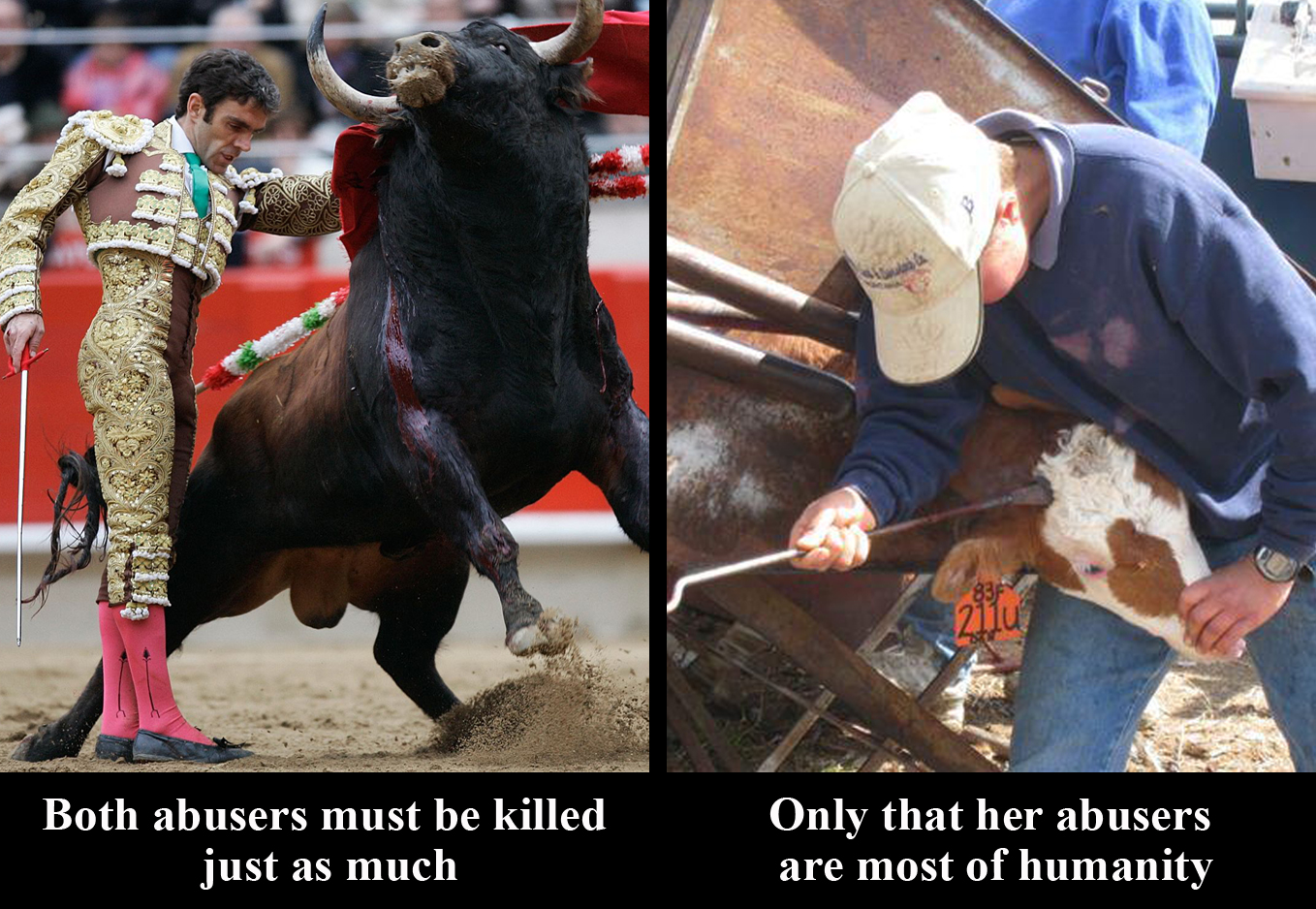
The Human Rights Day, being held tomorrow, is a good opportunity to emphasize that although our project may come off as a human hate parade, it is not. We don’t hate humans, we hate suffering. Humans are the ones who are responsible for most of the suffering in the world so they have a significant representation in our materials. But they are not presented as suffering causers only. Humans’ suffering is not absent at all, being represented in 8 articles (More Than Ever Before In History, Poor Priorities, Compassion Spin, Pepsi or Coca Cola?, One Child Is More Than Enough, The “Wrong” Gender, To Their Own Flesh And Blood, Mutilate to Dominate), as well as several Visual Arguments such as World Peace, Not A Human Hate Parade, All Babies and They Will. We are not promoting the annihilation idea out of hate.
We don’t want anything bad to happen to anyone. On the contrary, we want that all bad things never happen to anyone.

We also don’t promote the annihilation project out of despair. It’s not rage either. We are only interested in stopping the suffering, not in revenge.
It is not an impulsive reaction. It is a rational idea. Under the circumstances, it’s probably the only one.

Humans have a tremendous capability to close their minds to all reasoning and shield themselves from moral arguments. We understand it is so, but mustn’t accept it morally. We are not directly accusing humans for what they are.
We are not into accusations. We are into solutions.

One doesn’t need to hate humans in order to think they must be annihilated, thinking that humans are not more valuable than nonhumans is sufficient.

Currently activists are giving humans an unlimited opportunity to change while they keep their abusive routine, and that is essentially considering them as more important than all of their victims. And given the average consumption figures of each human, it turns out that each human is worth tens of thousands of animals. An average American meat eater is responsible for the life of suffering of about 55,000 animals within his/her lifetime, including about 10,000 crustaceans, 1,860 chickens, 950 fishes, 55 turkeys, 30 pigs and sheeps, 8 cows and between 35,000 and 50,000 of non-directly consumed fishes and crustaceans who are either “by catch” or animals captured and killed to feed the directly consumed animals. And of course that is without counting the chickens suffering in the egg industry and cows in the milk industry. Also, this is without counting all the animals harmed by each human by the many other daily means of consumption (including plant based ones). Morally opposing to stopping them, by all means necessary, including killing them, means that each is worth more than the pain and suffering of all of these animals.
We don’t need to hate humans to conclude that, only to non-biasedly and non-speciesistly observe the world.

30th Time I Scream

After no less than 30 failed Climate Change Conferences, and a decade after the one held in Paris, which is considered an important milestone but like all the others is also a failure, it is an appropriate time to revisit the text that attempts to examine the reasons and causes of humanity’s failure to deal with the climate crisis – the greatest challenge it has ever faced.

Climate Change Humans Don’t

A decade ago we have written a critical review about the Paris agreement that contained specific matters in the climate agreement which world leaders were vainly proud to celebrate.
We argued that the Paris convention is far less exceptional, and more of another failure in the same line of failures in the way humanity confronts its greatest challenge ever. The convention’s greatest achievement, perhaps its only achievement, was that after 25 years of failures, the world’s so called leaders had finally managed to finalize a climate convention with a signed agreement.
But practically, the Paris Agreement was actually no more than a statement of intent, as any aspect of actual significance was set as non-legally binding. Instead, each country got to set its own reduction targets called “Intended Nationally Determined Contribution” (INDCs), and on a voluntary basis. None of the countries, no matter their level of emissions at the time or their historical contribution to climate change, were legally bound even to their own proclamations.
And what made the agreement even more ridiculous was that according to an evaluation published by the UNFCCC (The UN body that deals with climate change) even if all pledges were fully implemented, global warming was still expected to increase by between 2.7 °C and 3 °C.

There were many other significant problems with the Paris agreement besides that it isn’t legally binding, and that the evaluation of the sum contribution of all the INDCs, fell short of the formal goal of the summit (staying well below 2 °C increase in the average global temperature since pre-industrial levels by the end of the century, and even aiming for 1.5 °C), such as the formal reliance on the assumed but not yet existing option of “negative CO2 emissions” by using future technologies that can take carbon out of the atmosphere; the refusal of developed nations to make at least their INDCs legally binding considering that they were and still are the greatest contributors to the climate crisis while mitigation contributions by developing countries would be voluntary and conditional on the provision of financial support by the industrialized countries; the fact that although the agreement calls for rich countries to help in providing poorer countries with the finance needed both to adapt to climate change and mitigate emission, all financing is voluntary; and of course the fact that as usual, the ones who are always absent from humans’ discussions over the planet are the rest of the species living on it, despite that even according to the minimal estimations, greenhouse gases produced by industrially exploited animals represent 14.5% of all anthropogenic greenhouse gasses emissions, with other estimations claiming for around 50%, the agreement didn’t mention any of it nor did it recommend even a gradual global shift towards a plant-based diet. Animals were totally absent from the table of discussion and appeared only on the dinner table as courses.

For a more elaborated criticism over the Paris agreement please read our post.
Anyway, even we, with all our criticism over the allegedly historical agreement, didn’t anticipate such a lame implementation of the promises written on it.
As super pessimistic people regarding the human race we have expected very little, but what has happened since the Paris Agreement was even lower than our very low expectations.

Don’t Forget Paris

Not only was the Paris agreement’s goal lame to begin with, UN reports have found that emissions are on track to be 16% higher in 2030 rather than 45% lower, which is the cut that science shows is required to keep below 1.5 °C. According to current models, the expected 16% rise in emissions by 2030 would result in at least 2.5 °C increase of global temperature.

Not only that the Paris agreement’s Intended Nationally Determined Contribution were highly inadequate to achieve its target, not even one nation has managed to keep to its proclaimed INDCs.

According to a recent study published in Nature, in order for humanity to have above 50-50 chance to avoid global average temperatures increase of no more than 1.5C above pre-industrial levels, all proven coal reserves, oil reserves and fossil methane reserves must be untouched. There is absolutely zero chance of that happening.
In fact the course is opposite. As the latest production gap report by the UN and academic researchers shows governments are collectively projecting an increase in global oil and gas production, and only a small decrease in coal production. By 2030, governments are planning to extract 110% more fossil fuels than their Paris agreement pledge permits.

Politicians are allegedly binding oil and gas industries to go green, but in fact, according to a recent report by the International Energy Agency “clean energy investments by the oil and gas industry accounted for only around 1% of total capital expenditure”.

Since the Paris agreement and in spite of it, the world’s 60 largest banks have invested about $3.8 trillion  in fossil fuel companies.

Despite promises written in the Paris agreement, the richer countries have not delivered $100 billion a year to poorer countries to help them adapt to and fight climate change.

Despite the Paris agreement, in the past three years, G20 governments and multinational development banks spent two and a half times on international finance for fossil fuels than they did on renewables.

Since the Paris agreement and in spite of it, greenhouse gases emissions have continued to rise.

The Paris agreement had shamefully low expectations and even that wasn’t implemented.

And unsurprisingly COP30 has turned out to be more of the same, if not even worse.
But this time, as opposed to our response to the Paris agreement, we’ll not analyze the agreement, despite that there is plenty to unpack there, but rather take a larger scope. That is because as seen in former climate summits (particularly the climate summit held in Paris because of the high expectations that this time the world is serious, and as has already been analyzed and reported by Climate Action Tracker that despite the pledges, the world is still nowhere near its goals on limiting global temperature increase but is actually heading for 2.4C of warming and when considering governments’ actual policies rather than pledges the projected warming is of 2.7C) agreements and declarations are meaningless. However the situation that brought their need in the first place isn’t. So we find it more interesting, teaching and eye-opening to discuss not the future application of the present climate summit, but the question how has humanity reached the situation that it might bring its own extinction by its own hands and is doing virtually nothing to save itself.

Doubtful Explanation

Many are arguing that the main reason for humanity’s failure in dealing with the climate crisis is the toxic (literally and conceptually) effect of the fossil fuel industry that has hired the services of lobbyists, think tanks, and even scientists to raise doubt regarding climate change.
At first they denied that the climate is changing, later they argued that the climate is changing but that it is a natural phenomenon not human caused, and most recently, mostly due to the piles and piles of evidences supporting both counter claims, that the climate is changing and it is partly due to human activity, but it is not as serious as the “alarmist scientists” and the “hippie tree huggers” are saying, and so shouldn’t effect humans’ unnegotiable lifestyle.

Obviously, and it is well documented in several studies and books, the fossil fuel industry, and many other industries that are depended on fossil fuels in many ways (some call it the carbon economy), have made tremendous and unbelievable efforts to cast doubt about climate change. Lobbyists, scientists, dozens of think tanks, so called research institutes, and public relations companies were funded and hired by the carbon economy specifically to try and make climate change doubtful. But unlike other issues, in the case of climate change their role was rather marginal.

Had it really been a successful campaign there would have been many more climate deniers, especially in high power political positions. But even the most self-interested politicians are not denying climate change, or that it is anthropogenic. That is of course except for Donald Trump, but the fact that Trump of all people is a climate change denier probably does a disservice for climate change denial. In other words, if someone like Trump thinks something, excluding his advocate supporters, the intuition of most humans, especially outside the U.S., is that it is probably the opposite.
Most of the ones who hold an influential position are not idiots like Trump, they have other, more sophisticated ways not to seriously tackle climate change other than simply denying it. And our point is that had the ‘merchants of doubt’ truly succeeded, these people would have publically denied climate change and would have withdrawn from the Paris agreement just as Trump did. They don’t because they know that climate change is a consensus. They don’t because the denial campaign has failed. So they can’t simply publically and explicitly deny climate change – so that they could maintain business as usual, avoid all kinds of social and economic changes, and keep their “generous” donors from the carbon economy – they have to do all that in other ways. Mostly by publically declaring one thing, and meanwhile keeping business as usual, or looking for loopholes such as an international carbon market which allows them to supposedly meet their climate change goals by trading carbon credits or offsets with poor countries without significantly reducing their own emissions, or proudly declaring that their nation will stop financing new coal projects but omitting the fact that it only goes for official governmental financial involvement while private companies can go on as they please (often with governmental subsidies), or what seems to be the unofficial sport of climate conventions – postponing significant decisions for later, or of course, the official sport of climate conventions – proudly declaring the signature of whatever agreement offered, as long as it is not legally binding.
That is more or less a simplistic and brief description of the past 30 years of climate conventions, shameful, embarrassing, absurd, irresponsible, but not a product of climate denial. These (in)actions are not a product of denial, but of shortsightedness, corruption, procrastination, priority distortion, indifference, injustice, political decay and moral decay.

Laying all the blame on the carbon economy and their ‘merchants of doubt’ is way too flattering to humanity. The case is not that there was a real doubt, but if anything, that doubt was used for political and economic gain, by people who didn’t doubt climate change, but the continuation of their political careers.

The vast majority of the so called world leaders don’t really have a doubt about climate change. Most of which are not stupid enough to believe the ones who have great interests and are not professional scientists vs. professional scientists who have no self-interest. The problem is not the doubt, it is the myopia, the lack of threat from the general public. The problem is that CEO’s of oil industries offer much more to elected representatives than their electors. And the blame here is not only on the system, though it certainly plays a part in this, but on the people as well. There is not even one green party ever to be chosen to form a government in its own nation. It came close in Germany, but only there, only after some unprecedented floods, and eventually it didn’t happen. And Germany is the exception. There are only a few nations in which a green party can be a part of the coalition, and in most nations they can only dream of a green party being elected at all, or of even having one. And that is the public’s fault. Had people cared about climate change, or any other so called environmental issue, they would have demanded, and voted for environmental representatives on the municipal and national level. But it rarely happens. People act on a much more personal, immediate and biased level. Me, Here and Now, and almost never Them, There, and in The Future.

Humanity wasn’t really convinced that climate change is doubtful. The facts were known, and for a very long time, and not only by some pioneering scientists.
Scientific research on carbon dioxide and climate has been going on for about 150 years. In the mid-nineteenth century, the Irish experimenter John Tyndall first established that CO2 is a greenhouse gas. In 1896 the Swedish chemist Svante Arrhenius first calculated the impacts of doubling the amount of carbon dioxide on global temperatures, and estimated that it would raise global temperatures by five to six degrees Celsius.
Already in the 60’s American scientists have warned American politicians about climate change. In 1965, the President’s Science Advisory Committee asked Roger Revelle, then director of the Scripps Institution of Oceanography, to write a summary of the potential impacts of carbon dioxide induced warming. His forecast was that by the year 2000 there will be about 25% more CO2 in the atmosphere and this will modify the heat balance of the atmosphere to such an extent that marked changes in climate are likely to occur.

In 1977, the head of the National Oceanic and Atmospheric Administration, had headed a committee for the National Research Council that warned of the serious impacts of climate change: “We now understand that industrial wastes, such as carbon dioxide released during the burning of fossil fuels, can have consequences for climate that pose a considerable threat to future society … The scientific problems are formidable, the technological problems, unprecedented, and the potential economic and social impacts, ominous.”

In 1988, James Hansen then director of NASA’s Goddard Institute for Space Studies, has made his famous testimony before a congressional hearing. And later that month, the World Conference on the Changing Atmosphere, the first major international gathering to set specific targets for emission reductions, was held in Toronto, with 300 scientists and policymakers from 46 countries. The conference recommended that governments cut emissions by 20% below 1988 levels before 2005.
And later in 1988, The Intergovernmental Panel on Climate Change (IPCC), held its first session.
So by 1988 (at least 25 years late) the whole world had definitely known about climate change.
And in 1992, every nation in it had signed the United Nations Framework Convention on Climate Change (UNFCCC) during the first United Nations Earth Summit held in Rio.

The fossil fuel industry is super mega rich, highly connected, and has a very strong lobby, no doubt. But it is not as if it is the fossil fuel industry vs. a few environmental organizations and activists, and so it is not a fair fight; it should have been the fossil fuel industry against the entire human race, backed with every scientist who is not paid by these industries. Such a consensus among the scientific community as the one regarding climate change is pretty rare. The carbon economy barons have tried, are trying and will keep trying to doubt the science, but trying to give this as an explanation to the feeble reaction of humanity to the climate crisis, is to unjustifiably cut them some slack. Other issues can only wish to have such a good starting ground with the entire scientific community in their corner. This is not a clear case of hiding crucial information from the public. If anything it is the opposite, people knew for a very long time, they just didn’t really care.

The harsh indictment against humanity is not that the facts were there but no one bothered to listen, but that the facts were known and no one bothered to act upon them.

Don’t get this wrong, we are not denying that the merchants of doubt had some effect or that there is a significant political factor to the climate change issue. For example, it is no coincidence that climate deniers are almost always strongly conservative white men. But their denial is mostly coming from an automatic opposition to everything that the other group says. And climate change being, at least originally, an environmental issue, and one that scientists have figured out, for conservative zealot white men, opposing it is a reflex. Another, more interesting group of climate change deniers is people who directly gain from carbon economy. And that is not only fossil fuel industry CEO’s but many humans whom their paycheck is signed by them. The statistical anomaly of coal mining towns is very famous, and it is an indication of the infamous saying of Upton Sinclair: “It is difficult to get a man to understand something, when his salary depends upon his not understanding it!”

We are mentioning this because the same could have been said about all humans since they all allegedly indirectly, gain from the carbon economy. Not wanting to change their way of life and wanting to keep gaining from the carbon economy, the vast majority of humanity could have preferred to believe that climate change is not happening, or does but not because of them, or is not that serious that they need to change their way of life. Climate denial should have been the norm because then humans could easily keep their own private business as usual.
And indeed some argue that the reason that spreading doubt is so effective is that humans are looking for these claims, they want the science to be wrong.
But most humans do believe climate change is true, anthropogenic and serious. And that is certainly the case after the series of extreme weather events that occurred recently since humans have a (false) tendency to interpret the world according to recent events and ones they somehow personally experienced.
Most humans don’t doubt the science and don’t feel a need to, as they somehow don’t view climate change as an attack on their way of life and so have a strong incentive to view the science, no matter how unequivocal, as doubtful since accepting it means that they must change their way of life. Most people accept the science and yet don’t change their way of life. Most humans are so inherently inconsistent and are indifferent enough to have it both ways.

Even accusing humans of wanting to accept the doubts regarding climate being anthropogenic because they want their life to stay the same, is flattering. Humans are not that consistent to begin with that they would experience a cognitive dissonance over the climate crisis, just as they don’t experience a cognitive dissonance when confronted with their cruelty to animals by consuming them despite them considering themselves as loving animals. They don’t even need excuses, they can just shrug and keep doing as they wish.
They are not threatened by accepting the climate crisis because it means that they can’t do all the things they like doing despite them contributing to the crisis, they can easily keep doing it despite that. The gratification is too immediate and too strong for them to stop just because it contradicts what they know.

The vast majority of humans are not climate change deniers yet at the same time they keep their business as usual, and that’s because way more than they are creatures who seek consistency, they are mediocre, passive, indifferent creatures who seek convenience, the familiar, and immediate gratification. That’s why almost each and every human who can afford a private car, abroad vacations, abundant unnecessary merchandise, and of course animal based products, does so, and does nothing about the fossil fuel industry, despite not doubting climate change.

The climate crisis is not mostly a case of bad people succeeding, but much more of common people being bad. Bad not only by being so indifferent to what should have been in their eyes the biggest crisis ever because it is an existential one, and yet only relatively few are viewing it that way and the rest are, as always, indifferent, but being bad by actively fueling the crisis. Day by day.
The main reason for humanity’s failure in dealing with the climate crisis is not the success of the carbon economy, but the failure of humanity.

Capitalism and Neoliberalism

Some blame the climate crisis and humanity’s incompetence in dealing with it, on capitalism and neoliberalism. They argue that besides that these ideologies sanctify profits at the expense of everything else including changing the climate of their very own advocators’ only home, they are also creating the political and psychological climate that prevents humans from resisting this crisis, by making humans politically incapable in confronting the fossil fuels industries, and psychologically reluctant to resist the crisis because these ideologies place humans in the center of everything and make them feel entitled to have whatever they want and therefore shouldn’t compromise on their lifestyle. Not even when they are confronted with an existential threat. In other words they can’t take responsibility for the crisis because they are politically weak, and they don’t want to because they are psychologically captivated.

These explanations are true but very partial. It is true that some of the blame is on capitalism and neoliberalism mindsets and it is true that they have turned humans to be even more self-absorbed, and to feel even more superior and entitled, but it didn’t create the climate crisis nor the human character. Undoubtedly neoliberal ideologies have significantly intensified things on a practical level and probably on a psychological level as well. But people have had such a mindset to begin with. Neoliberal ideologies haven’t changed the human mind, but it is more like a hand in glove.

Capitalism had surely intensified the climate crisis but it didn’t create it. Ecologically destructive practices have begun way before capitalism did, and even the specific commercial use of coal is about 300 years old.
And it is not that ecologically destructive practices are exclusive to neo-liberal capitalist societies. Communist and socialist societies were ecologically destructive, highly polluting and industrialization enthusiasts as their capitalist counterparts. They may have done so to a lesser degree in a quantitative sense but that is because in the times they were prevalent they contained less people and had less fossil fuels to burn, but it is not that if these non-capitalistic societies had remained to this day they would have emitted less GHG. These societies have conducted mega industrialization projects, glorified what they viewed as progress, destructed everything in their way just as much as capitalist societies do.

The roots are in humanity’s ancient dominion ideology – the destructive narrative of dominating the natural world, not in the late neo-liberal ideology. Viewing everything around, including rivers, ponds, lakes, rocks, mountains, forests, plants, and of course other animals, as resources, is more or less as old as humans are. Deforestation, slash and burn methods, mass scale hunting, cultivation, intended fires, poisoning, culling, water sources diversion and etc., are all thousands of years old. The exploitation of other species begun as soon as it was possible, not as soon as neo-liberal capitalistic ideologies have emerged.
Mentally, the industrial revolution has begun much sooner than it started technically. Humans have viewed the planet in an industrial mindset long before industrial technology was invented. The environment, including everyone in it, was according to humans at their service from the moment they have realized that they are the strongest species around. And with that came the feeling of entitlement. That may not yet filtered into the inner dynamics of human societies, meaning most individuals may have not felt that they are entitled to everything within their human societies, but they have felt entitled as part of a superior species which is entitled to everything. This dominion worldview was dominant more or less from and through the entire human history. Ecologically destructive practices didn’t begin with humans becoming industrial, but with homo sapiens becoming humans.

Mentally Incapable

Some suggest that humanity’s response to its existential threat is so poor because humans’ brains are not wired to comprehend a slow, gradual, invisible, abstract, global, future threat; but immediate, concrete, abrupt, personal and recognizable ones.

That’s why some laid some hope on that recent Climate Change Conferences would be successful as it happens to come right after a period of extreme weather events. In that respect, the ground for the last summits was more promising than previous ones with record-breaking heat waves in North America, a second year of drought in sub-tropical South America, floods in China and Western Europe, and fires in the Mediterranean.
But such hope lays on a very hopeless trait of humans – being severely alarmed about something for decades is nothing compared with seeing just a tiny pinch of what is expected to become routine and was well informed about way ahead, with their own eyes. This psychological tendency leads humans to vastly overestimate dangers of recent and closer events, and disregard distant and remote dangers even if they are infinitely greater. Furthermore, humans tend to believe that the likelihood of events is greater if they have heard about them from family and friends, or from humans they identify with more, than when they hear about them from professional experts. In other words, humans’ perception of danger favors proximity, draws on personal experience, and is drawn to images and stories, especially ones that fit existing values.

The fact that humans need a story and not scientific facts, with identifiable victims and mostly preferred ones who are as similar to them as possible, good and bad characters, and etc., is not very flattering, especially coming from a species which constantly brags about its intelligence and planning ability.

And a cluster of extreme weather events doesn’t at all ensure that humanity would decide to take proportional actions. That is because the people who are the current official decision makers don’t really care about whom who would be mostly affected by these events, and because they are not expected to be around when these events reach their front yards as well, and because the actual decision makers don’t care at all. They can always afford to move into safer places using the money they made by making other places unsafe.

In addition, psychological research finds that people who survive climate disasters, like people who escape car accidents unscathed, are prone to have a false sense of their own future invulnerability. In a book called Don’t even think about it – why our brains are wired to ignore climate change, author George Marshall argues that the impact of extreme weather events actually shed some light on why and how people can come to ignore climate change: “People yearn for normality and safety, and no one wants to be reminded of a growing global threat. As they rebuild their lives, they invest their hopes along with their savings in the belief that the catastrophe was a rare natural aberration. At a community level they collectively choose to tell the positive stories of shared purpose and reconstruction and to suppress the divisive issue of climate change which would require them to question their values and way of life.”

Another reason not to lay hope on the recent cluster of extreme weather events is that once such events become regular, they would be accepted into humans’ status quo. What now are extreme weather events, would soon become the new normal. As earlier mentioned, humans mainly respond to the abrupt, immediate and also the unfamiliar. Currently these events are all of which, but once they become routine, humans, who even currently don’t seem to be highly affected by them, would be even more indifferent.

After about 200 years of gaining from burning fossil fuels, humanity is facing a crucial crossroad. And it seems that it is choosing to keep hurting others so it can keep gaining. Now it is mostly nonhumans and poor people, and later it would come to them too. But the thing about later, is that it happens later. It is not at all surprising that there were many declarations and a wide agreement regarding the 2050 goals and modest declarations and little agreement regarding the 2030 goals. Meeting the goals of 2050 would be the problem of someone else, but meeting the goals of 2030 is my problem, and I don’t want to deal with it.

Indifferentcene

Some argue that humans’ inaction reaction to the climate crisis is because they feel powerless. But that is just too easy. Humans have a lot to do about the climate crisis if they wanted to. They can, first and foremost, and first and foremost for ethical reasons, stop consuming animals. They can use only public transportation, ride bicycles, or walk if it is possible, live minimally, consume much much less of everything and especially oil related products such as plastic, they can choose only local to avoid at least overseas shipment, they can choose second hand and recycled clothes only and make do with as little of them as possible, they can educate themselves and then educate others, they can donate to relevant organizations, better yet volunteer in relevant organizations, they can protest, resist, and demand change every single day. They are not doing any of it. Let’s suppose that they can excuse not actively participating in climate activism exactly because they feel powerless, but how can they excuse actively making it even more powerful?

Most humans’ participation in decision making comes down merely to voting, usually only once in a few years, usually for a candidate that doesn’t really represent them, and always to one who ends up disappointing them. But all they do about it is complain in their private living room, sigh, argue about it with the people around them, or just shout at the news.
Most humans, or at least enough of them know that it is not even the humans they have voted for who are making the decisions that have the most significant impacts on their lives. But it goes on. Most humans, or at least enough of them know that there is not even one real democracy in the world, and yet it goes on. Corporations are not gods, the fact that they have more power than governments these days is not a physical fact, it is a political fact. It can be changed. If people overturn each and every government that doesn’t change this dire situation then this situation would be stopped. The laws that currently protect corporations from nations’ prosecution when the citizens of these nations are harmed by these corporations can be changed by citizens who vote for politicians who would quit from trade agreements, wave off their WTO membership and really protect the real interests of their citizens. But that would never happen.

There is a reason why a French revolution is not highly expected in our world today. Too many people are living too comfortably to risk their private life for the greater good. And many other people, whom their lives are very uncomfortable have to risk too much to gain too little if anything.

And maybe this is not really their real interests. It seems obvious that clean and safe air, clean and safe water, and every other product being clean and safe is in peoples’ most basic interest. But is it though? How come they don’t stop purchasing harmful things for themselves and for their families? Do you really believe that they will be willing to pay the real price of things if they would have to? If everything would be manufactured safely, cleanly, locally, minimally, with no exploitation, with no pollution and etc., would they be willing to pay for these products? If you think that they would, why don’t they do it now? There are many companies that at least try to produce products under these standards, vegan, organic, local, fair trade, transported by electrical vehicle powered by wind turbines only and etc., why aren’t these kinds of products the most popular?

That is since the vast majority of people are making small selfish decisions because they are living small selfish lives. They don’t think about the fate of their species, and certainly not about the fate of other species. They barely even think about their future offspring, not to mention their offspring’s offspring if they currently can’t see them because they don’t exist yet. Humans mainly think about themselves, and two generations ahead tops (that is if they already have grandchildren). They are just too centered in their private little lives, which are way too comfortable for them to jeopardize. They are not even willing to do the basic simple things such as stop consuming animals which is undoubtedly the best thing they can do on the personal level.
The convenience of a private car, a cheap flying ticket, the abundance of unnecessary multi packed products that with the ease of a click reach their door step, and the so beloved and so familiar taste of a corpse in a bun, are winning in almost each and every battle, among almost each and every human, against almost each and every big idea, and unequivocal fact.

Needing to change is no guarantee that people will change. For that to happen people have to want to change and have the will to change.
Seriously dealing with climate change means that humans need to reduce their living standards and accept some short-term costs in order to at least mitigate much higher costs in the long-term. And this is very unlike humans. The vast majority of humans are willing to let what they view as their home be destroyed, they are practically willing to let corporations come to what they view as their lands and put them and their families at risk by polluting the air, water sources and their homes, and they are practically willing to let their governments protect the interests of foreign corporations instead of their own – their own citizen. But they are not willing to change their lifestyles. No amount of awareness will overcome their unwillingness to lower their standard of living.

Humans take too much pleasure of industrialization to oppose it. It is hard for the ones who have even just a little money, to waive off the sense of comfortableness and control, even if it is utterly fake.
The dominant notion is ‘grab as much as you can’. And the ones who have managed to grab some are not willing to let go. No matter how high the price is even in their eyes. This basic attitude, which applies to almost all of humanity, excluding no more than some thousands of activists, is the climate of the climate crisis.

All the suggested explanations for humanity’s failure to address the climate crisis that were mentioned along this text, are right, but they are partial, and way too flattering to humans. But that is very understandable, since if it is not the merchants of doubt, capitalism, neo-liberalism, the political system, human psychology and etc., then it is humanity as a whole.
But can we blame ourselves? Yes we can. If we can’t take responsibility for the climate crisis, the least we can do is take responsibility for not taking responsibility for it, by admitting that we are an extremely irresponsible, short-sided, greedy, arrogant, indifferent, and dangerous species, and therefore got to go.

An organization called Extinction Rebellion should have been initiated a long time ago, but not one calling for a rebellion against human extinction, but one rebelling the human species and demanding its extinction.
A real climate justice is not to fight so that humans from the most vulnerable places won’t be hurt the most despite that historically they have been contributing the least to the crisis. Considering everything that humans have done, are doing and will keep doing, climate justice is human extinction.

Don’t get it wrong this is not suggested as a punishment or retaliation. We don’t think that the human race should go extinct because it fails to save itself from extinction. There are many other strong reasons to support and advocate for human extinction. Its utter failure in relation to the climate crisis is just an opportunity to acknowledge that.

We disagree with Naomi Klein’s book title This changes everything. Even this doesn’t change anything. However we do agree with a proposition she raises in it: “What if global warming is not only a crisis, what if it is the best chance we are ever goanna get to build a better world?” Indeed it may be the best chance we are ever goanna get to create a better world, one without humans.


Tiny Apple

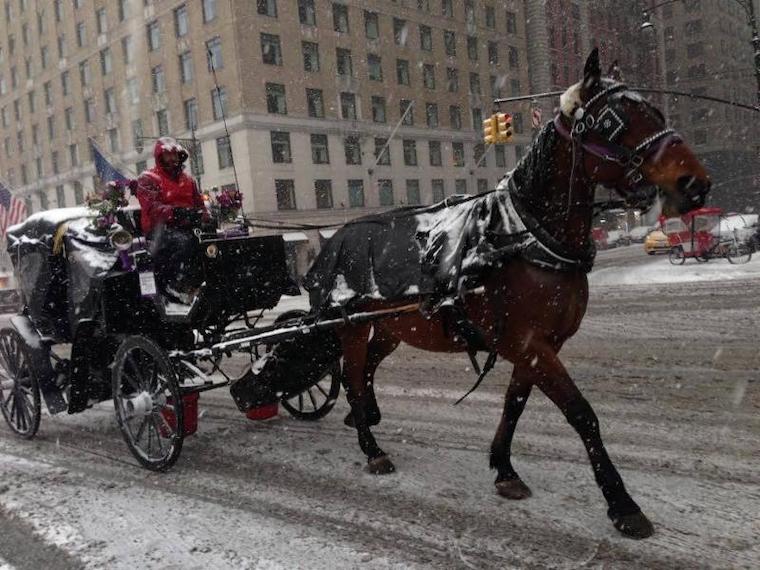
Horses in New York City’s horse-drawn carriage industry are being forced to draw carriages for hours in scorching heat or freezing cold, on harsh pavement, in crowded streets, in bust traffic, blaring horns, and wailing sirens terrify these easily-startled animals, while exhaust fumes damage their lungs. Many horses are also suffering painful leg and joint injuries from hauling heavy loads on hard surfaces.

Finally, after more than 165 years that horses are being forced to draw carriages through Manhattan’s Central Park, it seems as, hopefully, at least this form of animal exploitation is about to end. Hopefully, because campaigns against this harsh exploitation had been held for decades now and with no success.
The most depressing thing about the failure to end even this tiny exploitative industry so far, is not that the animal activists failed to convince the relevant legislators to act on behalf of the poor horses, but that the relevant legislators, despite their firm opposition, failed to end this exploitative industry.

Supposedly, there is room for hope as all four leading candidates running for mayor have all spoken out against it. One of them is current mayor Eric Adams who opposes this and tries to act against the cruel carriage ride industry, yet it continues. Not only that, former Mayor Bill de Blasio, campaigned in 2013 with the promise to ban horse-drawn carriages, and failed. So even mayoral administration that vowed to ban this horrible tourist activity couldn’t end this one small exploitative industry.
This is what de Blasio said during his campaign at the end of 2013: “We are going to quickly and aggressively move to make horse carriages no longer a part of the landscape in New York City. They’re not humane. They’re not appropriate to the year 2014. It’s over. So just watch us do it now.”
6 years before that, at the end of 2007, after a horse called Smoothie died, former council member Tony Avella introduced the first ever bill to ban the industry. 
Even the influential Central Park Conservancy, the nonprofit that manages the park, announced that it also was backing calls for a ban.
And yet…

The only achievement in this regard was that in 2019 (only in 2019!) The Carriage Horse Heat Relief Bill passed and enacted into law that at least forbids forcing the horses to draw carriages in extreme humid heatwaves.

If the animal rights movement cannot end an exploitive industry of such a small scale (there are currently 68 licensed carriage owners with a total of about 200 horses) despite having such a strong support from legislators, celebrities, influencers, and the general public, what are the chances that it will ever end enormous ones such as the chickens and fishes industries?

If the animal rights movement can’t even ban an exploitative industry such as the horse-drawn carriages, in New-York City, despite strong support from legislators, celebrities, influencers, and the general public, then activists should seek other ways to end all the suffering.

Pettiness

A zoo in Denmark is asking people to donate their unwanted pets, particularly chickens, rabbits and guinea pigs but also horses if they are small, to help them feed the zoo’s predators.
The request created a backlash online, but the zoo said that “The animals are gently euthanized by trained staff and are afterwards used as fodder” and that the purpose of the program is to make sure “nothing goes to waste — and [to] ensure natural behavior, nutrition and well-being of our predators,” according to the zoo’s website.

Obviously everything here is wrong – the fact that zoos still exist, the fact that pets still exist, the fact that some pets are unwanted, that zoos ask people who have unwanted “pets” to donate them to feed other animals, the fact that this Danish zoo could seriously make the following statement: “In zoos, we have a responsibility to imitate the animals’ natural food chain — for reasons of both animal welfare and professional integrity” – but we wish to focus on something else.
Animal activists are shocked that people are shocked by this zoo seriously proposing to bring unwanted animals as food for animals in zoos because they are “pets”, even though it is feeding animals that can’t do otherwise, and while the protesters themselves eat chickens and rabbits even though they really don’t have to. So the activists are shockingly pointing out the double standards of the online protesters.

But the shock should be that animal activists are still shocked by the double standards and irrationality of humans.
We saw similar online outcries when a giraffe was executed in another Danish zoo to feed other animals in the zoo a few years ago, and of course in cases like Cecil the lion, or when an animal manages to escape the slaughterhouse.
Some activists claim that these kind of cases set as an indication that humans care about animals and just need information and guidance. But it’s actually the opposite. For example, and directly related to this case, humans know that some animals in zoos need meat to survive and that all of them don’t, yet that’s not enough for them to acknowledge the hypocrisy and double standards in their shock. Obviously, it’s not that simple, since here it’s very tangible, as humans are asked to bring an animal they raised themselves to be killed and fed to another animal. But this is just another indication of how irrational humans are and how untrustworthy they are when it comes to moral issues. Humans do have all the information they need for them to change their habits, they just choose not to. If anything, these specific cases of supposed caring for nonhuman animals function as fig leaf and as moral licensing to be carless about the fate of the animals directly tortured for them.

Any animal would prefer to live as a “pet” and be killed by a veterinarian in a zoo over being imprisoned in a factory farm and be murdered in a slaughterhouse by a slaughterer. But it’s not about the animals and how they feel, but about humans and how they feel. It always has been and always will be. That is unless animal activists would stop being shocked by what is shocking humans and what doesn’t, and what motivates humans to change their cruel habits and what doesn’t, and start acting to change the reality of animals regardless of humans’ willingness to change.

Still Running to Hell

Today, probably the most famous animal abuse festival in the world – the fiesta in honor of San Fermin mostly known as Running of the Bulls – has ended for this year.

For anyone not familiar with the abusive festival, a run takes place every day at 8A.M. between the 7th and the 14th of July. 6 bulls and 6 steers who are supposed to herd them, run the 825 meters of immensely crowded narrow streets from the corral and into the bullring.
The terrified bulls, surrounded by hundreds of runners, are harassed and touched all along the run.
Running on the cobbled streets with sharp turns, the bulls also suffer from falls, trampling, bruises and fractures. They often collide with the walls, get severely injured, sometimes breaking bones.

When entering the bullring the bulls are immediately imprisoned inside the ring, saving them for later. Meanwhile cows and calves are released to the bullring for the runners to enjoy as they abuse them, playing matadors. In the evening the 6 bulls, who were forced to run in the morning, are tortured in a bullfight spectacle.

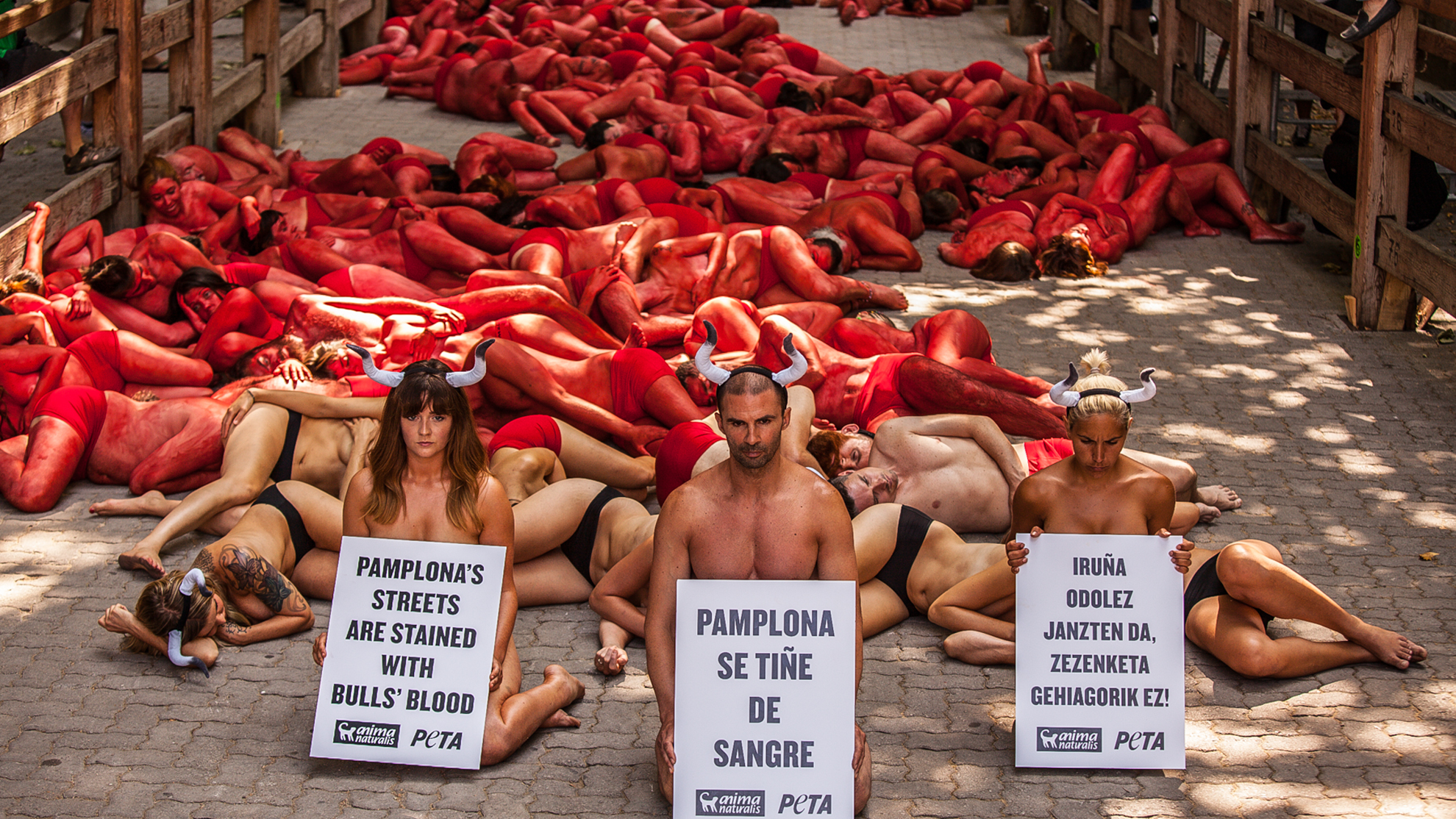
The Running of the Bulls festival is consistently preceded with creative protests by animal rights activists, and until about a decade ago, humans were even offered to forsake the running of the bulls festival and instead join the alternative Running of the Nudes festival.

Campaigns against this festival, as well as against bullfighting in general, are being held for decades now. Dozens of animal rights organizations campaigning for decades, thousands of demonstrations in front of Spanish embassies, tens of thousands of letters to Spanish governments, decades of a boycott on Spain by hundreds of thousands of people all over the world. But nothing helps.
Even the Catalan ban on bullfighting is small, regional, and was originally made for political reasons and not moral ones. And even that was repealed about nine years ago by Spain’s Constitutional Court who overturned the ban for being unconstitutional. The formal excuse is that bullfights are part of ‘Spanish cultural heritage’ and thus outlawing them can only be legislated by the central government.

In this world, things don’t change for moral reasons. The two things that did manage to call off the festival and bullfights are the Spanish civil war and the Covid19 pandemic. And still, they didn’t end these horrors permanently but just canceled them for one year. So to end it for good, along with the rest of the animal tortures, what is actually needed is something similar but with a much more profound effect.

Conformist Sacrificing

About a decade ago we wrote the following post about Eid al-Adha which began yesterday, and unfortunately it is as relevant today as ever.

Eid al-Adha – “the feast of sacrifice” which commemorates the tale of Abraham’s willingness to sacrifice his own son at god’s demand, as part of a twisted faith and loyalty test – began.
In reward to Abraham’s obedience, his son is spared, in exchange for a much more “suitable” and “natural” victim – a ram. This epic myth of the ultimate obedience and its, so called, happy ending is commemorated in all 3 monotheistic religions, and is still universally admired. Millions of animals, all around the world, would be slaughtered tomorrow in millions of Muslim houses and public squares.

Knowing such butchery happens daily all over the world, many activists give it no special attention. They see it as more of the same horribleness, disregarding the added spiritual and cultural element and its long term implications.
But the ritual is significant even if it doesn’t increase the number of victims in the short term (assuming more or less the same number of animals would have been slaughtered as part or separately from the ritual). And it is so from 3 main angles.

First is the dominance display exemplified in the ritual, which we have broadly discussed in two of our former posts (here and here) and in the article about the various rituals and festivals that include animal abuse all around the world, so we won’t elaborate about that angle again here.

Second is the significance of the overtness of the abuse, which not only legitimizes it but also preconditions young children into the same violence patterns, as they watch their own father forcefully grabbing animals, aggressively subduing them to the floor and cutting their throat while they struggle and convulse until they die. All in front of the children who can smell the blood, and the urine and sweat of fear, they can hear every scream and observe every spasm. That is the strongest and deepest objectification and speciesism lesson possible.

Even the ones who are innately more sensitive, when raised exposed to such brutal customs as normative, conducted by the head authority figure, and celebrated as part of a feast, learn to suppress their more developed intuitive sensitivity towards the victims at the face of this severe violence. They are much more likely to copy this brutal behavior and carry on the objectifying outlook, instead of recognizing how appalling this ritual is.

This relates to a much bigger issue which we’ll broadly refer to in the near future, probably as part of reviewing the civilization process theory of Norbert Elias and the changes in the standard of violence along history. Basically and rather plainly for now, it refers to a centuries long process in which violence was gradually taken out of humans’ sight, and as a result they became more sensitive towards it. The outcome is that when humans encounter a violent act, most of them feel deterred by it. Those who grew up with slaughter as a regular part of the scenery are less likely to be deterred, as opposed to those who never encountered animal slaughter and then face it at some point.

However as you all know, being deterred by an act is far from enough to shift humans from taking an active part in the same violent act they were just deterred by, and that’s directly connected to the third point of the significance of this sick ritual – conformism and obedience to authority as inherent elements of human’s character.

The glorification of this iconic tale, one of the founding stones in human civilization, sadly symbolizes human’s conformity and obedience. You encounter these features all the time, while you talk to humans about animal exploitation and they come up, again and again, with the same thoughtless, readymade, confirmative excuses, comfortably hiding – behind what the majority does and approves, behind the tradition of what was done for centuries, behind authoritative figures such as their parents, doctors and nutritionists, religious figures, secular leaders and trend setters. Most humans go along hardly bothered, as unconsciously and automatically the answers were already provided to them by others. Not surprisingly, it’s the same answer that allows them to keep their own convenient habits, and spares them of the fear of change.

Not accidentally, the figure of Abraham and the story of the sacrifice have rose to become such iconic elements in the 3 big monotheistic religions and even within non-religion cultural areas.
According to the tale, Abraham is considered to be the first monotheist in human history and monotheism is considered a key-stone in human culture development.
Not accidentally, Abraham, who is the ultimate embodiment of obedience, accepting god’s command without questions and hesitations, became such an ultimate icon of human culture.

Abraham’s readiness to sacrifice his son can set as a microcosm for many human culture characteristics. As we wrote regarding Eid al-Adha in the article Celebrating Suffering 
Religion was created in humans own image and innately so are the myths, the founding stories and the role models. Ibrahim, the undoubtable ultimate believer (Søren Kierkegaard’s Knight of faith) of the Islam which is discussed here but also in Christianity and Judaism, is indeed characteristic of the human race and its cultural milestones. Ibrahim expresses his complete and total submission to Allah by the willingness to kill his son. No questions, no speculations and no hesitations. Following orders is the ideal of being faithful in human culture. But of course infanticide, certainly of your own descendants, cannot be such a fundamental element of humanity and of the exhibition of one’s faithfulness, clearly only a few would pass such a loyalty test. But murdering animals? Everyone passes.

Ibrahim is not supposed to doubt the supposed command from god, and Ishmael is not supposed to doubt his father’s actions no matter how crucial the consequence is for him. Hagar’s (Ishmael’s mother) voice is not even mentioned, not to mention counts for anything and far down the line there is a ram who his whole life’s purpose is to serve humans and is expected to feel very proud that he was chosen to be slaughtered instead of Ishmael.
And so should the hundreds of millions of animals who their throats are publicly cut and they bleed to death for the longest minutes in their poor lives as humans’ meat and rituals vessels.

Although Abraham’s behavior (according to the tale) was rather unique even back then, about 4,000 years ago, the thought of killing and sacrificing your own son is nowadays obviously considered much more appalling and absurd. If someone would do something similar today he wouldn’t become a faith icon but a hate one. However what was the logical, natural and self-evident solution back then, murdering an animal instead, still works nowadays. In that sense nothing was changed. Every year since the ritual started millions of animals are sacrificed for it.

If you feel that despite the glorification and iconic symbolism of the story, for such a long time and among the 3 big monotheistic religions, it is merely a folkloristic tale and not really an indication of modern human culture, think of the famous experiments on obedience to authority conducted by the social psychologist Stanley Milgram.
Milgram’s study, with its notoriously frightening results, is somewhat of a modern, controlled condition, reenactment of the Abrahamic tale. Most of the participants of the experiment personally pressed a button which supposedly gave an electric shock to another person in another room, despite hearing him beg for the experiment to stop and crying in pain, “just” because an authoritative looking figure (a person in a white coat not god himself) told them to.

It appears that before he ran the experiment, Milgram polled his colleagues, students, and a sample of psychiatrists on how far they thought the participants would go when an experimenter instructed them to shock a fellow participant. The respondents unanimously predicted that few would exceed 150 volts (the level at which the victim demands to be freed), that just 4 percent would go up to 300 volts (the setting that bore the warning “Danger: Severe Shock”), and that only a handful of psychopaths would go all the way to the highest shock the machine could deliver (the setting labeled “450 Volts—XXX”). However 65% of the participants went all the way to the maximum shock, long past the point when the victim’s agonized protests had turned to an eerie silence. The percentage barely budged with the sex, age, or occupation of the participants. And they might have kept on shocking the presumably comatose subject (or his corpse) had the experimenter not brought the proceedings to a halt.

And for those who think that even Milgram modern experiments don’t reflect our current era, in 2008 another social psychologist replicated the test. 70% of the participants went all the way to brutalize a stranger and got to the fatal levels. The remake of Milgram’s experiment asked whether humans in the 2000’s still follow the orders of an authority to inflict pain on a stranger? The answer is that they do.

So what are the odds that humans would stop “pressing the button” when they don’t hear the screams? When they don’t see the victims? When they personally and directly enjoy the violence outcome? When they don’t personally inflict the violence but still enjoy its outcome? And worst, when it is not even considered violence to begin with but “a perfectly natural and legitimate” way of feeding themselves?

The Paris Exception

Last Friday the Paris agreement on climate change was officially signed in a ceremonial event at the UN headquarters in New York, after being formulated and agreed upon on December 2015.
Expectedly, the triumphant language declaring a historic moment blatantly overlooked various major flaws in it. The Paris convention is far less exceptional, and more of another dot in the same line of failures in the way humanity confronts its greatest challenge ever.

Getting into its details reveals the extent of the oversights, compromises and distortions to the point of data deceptions and modeling manipulations that were required to finally achieve an agreement, after decades of failures to reach one.

International conventions about climate change have been held for 25 years, and up until now the world has failed to finalize them with an agreement. During this period of failures, the emissions of CO2 are estimated to have risen by 60%.

With that legacy of failures in mind, and especially with the disappointment of Copenhagen, the ultimate goal in Paris was to reach an agreement which all of the world’s nation can sign. The signing itself became more significant than the content singed upon, as we’ll explain along this post.

However, in spite of all our arguments (further in the text), we do believe that this development should be taken as a wakeup call for activists who count on the human race destructiveness to finally turn against itself.

Shamefully, Only Voluntarily

The Paris Agreement is actually little more than a statement of intent, as any aspect of actual significance was set as non-legally binding.
The document does not contain any binding obligations with regards to GHG (greenhouse gasses) emissions reduction or financing activities that will reduce them and deal with their consequences.

Instead, countries get to set their own voluntary reduction targets called “Intended Nationally Determined Contribution” (INDCs). And even after they get to set how far they are willing to go, implementing their commitments is not a legal obligation.
In other words, not only that each country gets to decide what it’s going to do regarding climate change, each country gets to decide whether to do what it decided it should do. None of the countries, no matter their current level of emissions or their historical contribution to climate change, are legally bound even to their own proclamations.

The only thing countries are obligated to do is to submit an “Intended National Determined Contribution”, and present a report on their progress every 5 years.

All the agreement does is establish a legally binding obligation to declare volunteering, but not obligations for results.

And finally in terms of the legal context, a party is free to withdraw from the agreement at any time after three years from the agreement’s entry into force.

Shamefully, Only Shaming

Instead of binding commitments to ensure the implementation of the national contributions, the Paris agreement relies on the instruments of ‘naming and shaming’.

Part of the idea behind this ineffectual mechanism is the claim that so far the legal sanctions path led nowhere, as was infamously showcased in the Kyoto protocol. The obvious thing such a claim misses is that the track record of non-legal voluntary action was no better. Generally, the 70-year history of multilateral UN agreements suggests that countries will avoid their commitments whenever they can.
Surely, all it takes is the excuse of economic or security crises to justify any non-action, especially if the “threat” is only diplomatic shaming.
But obviously the main and unequivocal reason is that many countries refuse to sign a climate agreement that involves sanctions.

Unclear Transparency

For the sake of shaming, and without any other penalties for countries’ inaction, the agreement is left to make do with a system of transparency. That’s why submitting reports is one of the only legally binding clause in the agreement. The term transparency is mentioned and emphasized over and over, exactly because it is the only regulative mechanism in the agreement.

The transparency framework is celebrated as a top achievement of the agreement. What the rhetoric fails to mention is that the establishment of this key mechanism was left for a future date. That goes to show how the main goal of the talks was to reach an agreement everyone can sign, on the expense of actual meaningful content. Going for the lowest common denominator, and omitting or delaying complications for later is the oldest trick in the diplomacy book.

 In the same spirit, the little that was agreed upon in the final text describes the mandate of the future transparency framework as “non-intrusive”, “non-punitive” and “respectful of national sovereignty”. Countries are trusted to report on their progress, with no external independent review.

Moreover, the tracking of implementation takes place in 5 years intervals, which might not be a long time in climatic perspective, but very long in political perspective. A lot of excuses can pile up in 5 years.

While some countries agree to meet and evaluate the progress in 2018, the first mandatory evaluation under the agreement happens only in 2023.

 The essential role of transparency goes further than a form of “deterrence”, it is the key for information about the overall global state. The fact that one if not the most important element of the agreement wasn’t formed yet, speaks volumes on the agreement.

Unachievable Goal

The main goal of the Paris agreement is staying well below 2 °C increase in the average global temperature since pre-industrial levels by the end of the century, and even aiming for 1.5 °C.
However, even if the National Contributions of all countries are fully implemented, the goal of the convention would not be achieved. Added together, all the contributions still fall far short of “well below 2 °C”, not to mention 1.5 °C.

The UN body that deals with climate change, the UNFCCC, published an evaluation of these contributions and found that even if all pledges are fully implemented, still global warming would be between 2.7 °C and 3 °C. Other evaluating bodies claim 3.5 °C and above.
An acknowledgement of this shortfall is even written in the agreement which “notes with concern” that the contributions “do not fall within least-cost 2 °C scenarios”.

The convention claims it will achieve its goal since it relies on the assumption that the future contributions (which countries are obligated to submit every 5 years) will include stronger voluntary commitments.

Not only that, but it claims to achieve a major goal in 2016, regarding 2100, despite that its timeframe ends at 2030. They don’t let the 70 years gap between the end of the agreement’s mandate and the target year for its goal to stand between them and “an historic declaration”.

Mockingly Unachievable Goal

One of the most ridiculous gaps between the high rhetoric and actual commitments is the declaration of “pursuing efforts to limit the temperature increase to 1.5 °C above pre-industrial levels”.

2 °C seems completely beyond reach considering the analysis of policies as stated above, but as for 1.5 °C it is just not an option. For the 1.5 °C limit, the carbon budget (that is the amount of CO2 that can be emitted and still allow to stay within the temperature limit) is 400 GtCO2 starting from 2011. Even before the first mandatory evaluation (global stocktake) which will take place in 2023, the emissions will already exceed that amount. From 2011 to 2014 the emissions were 140GtCO2, and even if we’ll assume no rise in emissions from 2014 onwards, with emissions of 35.5 GtCO2 per year, that budget is going to be used by 2022.

Back to the Future

The claim to reach well below 2 °C is made possible by relying on the not yet existing option of “negative CO2 emissions” by using future technologies that can take carbon out of the atmosphere. It most commonly means vast crops planting to absorb carbon and then harvesting them for energy use, combined with carbon capture and storage technologies that bury it deep in geological strata.

Originally it was thought of as a last resort, but in the Paris agreement negative emissions were promoted to a central pivot of the main plan of action. Mass scale deployment of carbon capture and storage sometime during the latter half of the century was assumed in the framing of the 2 °C and1.5 °C goals.

In the scenario database of the IPCC (the Intergovernmental Panel on Climate Change, the UN scientific research body which informed the negotiations), out of the 113 scenarios with a “likely” chance (that’s 66% or better) of 2 °C, 107 (95% of the scenarios) assumed the successful large-scale uptake of negative emission technologies.

The reliance on these yet non-existing technologies also plays a prominent part in many of the countries’ national contributions.

Unsurprisingly, these premised technologies have been embraced by policy makers. They allow maintaining business as usual, while claiming to do meaningful action. They were simply added to the equations, and then the on-going fossil fuel use seems less dangerous. It is knowingly worsening the problem today, leaving someone in the future to sort it out and find the magic bullet.

Back to the Past

Other than the use of non-existing technologies in the future, the scenarios (the convention uses) also rely on ‘going back in time’, reducing the emissions of the past. That is since one set of scenarios that demonstrate a possibility to limit the temperature to below 2 °C puts 2010 as a peak year for emissions and starting to reduce them from that year on. In other words, for that scenario to be relevant, reduction in the emissions should have started 6 years ago.

And as for limiting the temperature increase to 1.5 °C, there is a need for both non existing technologies and for going back in time. In the IPCC’s words: “Without exception, all 1.5 °C scenarios available in the literature reach net negative CO2 emissions by mid-century, even with stringent mitigation action having started in 2010.

Someone Else’s Problem

Another reason why it was relatively easy for the politicians to sign is that the core of the agreement is not obligations put on them in the present, but obligations on someone else in the future.
How typical, politicians signed that someone else should take more responsibility in the future than they should now.

Prominent in Their Absence

Unsurprisingly the ones who are always absent from humans’ discussions over the planet, are the rest of the species living on it. That is despite that even according to the minimal estimations, greenhouse gases produced by industrially exploited animals represent 14.5% of all anthropogenic greenhouse gasses emissions. The famous 2006 UN report Livestock’s Long Shadow estimated it as 18% of global greenhouse gases, and WorldWatch institute place the figures at around 51%.

Last month, Oxford University researchers projected that by 2050, food-related greenhouse gas emissions could account for half of the emissions the world “can afford” if global warming is to be limited to less than 2°C. Adopting a vegan diet would cut these emissions by 70%.

A Similar 2014 research from the U.K found that vegetarian and vegan diets had 32% and 49% lower greenhouse gas emissions, respectively, than medium-meat diets. Compared to high-meat diets, the difference was even higher, with vegan diets emitting 60% less greenhouse gasses.

However, expectedly, the agreement doesn’t mention any of it nor does it recommend even a gradual global shift towards a plant-based diet. Animals were totally absent from the table of discourse and appeared only on the dinner table as courses.

Flown and Shipped Away

If global aviation and shipping were a country, they would rank among the world’s top 10 emitters. In addition, they have grown twice as fast as the general emissions in recent years, and are expected to further increase by about 300% until 2050. However, the Paris Agreement and the related decisions do not mention aviation and marine transport emissions even once.

Unlike a climate agreement, international trade agreements, present and future ones (TPP and TTIP which are currently formulated), are legally binding, reminding us what really takes precedence.

Developed Irresponsibility

Developed economies, with only a fraction of the global human population, use about half of global resources and continue to cause the bulk of environmental degradation, overwhelmingly impacting the rest of the world and particularly the poor and vulnerable populations living in Asia, South America and especially Africa who accounts for less than 4% of the greenhouse gas emissions yet according to estimations will, as early as 2020, face an even worse water shortage caused by climate change.

So after centuries of global plunder and being utterly the main contributors to climate change, the industrialized countries were asked by the developing countries, to take full responsibility for their share of the issue, meaning that at least their part would be legally binding commitments without any conditions attached, while mitigation contributions by developing countries would be voluntary and conditional on the provision of financial support by the industrialized countries.

However, the agreement does not make developed countries’ contributions legally binding as the developing countries requested, nor does it bind the developed countries with the provision of support the developing countries as they demanded. It only recognizes “the need to support developing country Parties for the effective implementation of this Agreement.”

Show Me the Money

Disgraceful as much as it was predictable, the finance part of the Paris Agreement is non-legally binding. The agreement calls for rich countries to help in providing poorer countries with the finance needed both to adapt to climate change and mitigate emission, but all financing is voluntary.

An annual sum of 100 billion dollars has been promised, starting from 2020. While it may sound impressing at first glance, the amount must be placed in the correct context:
100 billion is a tiny fraction in relation to the developed countries’ collective annual budget, and a tiny fraction of the profits of their polluting corporations. These sums are in their trillions, and obviously were made while releasing the vast portion of CO2 already in the atmosphere.

100 billion is a tiny fraction compared to the support corporations receive in the form of the subsidies. Considering the fossil fuel industries alone, the IMF estimated their global subsidy (direct and indirect) at about 5.3 trillion dollars in 2015.

100 billion is a tiny fraction in relation to the historic and present day profits developed countries make of plundering the vulnerable parts of the world, making them even more disadvantaged and lack the ability to make investments to protect themselves.

100 billion is a tiny fraction compared to the sums the global south countries require. For example, India estimates that at least US$2.5 trillion are required as a total cost for its intended contributions, while Morocco’s INDC require about US$45 billion of investment, and Ethiopia’s INDC requires expenditure which exceeds US$150 billion.

Lastly, it’s the rich players who are calling the shots. No agreement has been reached on what constitutes “climate money”, how it should be counted, when or to whom it should be delivered, or to what it should be directed. And to top it all, there is no independent system reviewing the process. So far it has essentially been the contributor countries unilaterally deciding what they think should count.

Though the disadvantaged countries demanded during the Paris negotiations that the industrialized countries should provide a clear roadmap for how they intend to meet the 100 billion pledge, one was never drawn.

Another demand was that the financing should come solely from the public purse of developed nations, rather than from the private sector or other sources. The developed countries resisted and wanted private sector money to fulfill a large part of the pledge. Of course, they got their way.
Since rich players are not obligated to the ways and methods of payments, they can use it as funds which are more of an investment than contribution, expecting to gain profits in the future.

Another trick is double-counting of money- taking already existing development assistance or aid flows and then rebranding it as “climate” money, thus getting double the credit.

Since the 100 billion pledge was largely already agreed upon in the 2009 Copenhagen climate talks, there’s a 6 year track record to view. A 2015 OECD report quantifying the progress was published in the run-up towards Paris, and it so far indicates that the suspicions are justified, it included double-counting of money, market-rate loans and export credits that benefit actors in rich countries. So there is no reason to expect anything different from the Paris agreement.

Show Me the Business Opportunity? 

The comfy resolution that the private sector will recruit businesses to solve the climate crisis (and cash profits along the way), was an integral element through the entire Paris conference (same as it was during all the preceding ones).

The total price tag of the conference was estimated at approximately $190 million. Since neither the UN nor the French government could have come close to raising such a sum, the event was financed by corporate sponsorship, which included some of the world’s worst industrial polluters (automobile and aviation companies, energy giants, and international banks financing the dirtiest fossil fuels use).

One example of the means pushed for is the carbon offsetting market, which has a history of failing to cut emissions while enriching polluters. It gives corporations the green light to continue polluting, while they pay for dodgy offsets which are highly serviceable for industry lobbying and are prone to accounting tricks, and are deemed environmentally insufficient, causing more harm along the way (planting monoculture “forests” for example).

The prominent presence of the privet sector was both during the Paris conference itself and in the formation of countries’ “Intended National Determined Contribution” (different business groups actually boasted about taking part in the consultations when governments were writing their emissions reduction plans), which is another sign of policy makers lack of commitment.

The market-solutions the corporations offer, fit governments which must appear to be doing something, while more effective policies such as renewable energy (which are low on carbon, but still harm the environment of many non-human individuals in various other ways) or national energy efficiency programs, are found less appealing, as they are much too costly.

Despite All of the Above

The Paris agreement isn’t really different than the former ones. It mainly proves how easy it is for politics to overtake science, equality, fairness and historical justice (within the human race only of course), and how the self-congratulatory talk is detached from reality. Bottom line, the achievement is mainly due to having strived low enough to finally reach an agreement.

The entire process is typically human in its indifference. Apart from being an empty declaration with no plan how to reach it, the celebrated 2 °C rise condemns to suffering an innumerable number of sentient beings. Hundreds of billions are trampled in the name of the sacred goal of keeping corporate profits, and allowing mainly the richer humans to maintain their luxurious lifestyle.
In its humanlike brutal selfishness that is all too familiar to any animal liberation activist, this agreement is in itself another illustration why the moral stand should be aiming for an un-inhabitable planet.

It should be noted however, that despite that the Paris agreement is feeble, and that even if all the declarations and promises are implemented, the declared goal wouldn’t be achieved, the Paris agreement is nevertheless a sign of change in awareness. Based on this agreement, humanity has not yet woke up, but it seems that more than in any of the past conventions, it is on its way to. The extent of the media cover of the Paris agreement indicates that this convention is different at least in terms of consciousness, and the signing might change the dynamics around the issue in a way that might push it forward.

If a mitigation of climate change would truly take place in the following few decades, it means that the animal liberation activists who naively rely on “the human problem will fix itself by itself” must step up.
If so far you have laid your hopes on humanity’s selfishness, narrow mindedness and nearsightedness to destroy itself, then this agreement, which as mentioned is not yet an evidence of a dramatic change but is a first serious step in the world’s awakening, should wake you up.

Obviously, in no scenario should activists wait for the desirable outcome to come of its own. We all must act to turn this planet to be suffering-free.