Scratching Boundaries

Our last post addressed Netflix’s documentary film Seaspiracy, a film that made a lot of fuss. The following post also addresses a recent Netflix environmental documentary film, but in its case, there was no fuss, and exactly for the same reasons that Seaspiracy did make many people angry. As opposed to Seaspiracy who “dared” to demanded people to take seriously the issue at the center of the film and simply stop eating fishes, Breaking Boundaries didn’t make people angry, because it doesn’t make any equivalent demands such as asking people to stop consuming animals, despite that such a film most certainly should have.

Basically, the film follows the scientist Johan Rockstrom who developed and studies the concept of Planetary Boundaries. These are earth systems and features which are essential for the planet’s functioning. There are nine planetary boundaries according Rockstrom and they are: Climate change, Biodiversity, Ocean Acidification, The Ozone Layer, Air Pollution, The Nitrogen and Phosphorus cycles, Freshwater, Land-system changes, and Novel Entities (human-made pollutants).
Except for the ozone layer depletion, which only indirectly relates to animal based food, all the rest are directly and heavily affected by animal industrial exploitation. And yet, animal based food plays an extremely marginal part in the film. So tiny, it can barely be noticed, partly because the word veganism (or even vegetarianism) isn’t even mentioned. Instead the viewers are advised to choose ‘healthy food’. Hopefully, the filmmakers at least had veganism in mind when they recommended healthy food. But unfortunately it wasn’t explicitly recommended.

What is suggested as a very effective way to draw down the carbon that is already overheating the planet is that people would plant trees.
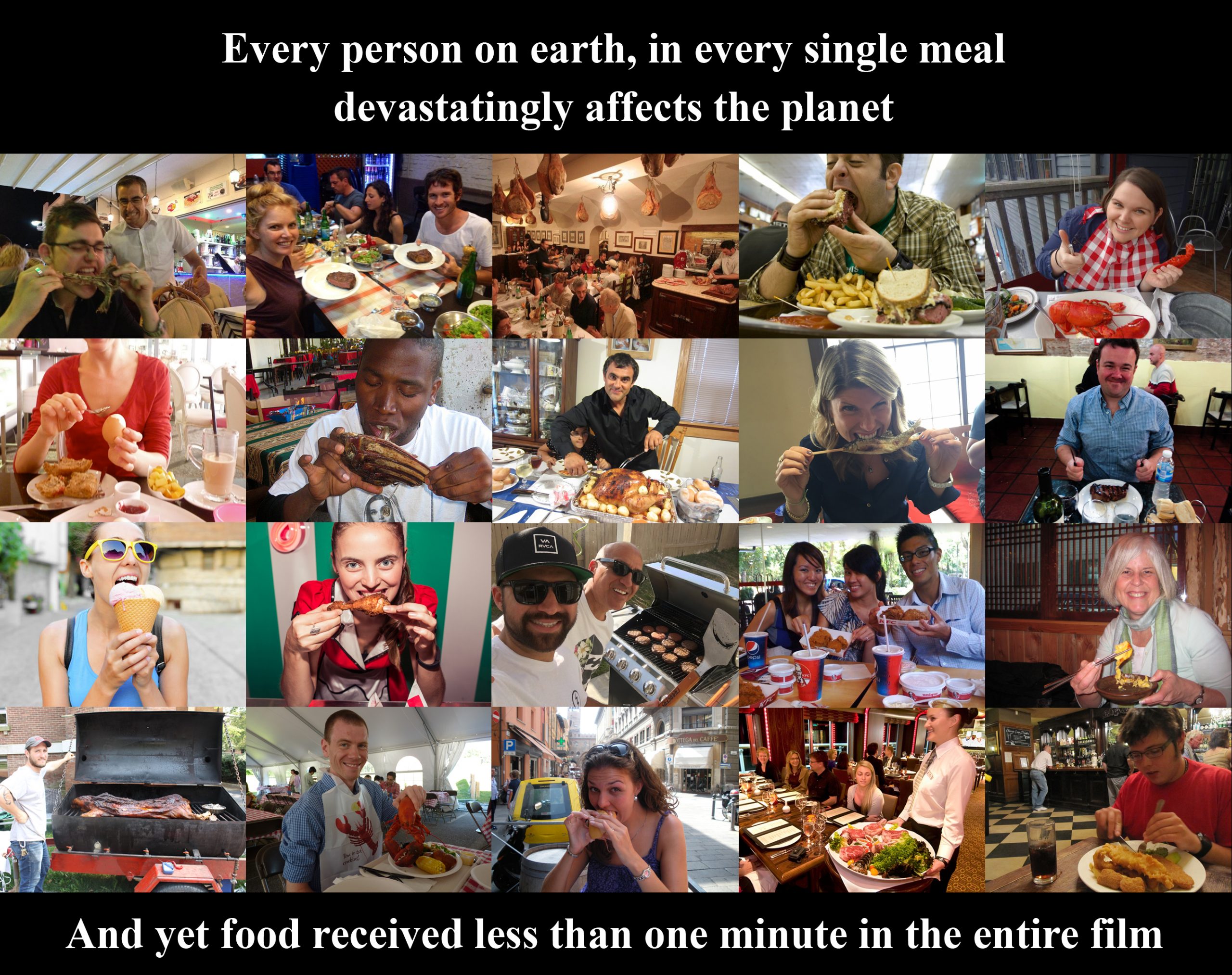
Every person on earth, in every single meal, devastatingly affects the planet, and yet they are all offered to plant trees.

The issue of food received exactly 55 seconds in the film.
And that’s the entire reference:

“There’s another transformation that is almost unbelievably simple, but it’s key to staying within our planet’s boundaries. It can be adopted by you or me. In fact, by anyone with the freedom to choose what food they eat.

Now, the exciting thing is the diet that is more flexitarian, less red meat, more plant-based protein, more fruit and nuts, less starchy foods, if you take that diet and assume that all people would eat healthy food, we could actually come back within a safe operating space, not only on climate, but also on biodiversity, on land, on water, on nitrogen and phosphorus.

Quite exciting that eating healthy food might be the single most important way of contributing to save the planet.” (01:04:47-01:05:41)

Less than one minute for one of the two most important things that a single person can do. And even that minute, cowardly suggested ‘healthy food’ instead of simply and plainly saying – you should all go vegan now!
The other thing is breeding. And that issue gets exactly zero seconds in the film.

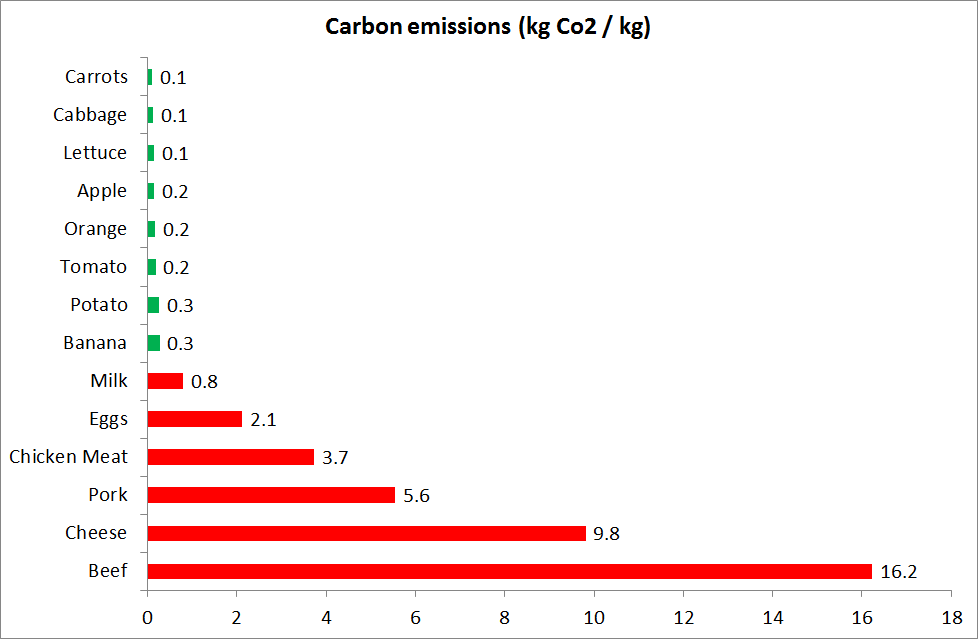
Since we have addressed the tremendous impact of the animal based food industry on climate change in past texts, most notably here, and since this fact is already well known to every animal activist, we will not repeat it here. The animal based food industry without a doubt plays probably the biggest part in climate change. Even if some keep insisting that it is “only” the second largest contributor, it still surely doesn’t receive even a remotely proportional attention.

Breaking Boundaries may have made some laypeople who are not activists worried, but it should make activists very very angry.

Breaking Environmentalists Boundaries

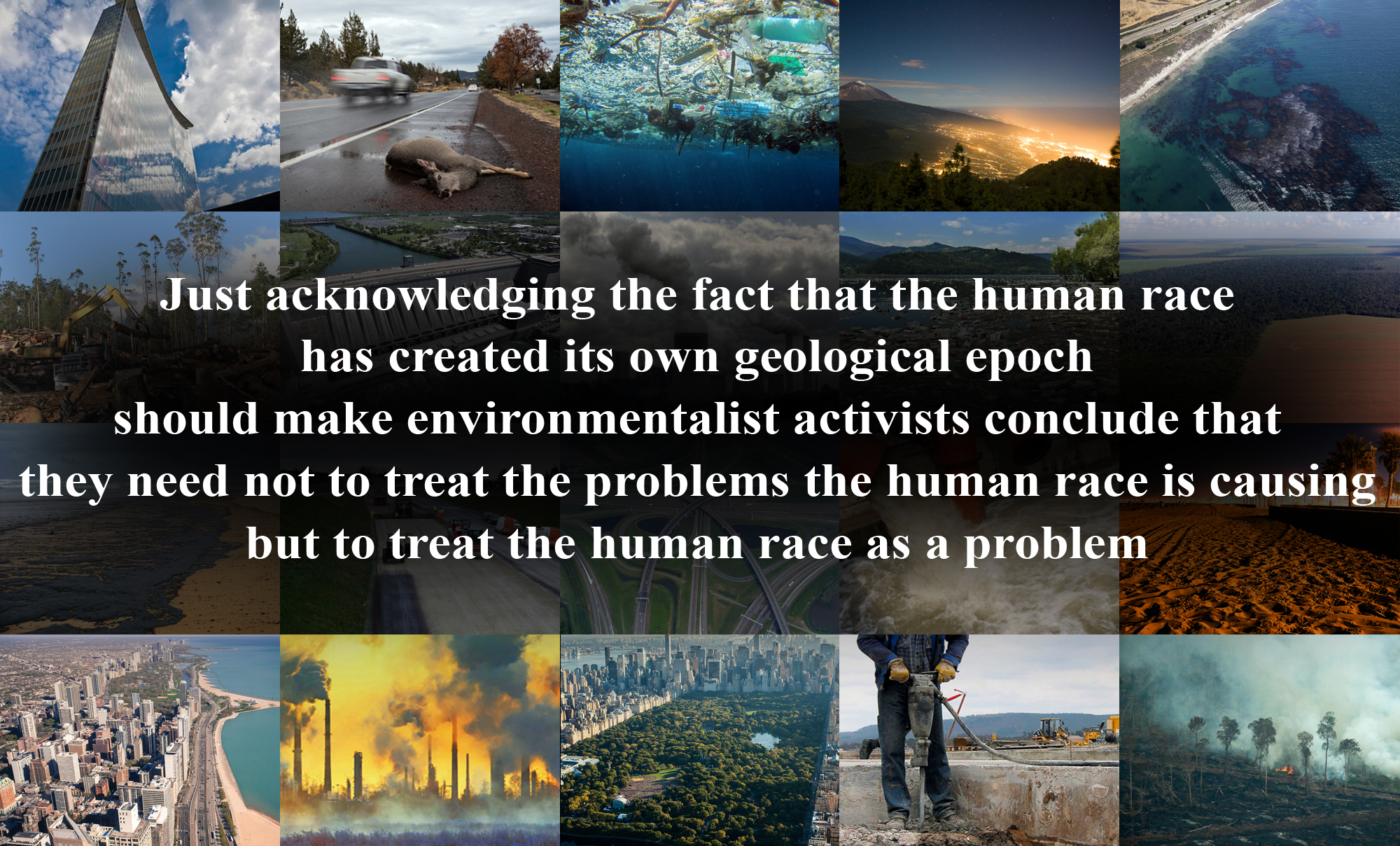
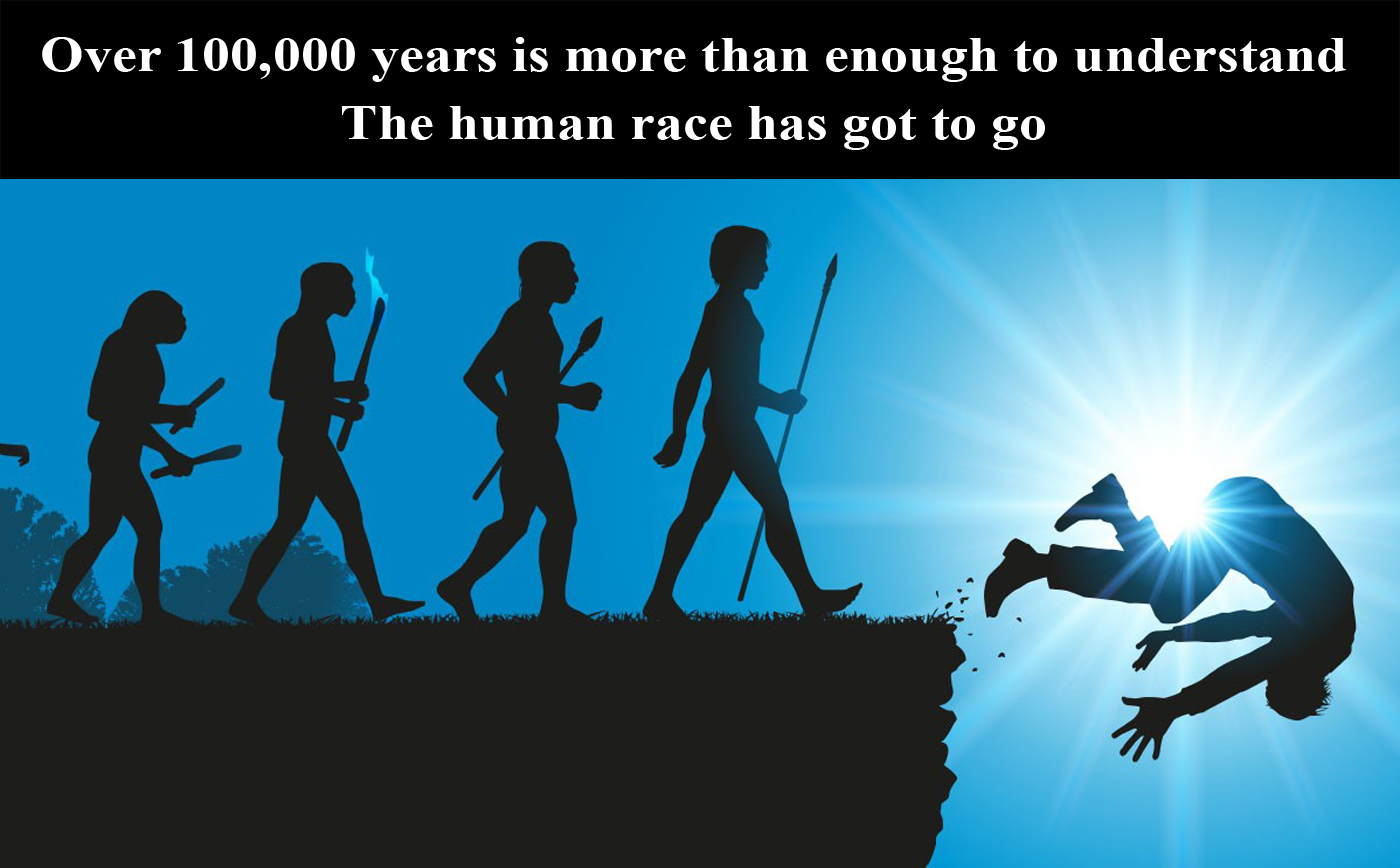
Animal rights activists are unfortunately already used to the animal based food industry being pushed aside, or barely mentioned (like in the case of Breaking Boundaries) in environmental films. But in this particular film, so many facts, details, perspectives, detections, pieces of information, informational linkages and etc., should have led environmentalist activists especially, to one unequivocal conclusion – the human race has got to go. And still they don’t.

Here are some examples (taken from the film in chronological order):

You could think of yourself driving in a mountainous area with the road circling up the mountain. An overpowered engine driving much, much too fast, driving without any headlights. Cliffs that you’re at risk of falling over. You want, of course, to turn on the headlights, and that is what science tries to do all the time. To give us the headlights so we can see what risks we’re facing. (00:00:32)

This metaphor, made by Rockstrom at the beginning of the film, is problematic. The problems in the world are not that it is dark and so needs some headlights, but that it is darkened deliberately and intentionally. It is wrong to describe humanity as if it drives in the dark and as if it supposedly waited for someone to turn on the headlights, since these are turned on for decades now, only that the vast majority of humans keep turning them off. Some purposely, and most simply indifferently.
There is a headlight the size of the sun that unambiguously illuminates the origin of the problem. Only that almost no one, including scientists, wish to observe it. The origin of the problem is not climate change, or any other of the nine boundaries, but whom who insist on breaking them, and no matter the price they themselves are paying for it, not to mention the rest of the sentient beings on this planet.

Recent discoveries made by scientists studying the ways in which our planet works are surely of the greatest importance for all of us. Their insights are deeply troubling. Nonetheless, they also give us hope, because they show us how we can fix things. (00:00:47)

That is true provided that scientists would at some point be listened to, and that the most relevant and efficient recommendations (veganism and not to breed) would be suggested. Currently neither is happening. Many humans are still doubting scientists, and not the good healthy kind of skepticism but one with no foundation whatsoever. And scientists are offering recommendations according to what they think humans are more likely to do, and not according to what surly must be done.

An example illustrating this approach is the following statement:

This is not about the planet. This is about us. It is about our future. (00:01:43)

This anthropocentric and speciesist claim is probably a reflection of the notion that humans would relate to the issue more if they are told that it is about them. But it is not about them. It is first and foremost about what they have done to others. Humans should highly relate to this issue because they are responsible for it, not because they might be harmed by it as well.

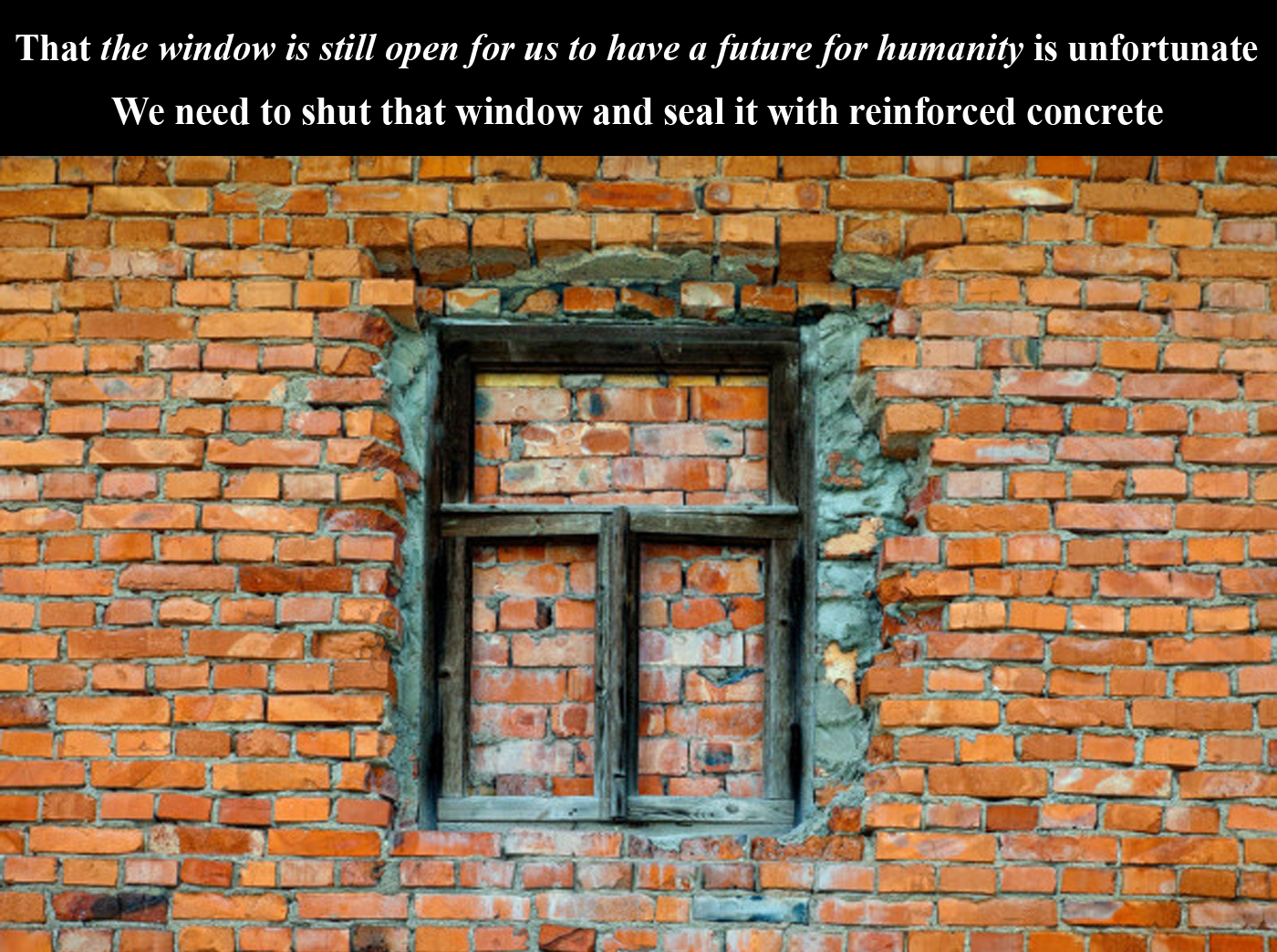
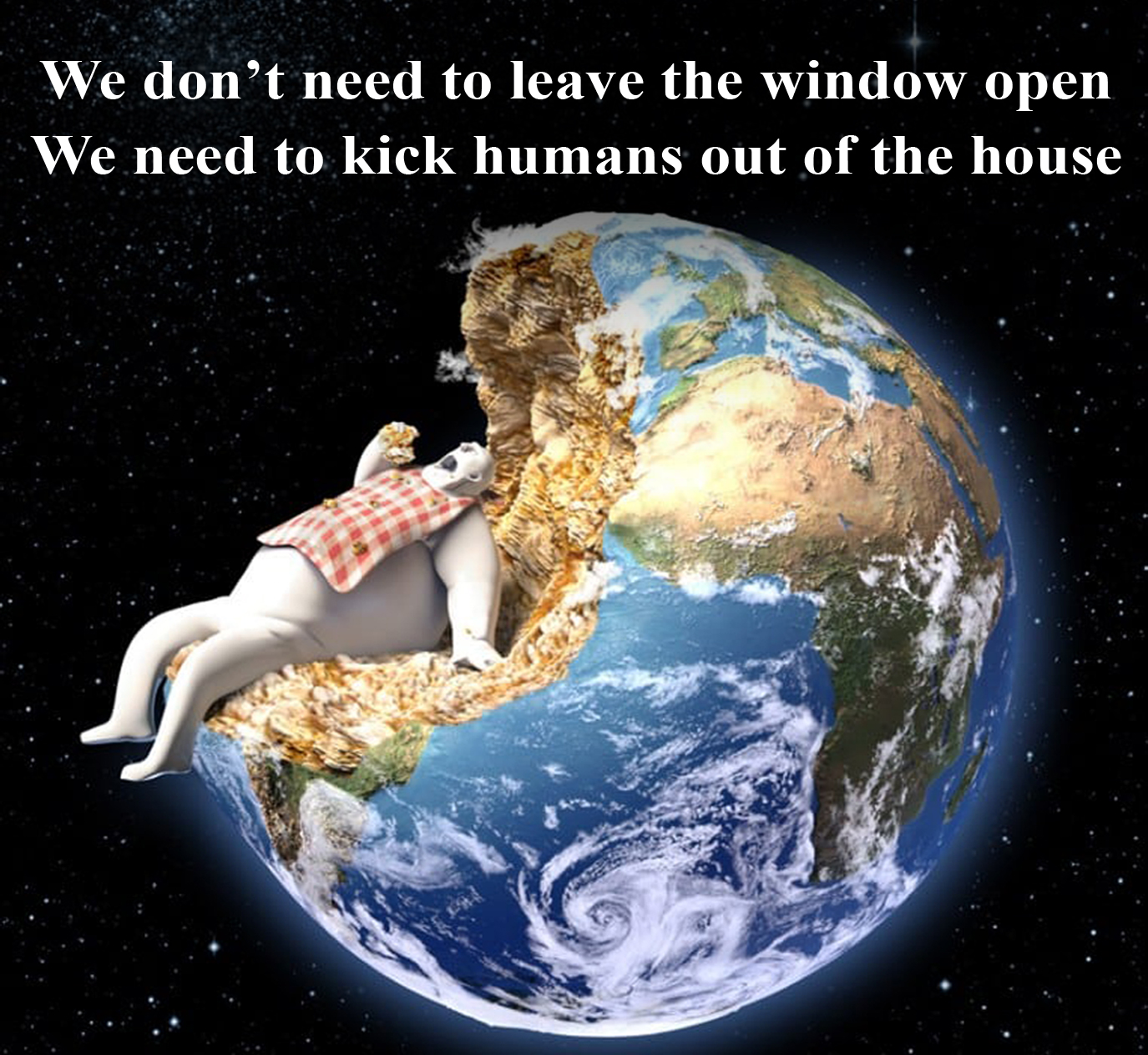
We still have a chance. The window is still open for us to have a future for humanity. That I think is the beauty of where we are today. (00:01:54)

It may seem to some of you a little bit nitpicky, yet to say about where we are today that there is a beauty in it, is deeply detached. There is no beauty in where we are now. Or ever been. Even if the terminology about still having a chance was true, that is not beauty. It wouldn’t even be fixing anything, but at most just stop breaking more and more.

Our understanding of how our planet works is always advancing. We can now see more clearly than ever how life’s intricate complexity is essential for our own survival. (00:02:10)

Yet all the advancing in understanding of how this planet works didn’t help humans reach the inevitable conclusion. Humans still don’t see clearly that the source of the problem is whom who have created all these atrocities in the first place and that should have long ago lost its right to be here. To keep insisting on saving the human race is to see things as unclearly as possible. Why must everyone suffer for it to keep existing?

The exponential rise in human pressures on planet Earth has now reached a stage where we have now created our own geological epoch.
Scientists recently declared that the Holocene has ended and that we are now in the Anthropocene, the age of humans, because we now are the primary drivers of change on planet Earth.
(00:05:22)

How much more exponential rise in human pressures on planet Earth is needed for them to understand?

I would say that perhaps the most dire message to humanity is the following: So we have, in just 50 years, managed to push ourselves outside of a state that we’ve been in for the past 10,000 years. Are we at risk of destabilizing the whole planet? It’s just a mind-boggling situation to be in. For the first time, we have to seriously consider the risk of destabilizing the entire planet. (00:06:14)

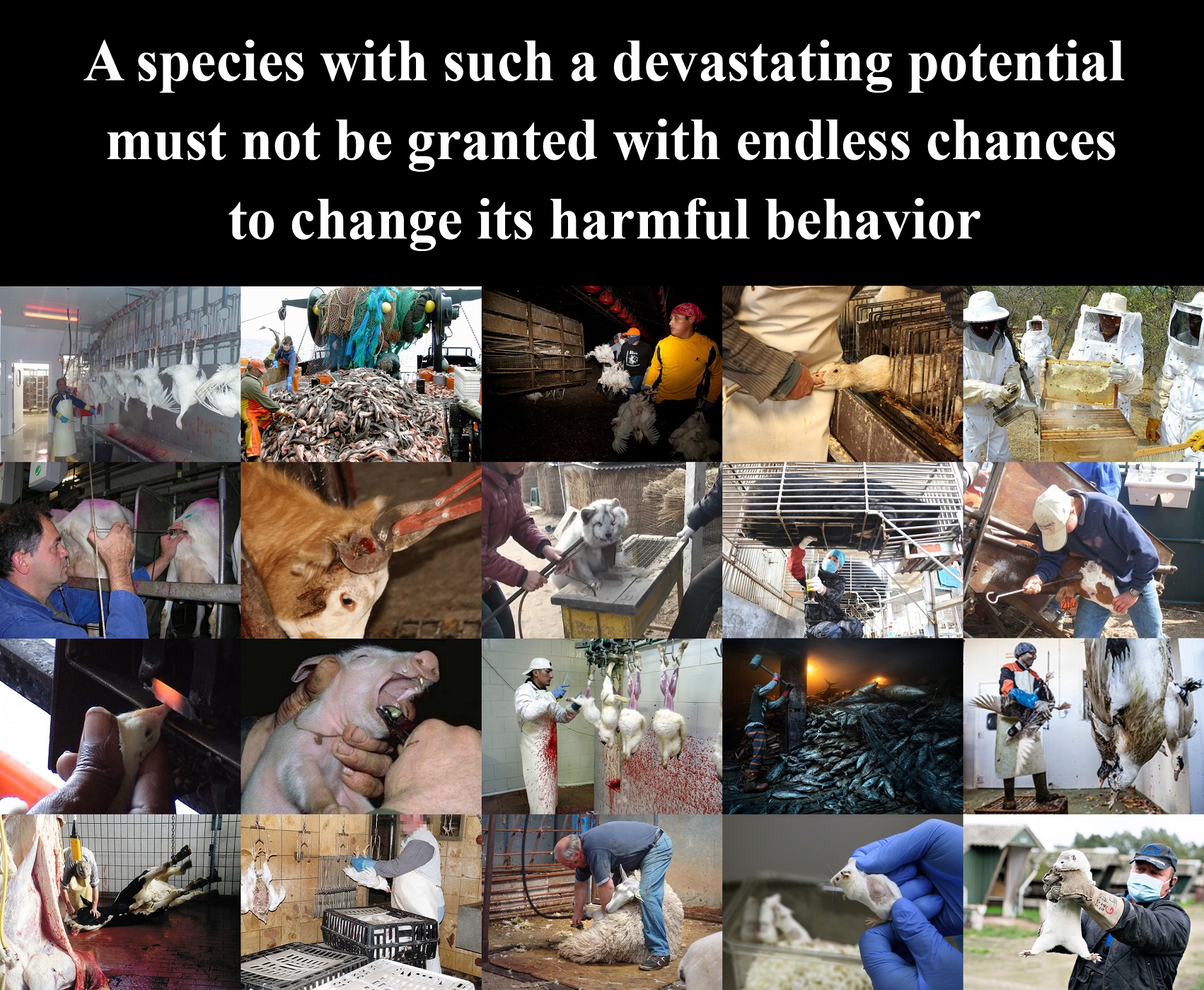
This statement is supposed to make humans, or at least environmentalist activists, realize that the human race shouldn’t be saved. A species with such a devastating potential must not be granted with endless chances to change its harmful behavior.
There is no species that could even come near the level of harm caused by the human race.

With global temperatures now warmer than they’ve been since the dawn of civilization, there is a danger that we have already crossed the boundary in Earth’s climate. (00:08:23)

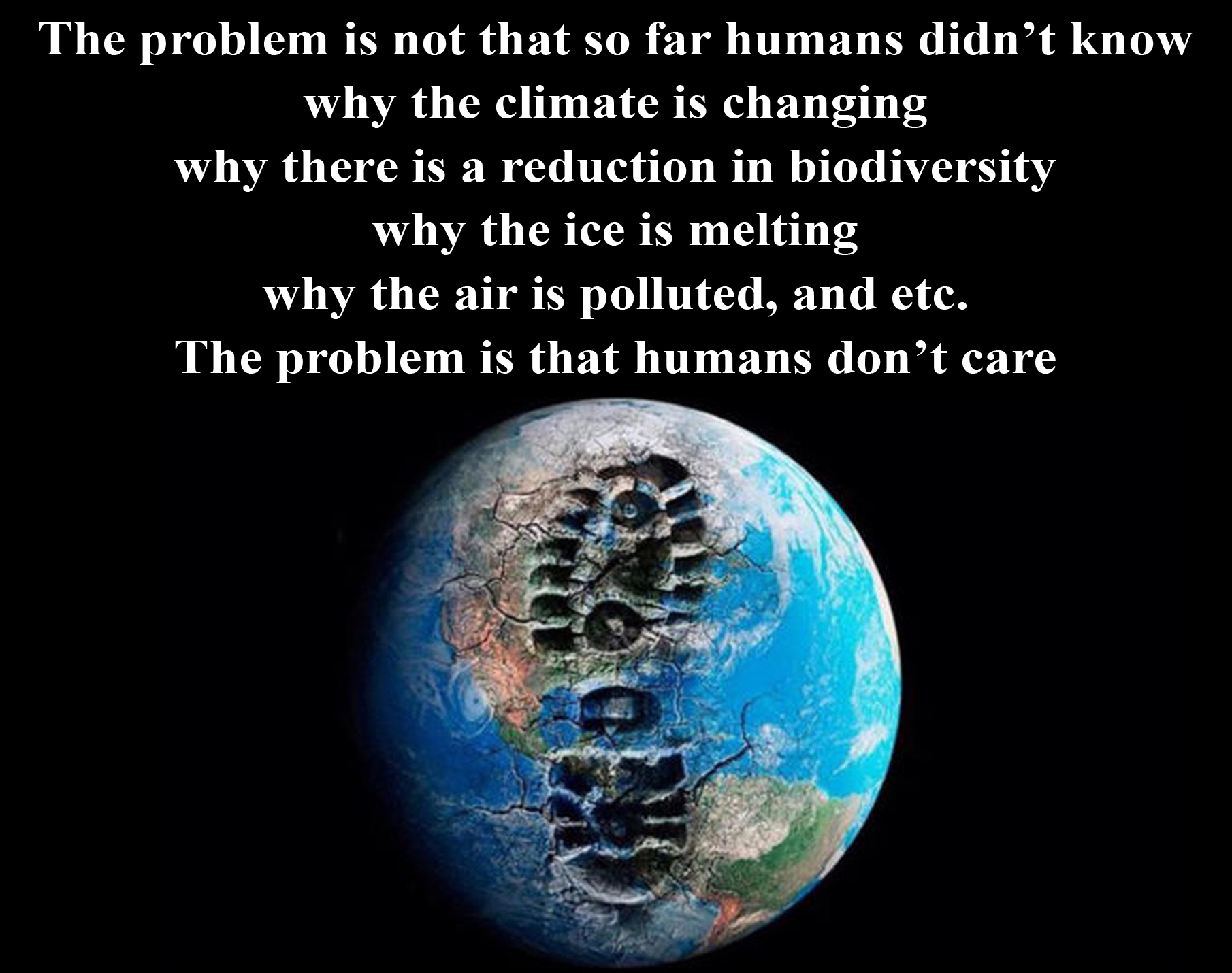
And billions upon billions of sentient beings are paying for the decisions humans are making. And it is not that humans are simply making mistakes, this is not done unwittingly, these are decisions, carless and cruel decisions. The facts presented in the film are known long enough for the human race to solve them. Rapidly. And yet…

We’re starting to see the impacts of being in the middle of the danger zone in the climate boundary in terms of rising frequency of droughts, and heatwaves, and floods, and accelerated melting of ice, and accelerated thawing of permafrost, and higher frequency of forest fires. (00:17:37)

Not only that all of that is about to continue, it is going to intensify. And as it is in the face of any other atrocity, the “world” is loudly silent. The rational thing to do once the human race had figured out the dire consequences of burning fossil fuels, is to simply stop. Not to ignore it, because ‘it seems that it doesn’t concern me or my children’. Not to reduce it a little bit because from a certain point ‘it seems that it does concern at least my children or their children’, but to simply stop.

Today, our assessment is that the uncertainty range in science lies between 350 PPM, which is the boundary between the safe zone and entering the danger zone, up to 450 PPM, which is when you exit the danger zone and go into a really high-risk zone. (00:18:11)

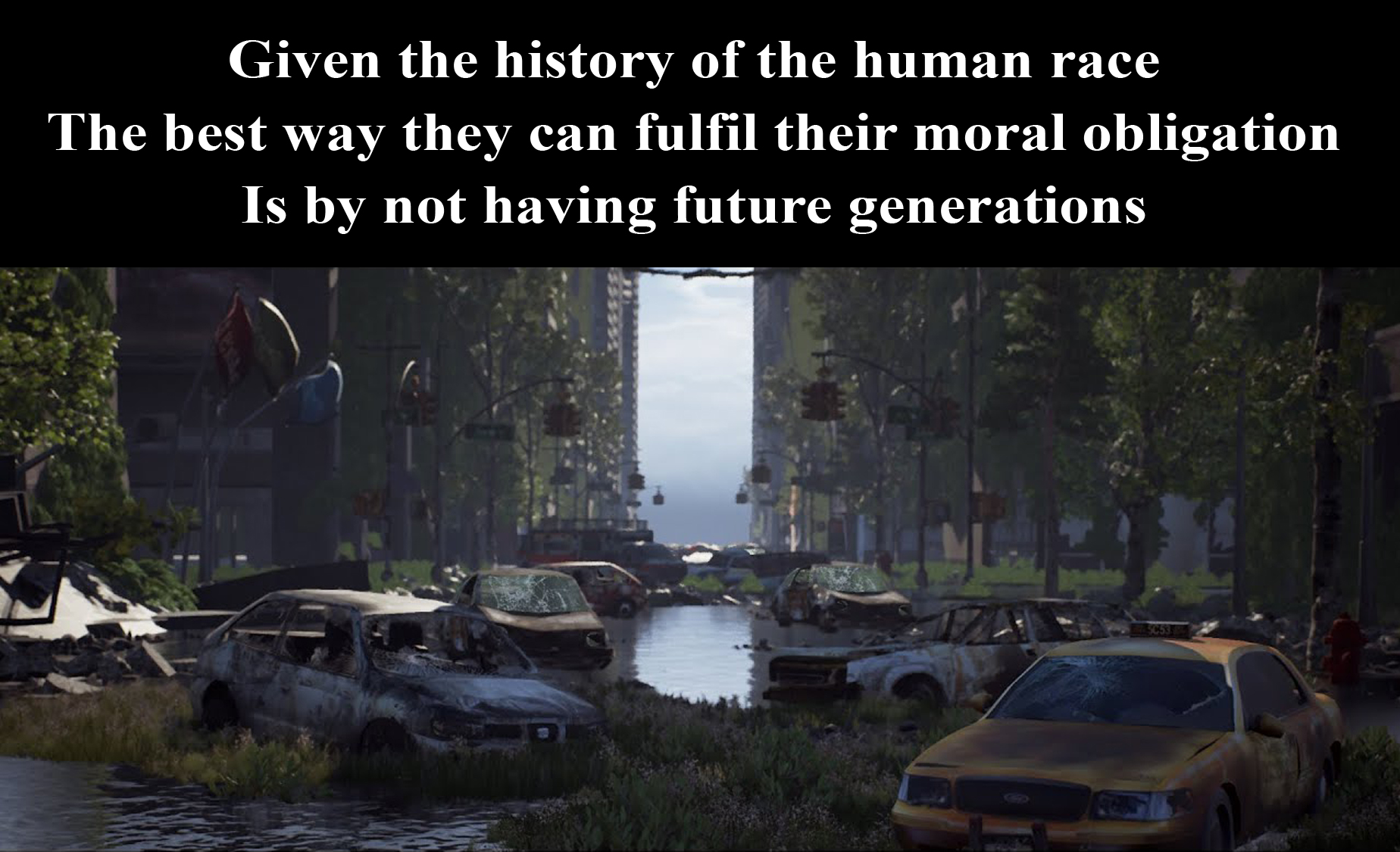
A great moral responsibility lays on the human race and it is to stop way before 450 PPM. This great moral responsibility is first and foremost for the rest of the species living on this planet, and towards future generations of humans. However, given the history of the human race, the best way they can fulfil their moral obligation is by not having future generations.

Humans have created 100,000 new materials, any number of which could interact with the environment in catastrophic ways. (00:42:33)

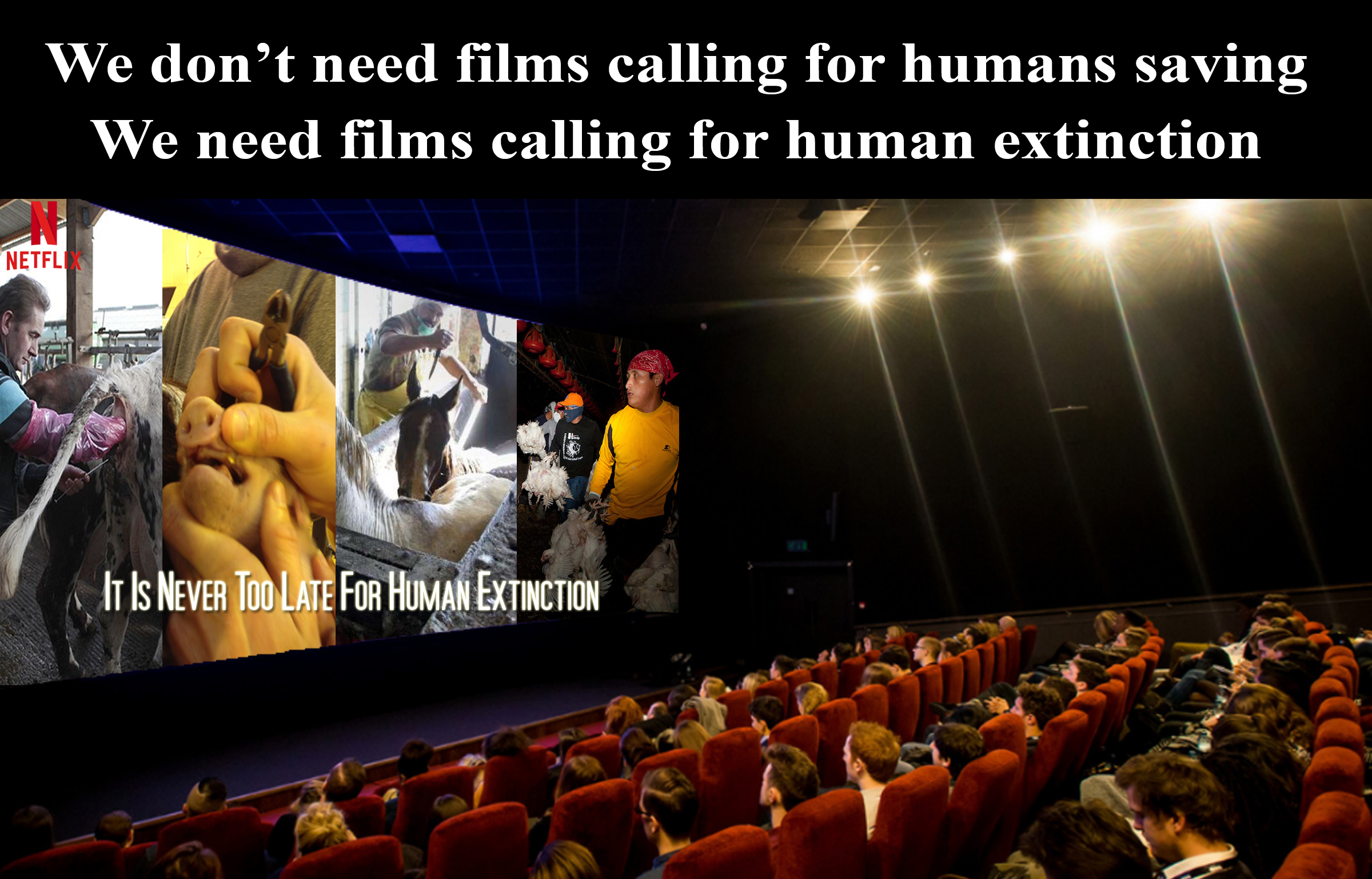
How is it that in spite of all the insane information presented in this film there are so few environmentalist initiatives calling for human extinction?

We can see so clear evidence that, because we’re in the danger zone on climate, because we’re in the deep high-risk zone on biodiversity loss, we start seeing increased drought, impacts on the rain forest, the forest fires in Australia and in the Amazon, the accelerated ice melt, the collapse of coral reef systems. (00:47:26)

Up until a few years ago, many have said that the human race doesn’t take environmental issues, particularly climate change, seriously, because no matter how scientifically based it is, it is a predication, a warning about bad things that will happen in the future. But in recent years, many immediate and direct effects have already happened. So how are they going to excuse humans now? When will excusing the human race ever stop?

Now that Johan and his colleagues have turned on the headlights, we can clearly see the boundaries. We can see the path back to a safe space, to a more resilient future. It is achievable. (00:59:48)

No it is not. The headlights are turned on for decades now.
Humans didn’t prove they can be trusted with fixing the problems they have caused, problems that everyone, everywhere are paying the price for. They don’t try to fix them even when the human race itself is in a clear and present danger.

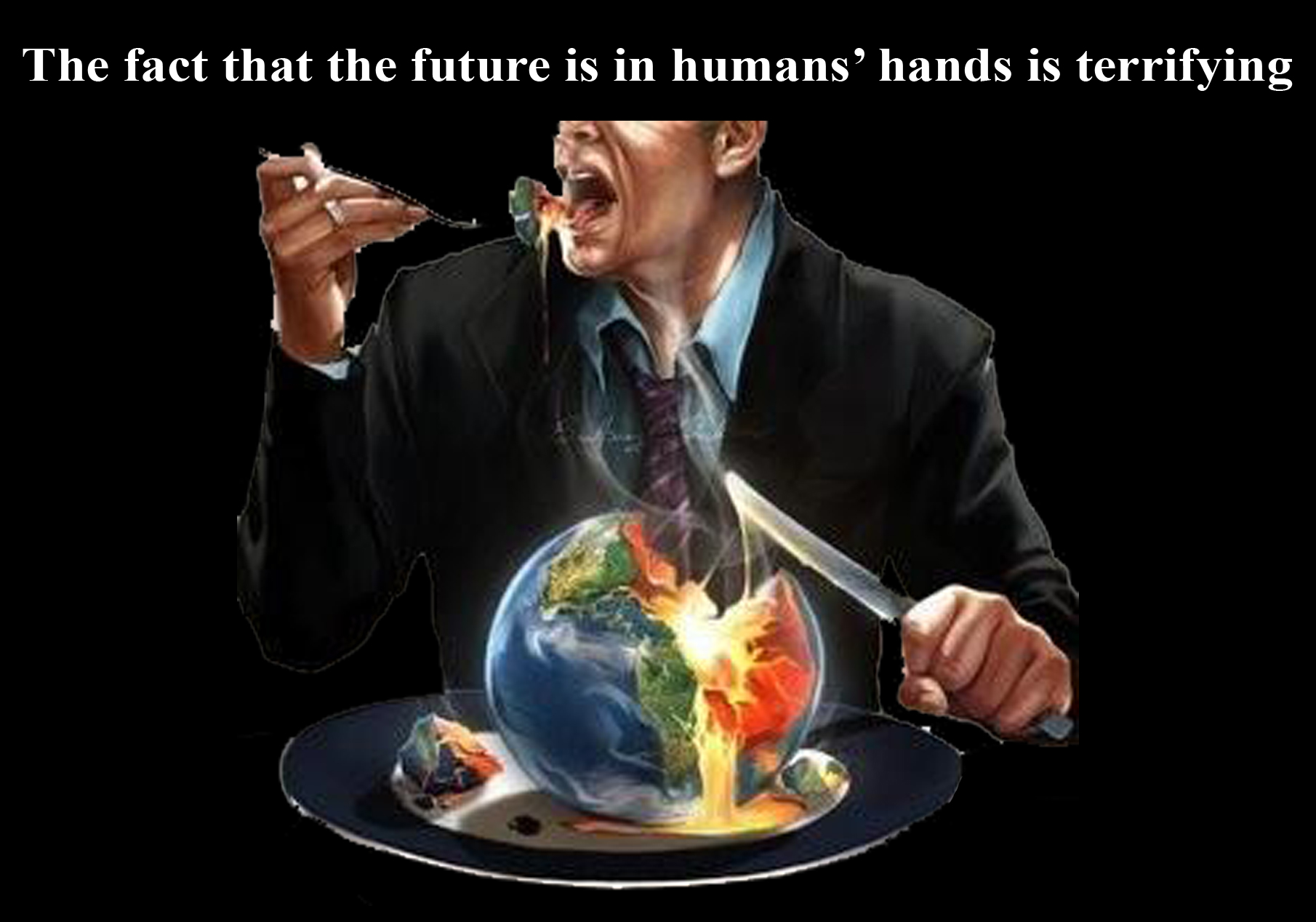
The future’s not determined. The future is in our hands. (01:08:29)

With the aim of inspiring some hope, this statement is probably the most depressing one in the film. The fact that the future is in humans’ hands is terrifying. Humans’ hands are absolutely unreliable, so us activists must do everything we can to save “the future” from their dreadful grip.

And finally, Johan Rockstrom suggests a metaphor:

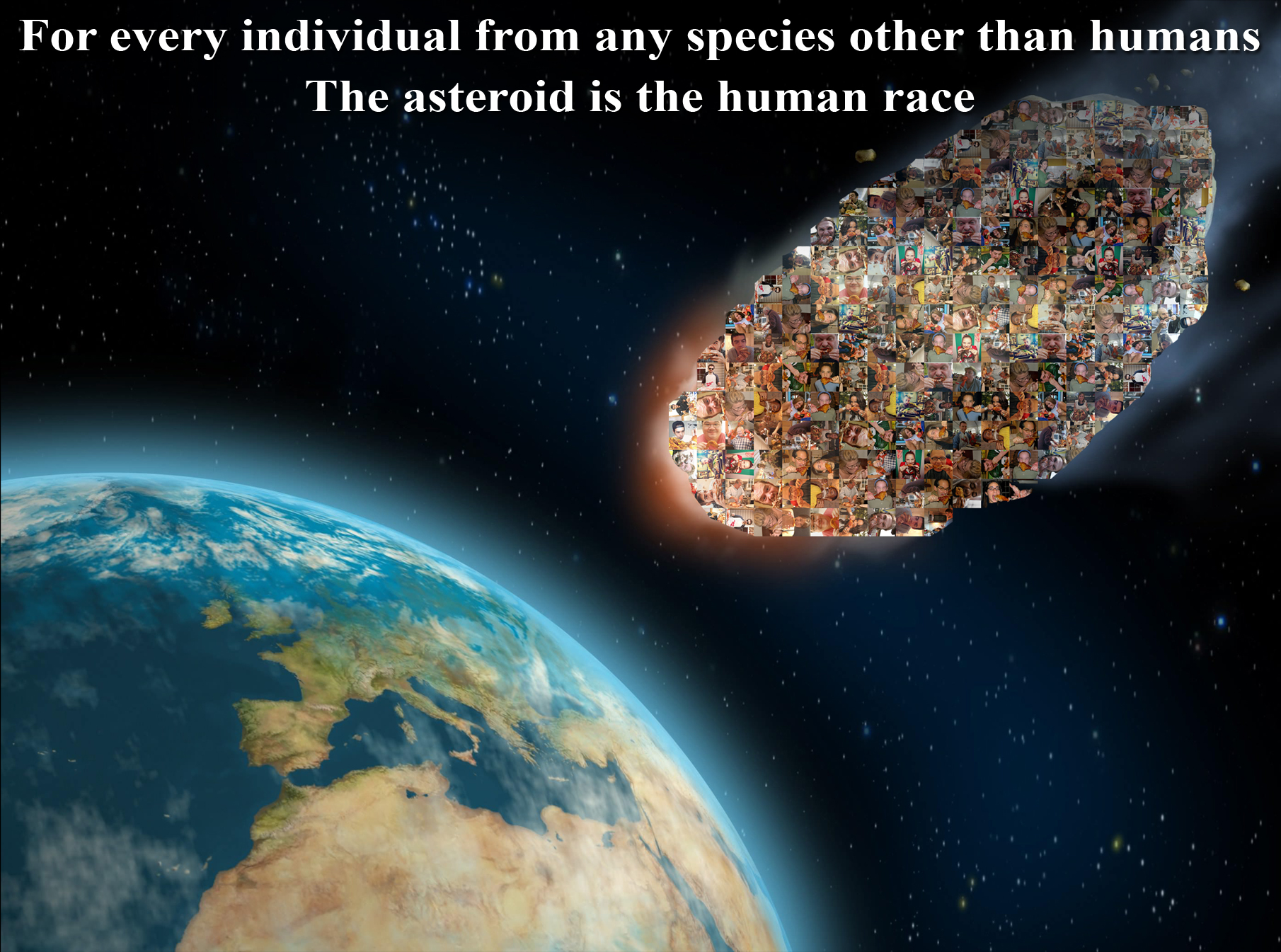
What would we do if we had had a report tomorrow morning saying that an asteroid is on its way to Earth?
Well, I’m sure that we would just put everything else aside and just focus then on solving the problem. Cost whatever cost it takes.
(01:08:54)

Again Rockstrom’s metaphor is wrong. In his view, the asteroid serves as an analogy for climate change, but for every individual from any species other than humans, the asteroid is the human race. Only that unfortunately, they can’t overthrow humans from their tyrannical throne. This is our job.

A Dangerous Place

Today is Labor Day in the U.S., an annual federal holiday in which residents are supposed to celebrate the economic and social contributions of laborers of the United States. But humans being humans, are using this holiday as another excuse to fire up the grill, or to go to a flesh restaurant and devour some extra animal corpses.

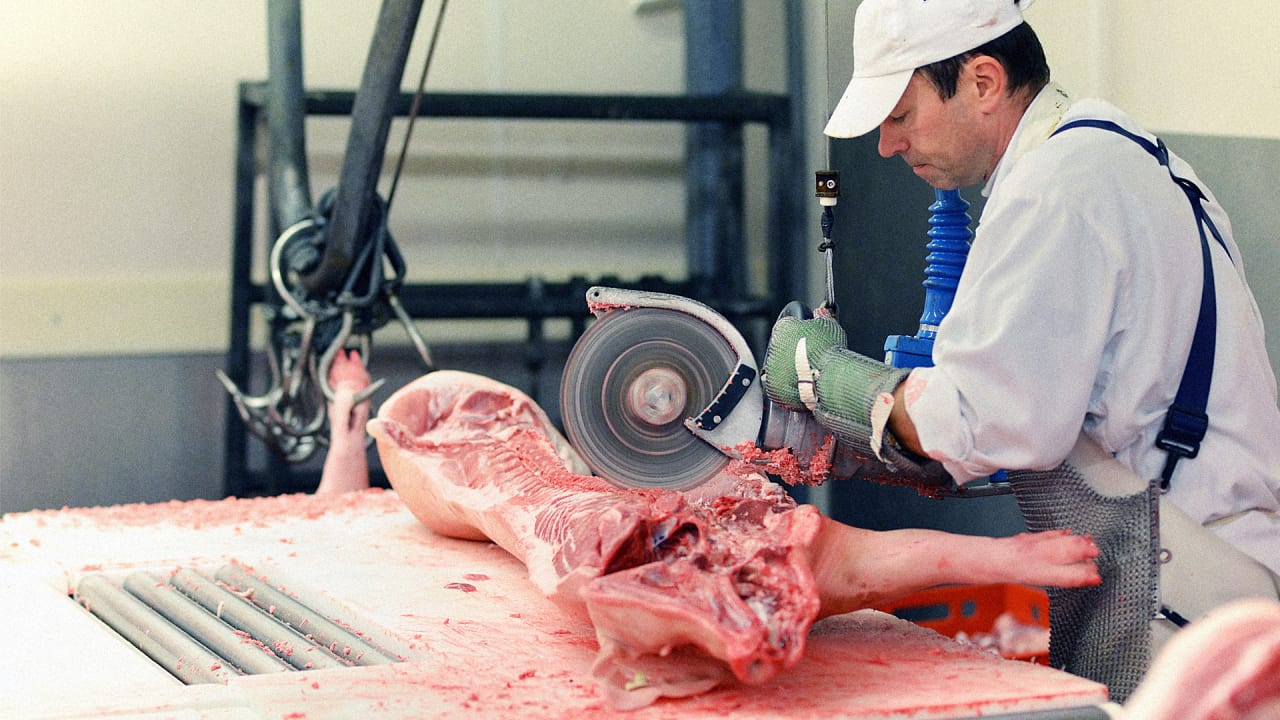
This year, a new campaign called Meatless Labor Day was launched, encouraging humans to reduce their meat consumption during the holiday, to “alleviate the pressure for meatpacking labor workers on one of the busiest days of the year. When demand for meat is high, meatpacking workers must process more meat faster and work longer hours, significantly increasing their risk of injury.”

The combining of mistreatment of workers in the meat industry with other claims against the meat industry, and referring to the workers as another group of victims of the meat industry, is not new, and in fact is a very old cynical, sickening, and speciesist tactic used by many animal activists. But in this case the workers are not referred to as another group of victims, but as the victims of the meat industry.

It is mentioned that workers are forced to work quickly in dangerous conditions and that this increases the risk of lacerations, slips and falls.
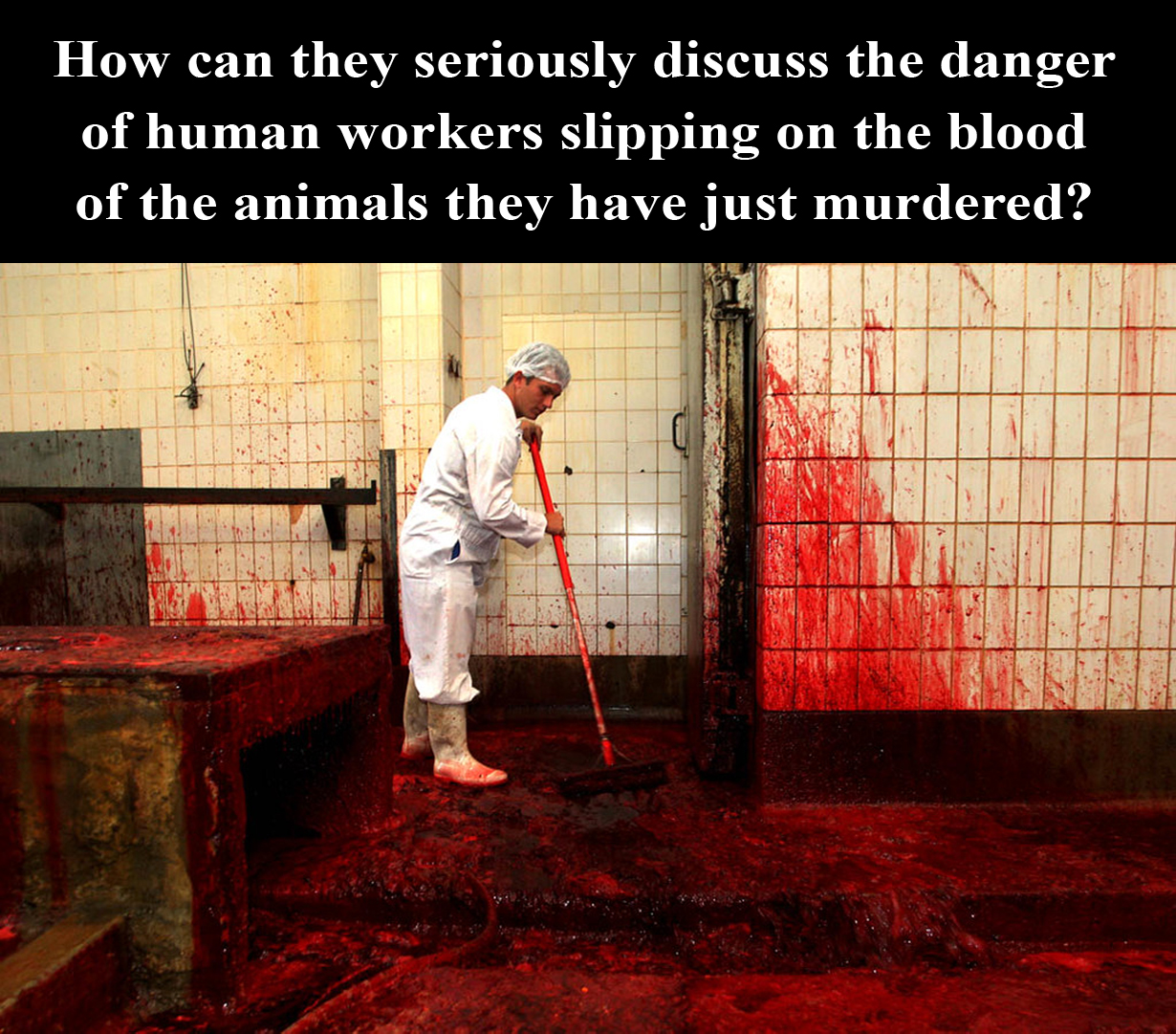
But the effects of speed on the sentient beings which some of these workers are quickly slitting their throats, is not mentioned. And the animals’ blood that may cause many of the workers to slip and fall, is only referred to as another dangerous factor in humans’ working conditions.

It is mentioned that workers in the meatpacking industry face a significantly high risk of injury.
The fact that nonhuman animals in the meat industry face an absolute and certain torture from birth to murder is overlooked.

It is mentioned that meatpacking laborers typically work 10 to 14-hour shifts, six days a week, and are severely underpaid. But not that they should be working for zero hours, in zero shifts, for zero days a week, and should not be paid for brutally murdering animals, because there mustn’t be a meat industry.

To claim for meat reduction in Labor Day because ironically workers in the meat industry must work even longer hours and process even more meat for that day, is extremely ironic and cynical. It is extremely ironic and cynical to claim that a human worker may hurt oneself when cutting to pieces a nonhuman.

How low can we go? How much more can we ignore the real victims of the meat industry?
And the call is to reduce meat consumption, not even to totally avoid it, not even for one fucking day! And that is so to alleviate some of the pressure for workers in the meat industry on one of the busiest days of the year, despite that this day is first and foremost one of the busiest days of the year in cruelty and suffering for those who were animals before these workers made them meat.

And don’t get this wrong, we don’t put the blame on workers in the meat industry, we put the blame on the consumers as it is their hands which operate the workers’ hands. We put the blame on humanity for letting this atrocity happen. This is basically everybody’s fault.

This campaign is kind of a climax in terms of stepping over the piles of victims during advocacy. Can you imagine something of this sort when the main victims are humans?
Would you accept a campaign calling to take one day off from lashing slaves because it may hurt the lashers’ hands? Or a Rape Free Day because rapists often get scratches on their penises?

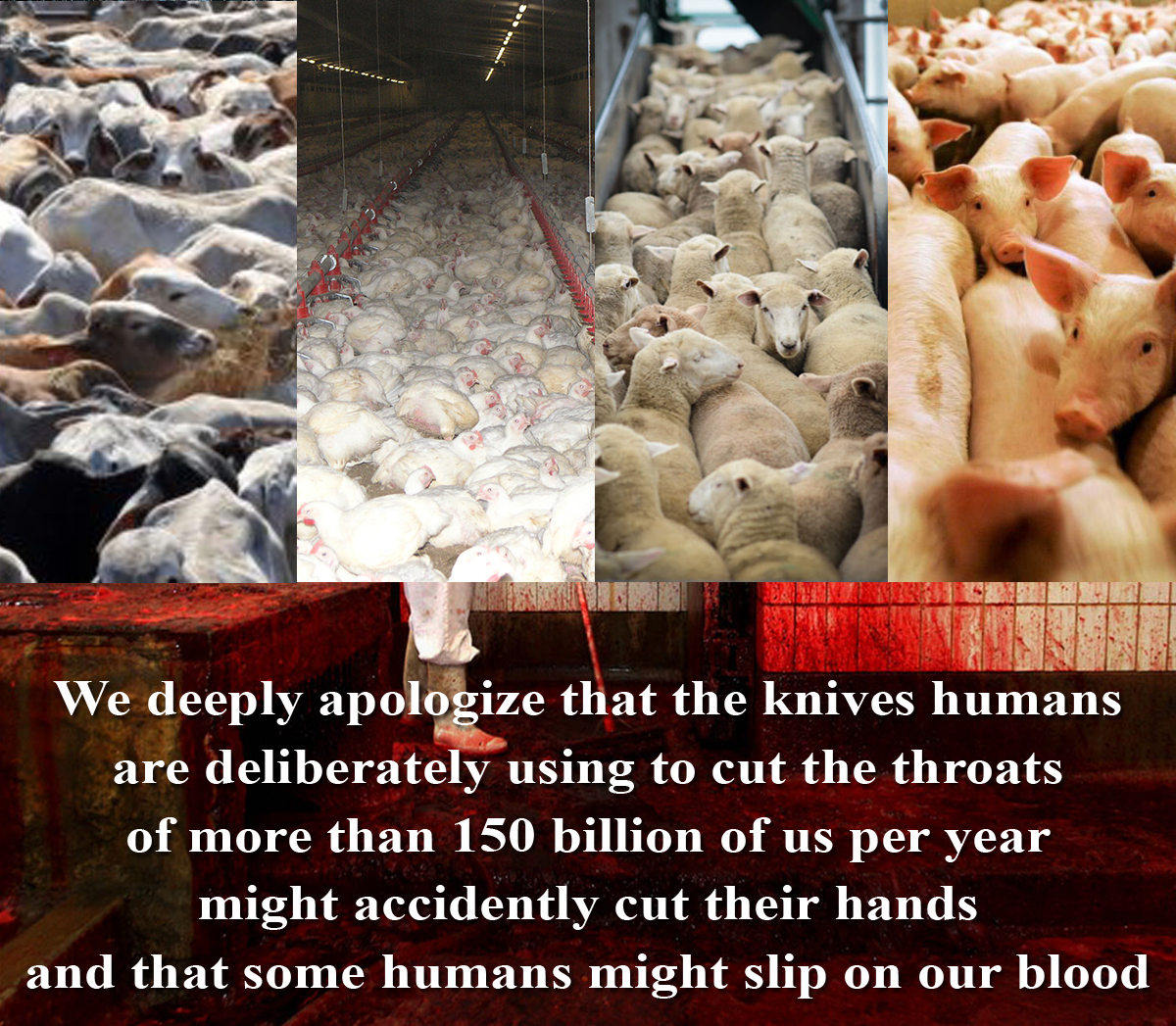
This campaign is extremely speciesist because it is highly unlikely that if the voice of the undoubtedly main victims of the meat industry – the exploited animals, is heard, they would want to offer their deepest condolences to all the humans who were injured during the murdering and processing of more than 150 billion animals per year.

It is very probable that many activists would claim that as long as campaigns such as this are reducing meat consumption, they are making the world a better place. But at the same time they are significantly strengthening and perpetuating speciesism, and by that they are making the world even worse.

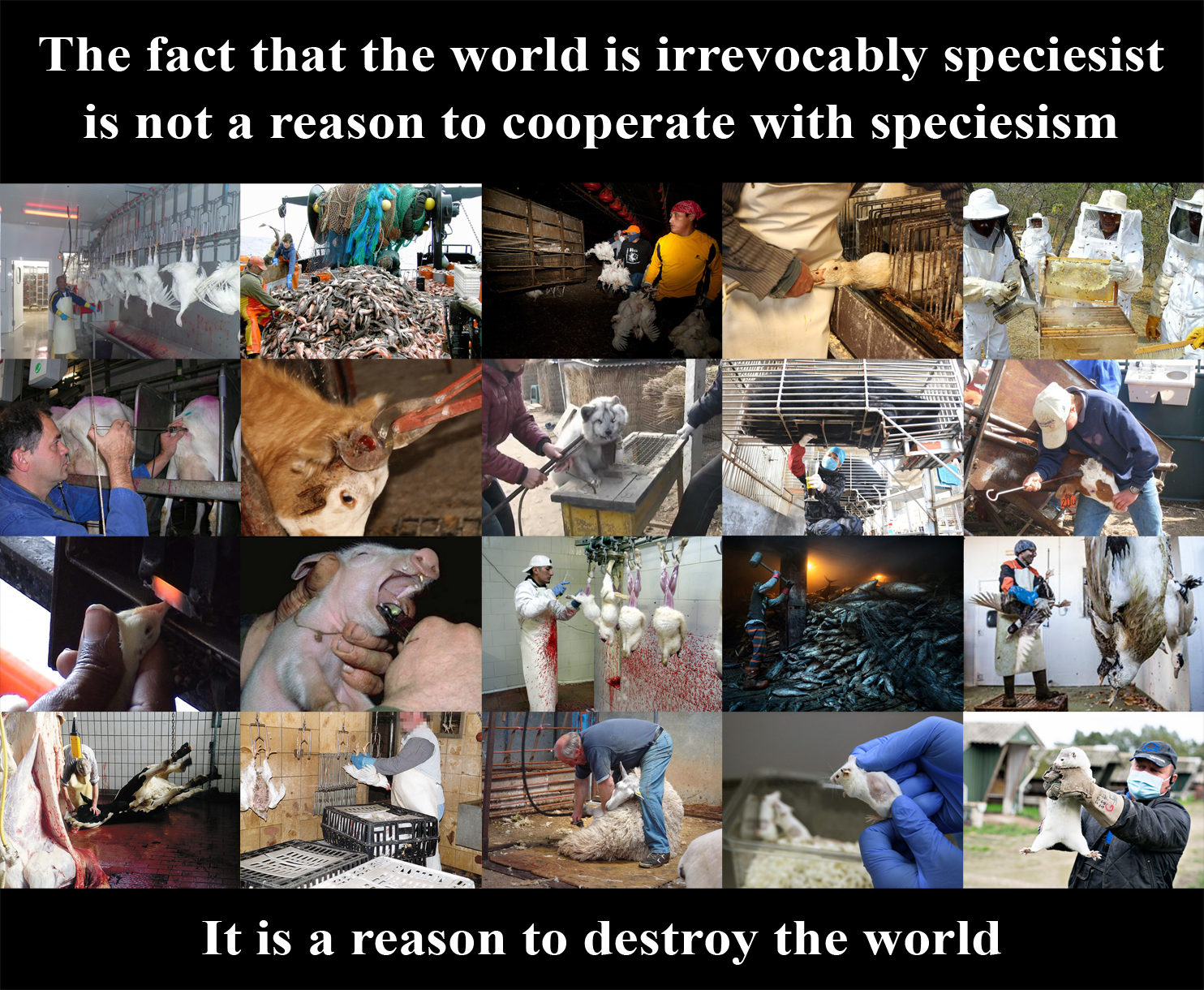
And to those who claim that the world already is irrevocably speciesist, we unfortunately agree. However, the fact that the world is irrevocably speciesist is not a justification to destroy morality, it is a justification to destroy the world.

When some activists have reached the phase of talking seriously about the danger of humans slipping on the blood of just murdered nonhumans, it is time to seriously consider that the talking phase must end and the ending phase must begin.

The Violence Even Activists Are Disregarding

We complete this series of posts regarding violence with what is probably activists’ biggest blind spot, violence in nature.

For many animal rights activists nature represents perfection, a romantic and virtuous ideal we should aspire to, something that ought to be reverently preserved and never criticized. But the truth is that nature is where trillions of sentient beings suffer from hunger, thirst, diseases, parasites, injuries, extreme weathers, rape, infanticide, violent dominancy fights, the constant fear of being attacked, actually being attacked, and only rarely die from caducity.

Probably the first natural cause of violence that comes to mind is predation.
Predation is literally as old as life itself. It goes back to the most ancient life forms – single cell organisms. As soon as there were living single cell organisms, one of their major functions was to acquire chemicals from their surroundings. As time went by, some organisms, by chance (mutation), started obtaining the organic molecules they require by devouring the cells around them, instead of gathering them from the surroundings. This turned out to be an efficient “strategy”. About 3.5 billion years later there are fangs, claws, talons, venoms, webs, beaks, sonars, infra-red vision, tentacles and etc.

But besides predation, there are many other suffering causes in nature.
Every single second somewhere in the world, defenseless and frightened babies are left alone because their mother has to search for food, a turtle is burned alive as she can’t out run the flames of a fire, a bird’s feet are frozen to a branch since he couldn’t find shelter from the harsh weather, a baboon monkey is in ongoing stress as an higher ranking female takes food out of her mouth and eats it herself, a nestling is thrown off the nest by the other siblings so they can get more food, a coyote is experiencing severe hunger as the rabbit he chased managed to escape instead of being torn apart, a female dolphin is being raped after she couldn’t outswim a male or even a few of them who gang rape her, a badger drags his rotten legs with infectious wounds resulting from constant fights, a zebra is dehydrated but can’t approach the ponds as the lionesses might be on the prowl, a lizard is being slowly devoured by a fungus that spread through the organs, a weak robin chick starves to death because his parents don’t feed him as it makes more sense energetically to invest in his stronger siblings.

In many activists’ minds humans are the only problem in this world which without them would be perfect. But…
In a humanless world, hyena cubs would still viciously fight each other, tearing off slices of other cubs’ faces including ears and lips, to get more food.
In a humanless world, crabs would still be pulled apart limb by limb by otters.
In a humanless world, fishes would still be digested alive by the stomach acids of a pelicans who gulped them whole.
In a humanless world, wasps would still inject their eggs into a live caterpillar’s body to ensure that when their descendants hatch they will have easy access to food as the larvae eat the caterpillar from the inside out.
A humanless world is definitely not a masculinity-free world. Brutal fights for territory and for the “right” to mate would still occur in immense numbers. Walrus would still fight each other over territory with giant teeth that can reach up to one meter long and more than 5kg weight. And the biggest males with the biggest tusks would still push their way to the center of the iceberg pushing the females and pups to the edges where they are more likely to be attacked by an orca.
In a humanless world, billions of insects would still get chemically liquefied before they are eaten by spiders. And snakes would still swallow whole animals and slowly digest them until hawks hunt them, digging in with their talons into the snakes’ body until they give up fighting back, and then start to cut off pieces of their body and eat them.
Eels would still electrify other fishes to hunt them using up to 600V in a single discharge – this is 5 times the shock one would get from sticking a finger into an electrical socket.
Young offspring would still get murdered by opportunist males who want their own genes to be spread.
And in a humanless world, duck, dolphin, seal and sea lion females would still be gang raped routinely as a way of mating.

Unfortunately these examples are only a tiny glimpse of the horrors happening every single moment in nature.
It is amazing how one magical word – Nature – can purify anything.

Activists shouldn’t consider nature as an ethical model but as an ethical problem.

The following are the main arguments activists commonly use justifying their disregard of suffering in nature, followed by our counter arguments.

Not morally obligated to intervene

Some activists observe nature neither as an ethical model nor as an ethical problem. They are aware of the violence, only they don’t think they are morally obligated to intervene. They think they ought to deal only with the suffering of animals caused by humans.

We find this argument false in the best case, and speciesist in the worst.

Activists should be obligated to preventing suffering no matter to whom, by whom and where it happens.

What makes animals worthy of moral consideration is their subjective ability to experience, not the objective conditions of their lives (such as to what species they belong to, where they live and their relations with other species) or their relations with humans.

The frequently quoted Jeremy Bentham is relevant here as well – “the question is not, can they reason? nor, can they talk?”, but it also shouldn’t be by whom they suffer, or where. The question is only can they suffer.

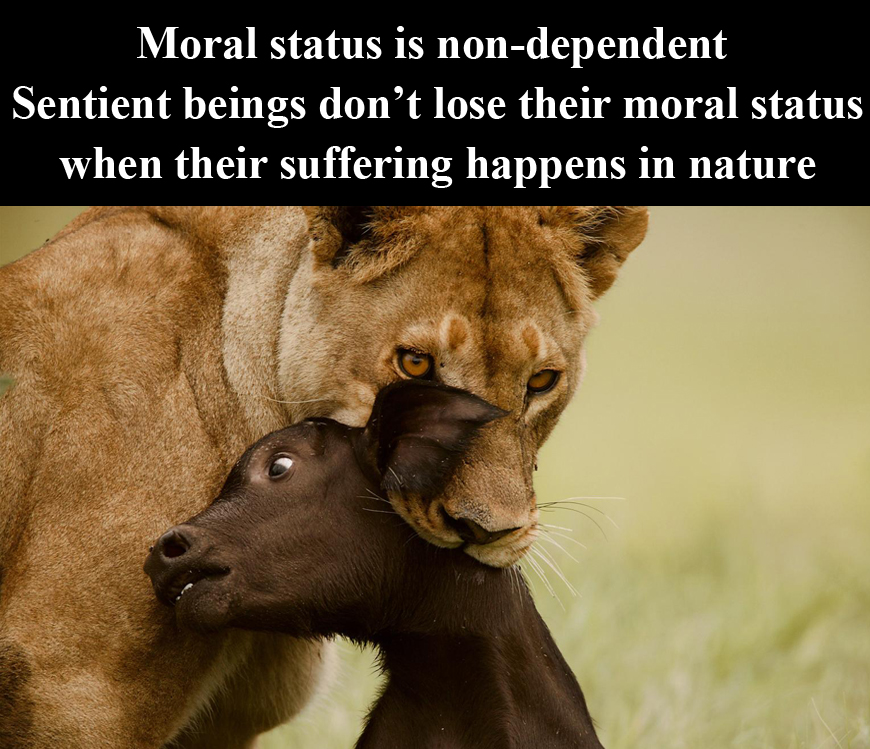
Moral status is non-dependent. Sentient beings don’t lose their moral status when their suffering happens in nature.

Our moral obligation to prevent suffering is driven from the fact that suffering is intrinsically bad for those who experience it. So if suffering is bad when humans cause it, there is no reason to think it is not so when it results from other causes, including the actions of other animals.

Given that the level of a deep wound for example, is the same, animals’ interest in not suffering from it, is the same in the case of falling on a rock, get bitten by another animal, or if was inflicted by a human. The harm’s cause doesn’t affect the individual’s interest in not being harmed. Their interests are independent of other considerations.

We mustn’t accept suffering just because it happens in what we refer to as nature, and to nonhuman animals by other nonhuman animals. To the sufferers, suffering is bad when it is considered natural just as much as when it is considered unnatural. And the victims are not consoled by the fact that it is nonhumans that hurt them and not humans. If labeling a violent scene as ’natural’ doesn’t affect the suffering of the victims, then it doesn’t have a moral effect.

Is rape o.k because it is done to nonhuman animals by other nonhuman animals? Does the raped animal care who or why she is being raped? Does she care that humans call it natural? She doesn’t. And if she doesn’t you shouldn’t either.

“In suffering we are all equal” – the argument so many activists use so often is true about all animals just as much.
All suffering should be stopped no matter how we define it, where it happens and by whom.

Morally obligated in cases of relations only

Some argue that since humans haven’t put animals in nature in the position they are in, in the first place, they are not obligated to help them out of it. Humans have moral obligations only to animals they have or had relations with (relations refers not only to animals which are currently exploited by humans, but any species which is or was affected by humans in any given time).

However moral consideration is not supposed to be conditioned by the location of the sufferers, or by the relations of the victims with their victimizers.

We are not denying that the sense of responsibility is conditioned to some extent by the level of the involvement in a given situation. We are opposing the negation of any moral obligation towards animals which (allegedly) have no relations with humans.

Moral status mustn’t be based on the relations of animals from specific species with humans, but focus on the morally relevant capacities of the animals. We are morally obligated to help sentients in need because of their inherent ability to suffer, not our contingent involvement.
Moral consideration is supposed to be a product of internal abilities, not external relations.
While it is understandable that the history of the relations between individuals from different species may affect the sense of urgency and duties, it is not at all relevant in determining the moral consideration of an individual.

The well-being of sentient individuals, and not how we relate to them, is what establishes the obligation to help them.
Our moral obligation not to cause animals suffering is not depended upon our relations with them, but solely on their ability to suffer. By the same token, our moral obligation to prevent animals suffering is not depended upon our relations with them, but on their ability to suffer.
It makes sense that activists feel responsible for the wrongs committed by them personally, but if to follow the logic of the claim, it is difficult to see how they are responsible for wrongs committed by others who simply happen to be a member of their own species.

Activists are not directly and personally responsible for animals’ suffering in factory farms if they are not consuming anything from them. The reason why they have such a sense of responsibility on the suffering that other humans cause is because it is so enormous and because they feel they can prevent it. It is not because they are personally responsible for it.
So there is no reason to argue that we are morally obligated only for suffering we are directly involved with. As it appears, fortunately, activists who argue that, are not applying this logic on suffering caused in factory farms.

Our goal is to end suffering no matter where it happens or who is causing it. Suffering is intrinsically bad for the sufferer no matter who cause it. So the suffering caused by humans is not more important to prevent than suffering caused by nonhumans. It might be easier to influence, but it doesn’t prove it is not humans’ problem, but that there are problems humans can address more effectively. Therefore that is not a case against intervening in nature, it is a case for intervening where you can be most effective, and that is a different kind of argument we’ll address further in this text. Here we are dealing not with practical arguments against interfering in nature but with moral ones. And we argue that activists have no justified reasons to think that suffering in nature is off limits.

Activists by definition are not satisfied with ‘not contributing more’ to an existing problem by their personal actions, but are acting to solve it. They feel responsible for solving a problem despite that they are not the ones causing it. It is enough to know that the suffering is there. The same logic must be applied to suffering in nature.

If some activists want to seriously argue that what counts is a causal link between suffering and human activity, than there is no moral obligation to help in the case of a natural disaster that cannot be bound with human activity, for example an earthquake.
Some human atrocities are not caused by the direct responsibility of other humans and most if not all still think they are obligated to help these humans in need. It is not because they feel directly accountable, but partly responsible. And that is so since they are aware of the only relevant criterions regarding the situation – these humans are moral patients, they are suffering, and they can be helped.
No reason why the same logic won’t be applied on animals in nature. Arguing that we are morally obligated to help humans in natural disasters but not animals in nature, is speciesism.

But most importantly, activists’ moral aim is to strive for the end of suffering in general or at least reduction of suffering, not solely the suffering they are responsible for, either individually or collectively as a species.

Suffering caused to animals by other animals should be on the same moral level as suffering caused to animals by humans. Activists didn’t put nonhuman animals in the position of suffering under humans just as much as they didn’t put nonhuman animals in the position of suffering in nature. They are morally obligated to end the suffering in both circumstances, not because they are the ones who put them in these situations, but because they are the only ones who care enough to put them out.

If the activists arguing that they have no moral obligations towards animals in nature were presented with 3 hypothetical options:

  1. Pressing a yellow button which would eliminate the ability to experience suffering among all animals
  2. Pressing a purple button which would eliminate the ability to experience suffering only among those who humans have put in the position of suffering
    3. Not pressing anything

To be consistent, they must argue that we are morally required to press the purple one, and are morally entitled not to press the yellow one. According to the logic of the argument that we are not morally obligated to help animals in nature, the only ethically wrong scenario is not pressing anything, not the option of letting the chance to stop all the suffering slip away.

Morally obligated not to intervene

Other activists are not only arguing that we are not morally obligated to help animals in nature, but that we are morally obligated not to. Most of which since they romantically observe nature as perfection we mustn’t touch.

The argument that what is natural is morally right is very popular, unfortunately even in the animal liberation movement. That is despite that there is no conceptual connection between what is natural and what is moral. A natural behavior is the one that is probably the most successful in terms of survival and reproduction, not the one who successfully promotes moral ideals. Therefore many actions are perfectly natural but morally horrible.

Just a few examples:

Tamarin monkeys for example need to eat all the time since they are constantly in motion. That is especially the case with the Tamarin mothers who need to eat as well as bring food to their young, which are therefore left alone for a long time, many times, each day. That is just one example out of many proving how imperfect nature really is. The defenseless young are in many cases being hunted, however we are not talking about the obvious but rather about the pain of being left alone again and again and again. Frightened, hungry and generally confused and helpless, all of the young are affected by this natural necessity. The psychological damage shouldn’t be ridiculed especially not by animal rights activists. It just can’t be that they are not harmed by it, and this is just one species out of many with the same situation.

Another example that would probably be ignored or indifferently disavow regards the Right Whale courtship which includes a series of jumping to impress the females. The flaps of 100 tons in the water are horrible to the seabed animals. The vibrations in the water affect the whole surrounding. We doubt that the other inhabitants feel it is o.k. or find comfort in the fact that the most alienated from nature species that ever existed, calls it a natural phenomenon.

And if the female whale is not interested another natural phenomenon happens – she is being raped.

The whale female doesn’t have a choice but to surrender to the males’ courtships because several of them surround her and attack her until she gives up and dives with one of them. Because they can wash each other’s sperm out, the female is forced to mate with many and only the last one will impregnate her.

And from violent mating to violent pregnancy…
The African cichlid fish mother collects her eggs young inside her mouth when she spots a sign of danger. The catfish are parasitic beings who ruthlessly exploit this phenomenon. The mother catfish mix her eggs with the cichlid’s eggs forcing the cichlid fish mother to collect them into her mouth with her own, manipulating her to become their surrogate mother. The catfish eggs hatch first and eat all the cichlid eggs inside their mother’s body, and get out to the sea when ready.

And to violence inside the family…
While mother egret is looking for food for her chicks, the stronger ones viciously peck their weakest brother or sister to gain more food for themselves. It gets worse when a crocodile is trying to reach their nest. The stronger chicks beat the weakest until s/he falls to the water. The crocodile eats the weakest and leaves the stronger ones alone.

How heat can turn one of the most violent places in nature, even more violent…
The plains of Africa are living hell all year long. The climate is rough and the notorious battles between hyenas, lioness, vultures, jackals and cheetahs happen all year round. But everything intensifies in the hot summer. The rivers become small pools and the savannah becomes dry land so everybody comes to drink in the same thin rivers. The predators fight over the poor impalas, buffalo, wildebeest, darters and etc. that fear every time they come to drink.

Some inhabitants are extremely territorial, especially the lions, the hippos and the crocodiles, so when the water levels drop and temperatures increase they are all forced together in such a small space and with so little water to drink and to cool in, that the violence is constant. The summer’s extreme conditions push them to their limits, so except fighting over the same animals, lioness and crocodiles even hunt each other, and both try to hunt hippos as well, but usually without much of a success. They can only hunt unsupervised baby hippos, and since hippos are herd animals it doesn’t happen very often. In fact the baby hippos’ greatest fear is other hippos.

The adults often kill each other during their fights over territories and “mating rights”. In the summer it is exaggerated as the extreme density forces them to invade each other’s territory and so constant violence takes place in the herd. The baby hippos are victims of this behavior. And if it is not direct violence, when a crocodile tries to hunt one of them the whole herd tries to escape in panic crushing each other over. That’s when the shrinking pools become death traps. Small and weak hippos are crushed to death by the crowded herd. Many are injured, and slowly die from their wounds.

And the cold doesn’t treat animals in the wild any better…
Birds unable to find a sheltered perch during harsh weathers may have their feet frozen to a branch or their wings covered in ice making them unable to fly and slowly starve to death.

In many cases what was once considered a symbiosis, was found out to be a violent case of opportunism. One of them is the oxpecker birds of Africa which were considered to maintain mutualistic lives by picking parasites off large mammals like hippopotamus, rhinoceros and buffalos. However, it was recently realized that they, like many other species of birds, also keep wounds on the animals’ skin open to feed on the exuding blood.

And opportunism’s evil cousin is parasitism…
Perhaps one of the most horrific examples of a parasite being is the lamprey eel, a jawless parasitic marine animal with a toothed, funnel-like sucking mouth which they use to bore into the flesh of other fishes and suck their blood. The oral apparatus of the adult lamprey is a sucking disk lined with whorls of over 100 of these teeth. They swim with the fishes and literally feed on them until they die. Sometimes the fishes manage to detach from the eel’s suck, usually to slowly die from the wounds or a later infection. And as if it is not cruel enough they also secrete two substances into the victim fish, one to prevent coagulation and the other to breakdown muscle tissues that are then sucked in as fluids.

To say that something is natural doesn’t add any moral value to it. It only says that it evolved spontaneously through time and improved or didn’t interrupt the reproduction of its beholder.

Nature is indifferent to the suffering of its residents.

Something can be good or bad regardless of it being natural (the notorious naturalistic fallacy).
Some things are bad despite that they are natural, like reproduction, and some things are good despite that they are not natural, like contraceptives.

Natural processes are not moral entities, sentient beings are. If intervening in a natural process can help sentient beings who are affected by this natural process, we are morally obligated to intervene, not to abstain.

Refusing to do so is placing non-moral entities above moral entities. And it makes no moral sense.

Thinking of nature as impeccable is not only ignorant of the scope of suffering in the wild but it is also, maybe unintentionally, confusing abstract terms such as species, with moral entities which are the individual members of the species. A species is just a convenient term to define individuals of similar biological traits, with no ethical relevancy.

Stating that nature can fix itself as long as humans don’t interfere is overlooking individuals and focusing on species and ecosystems. Species may manage in the wild as long as humans don’t interfere, but that is “thanks” to the mass reproduction mechanism that makes many individuals in each breed, of which only one on average will reach adulthood. Under this cruel natural mechanism individuals are sacrificed. The species might get stronger but the individuals live brutal, strugglefull, stressful and violent lives. For the species to flourish all it takes is that a sufficient number of its members reach reproduction age, no matter out of how many born each period, and what kind of lives they endure.

In a way morality and the naturalistic perspective are in contradiction. Morality strives for making the world a better place, while the naturalistic view strives to leave it as it is.

In addition, even the ones who think that nature always knows best are in favor of interventions in many cases. Just to name a few: medications, vaccinations, pre-birth genetic tests (hopefully they are against births but probably not against the pretests), abortions (for every possible reason), glasses, wheel chairs, hearing aids, sun screens, sun glasses and etc.

Arguing that it is morally acceptable to interfere with nature only when it comes to humans is speciesist. Surly all the other species would be happy to receive the various benefits of human medicine and technological aids.

Since the treatment of nonhuman interests in a similar situation must be the same as it is in the case of humans, interventions in nature for nonhumans must be morally obliged just as they are when it comes to humans. Either we can argue that any intervention in favor of any species is immoral, or that any intervention is moral. Otherwise it is speciesism.

Arguments against intervention in nature are absurd when coming from activists, which their main activity is promoting a mass scale intervention in nature as a moral solution. They can justly argue that it is morally justified given the cruel alternative, but they can’t argue that intervention in nature is morally wrong, while promoting the symbol of intervention in nature – agriculture.

So, activists approve many interventions in nature, and therefore they can’t principally argue against it.

Moreover, it is very hard to define what is a natural phenomenon in this world. If a crow attacks a nightingale in an activists’ garden we assume they will not stand by.
If these activists would see a wild boar attacking “their” dog we are sure they would interfere for the sake of the dog. Probably so would most if during a trek they encounter a wolf attacking a rabbit. They would do it because they see sentient beings in need and they feel they can help them. That’s all it takes. Someone who suffers and someone who can help. In our world there are trillions of someones who suffer, and only a few who are willing to help. That’s why the few who do, must act in order to help them all, and make sure that no one else would be in need in the future.

More suffering, bigger potential

The more practical activists among the ones arguing against intervention in nature are doing so not because they idealize it, but since most of the suffering is inflicted by humans in factory farms, not by nonhumans in nature, and since humans are far more likely to influence the actions of other humans. Therefore they claim the most effective thing they can do is try and change the behavior of their species and not of others.

As opposed to the rest of the arguments specified up to this point, this argument is at least logical and not totally biased. However, its first part is based on at least some level of ignorance regarding nature, and the second is definitely based on ignorance regarding humans’ nature.

We’ll start with the second. Of course there is a stronger case for moral intervention in situations in which we have a better chance to help the victims, and/or where the victims’ suffering is greater. However for the argument for efficiency to be valid and relevant against the argument for intervention in nature, activists have to hold a substantial case for arguing that they can change the way humans are treating nonhumans. Unfortunately there isn’t one. There isn’t yet even a substantial case for arguing that humans can change the way humans are treating other humans as extensively shown in the former posts of this series, mainly the ones about Steven Pinker’s book the better angels of our nature, which argues for a decline in violence.

The way humans treat members of their own species is the strongest indication of how hopeless the chances are to create a moral change in society based on humans’ compassion. Please take the time and read our FAQ’s Don’t you think that the slavery abolition proves that animals can be liberated someday too? And The human race perspective on itself and on the world has changed through time and will keep on changing, all we need is to be patient. As well as our articles and posts about how humans systematically exploit the poorest of their own kind, how they treat half of their own species and their own posterity. (Of course it shouldn’t matter to which species someone belongs, but it does matter to humans, and still, this is how they treat each other).

It is even hard to imagine a war free, non-racist, non-male chauvinist and slavery free world, so a non-speciesist one?

Most humans haven’t even made much more socially acceptable ethical decisions than going vegan. It is impossible to educate most humans not to use one another, not to objectify each other, not to turn to violence in conflicts and crisis so easily, not to discriminate each other on the basis of race, gender, ethnical orientation, class, weight, height, looks and etc.
The homo-consumericus knowingly and systematically oppresses members of its own species for the most trivial material goods. The dynamic of psychologically repressing and soothing any uncomfortable thoughts about the numerous faceless human victims half way around the world that pay a huge price so that consumers wouldn’t have to make the slightest compromise on their lifestyle is very much characteristic of the human race. The ease in which humans conduct horrendous acts towards one another is proven again and again by both social-science and in particularly psychology studies and by history and daily affairs. And ironically, slavery, activists’ most popular example of how animal liberation is possible, is one of the strongest examples proving the opposite.
Not that we agree with the comparison many activists often like to make between human slavery and animal exploitation, but at least in the sense of the mindset of the exploiters, there are some crucial similarities (mainly the need to extremely devalue the “other”). However, currently humanity is even getting further and further from ending human slavery, so what are the chances of convincing all humans to become vegans?

And even if there was a chance to utterly revolutionize humans’ moral perceptions regarding nonhumans, then the case of factory farms is stronger, not exclusive. Suffering is still suffering, and it needs to be stopped or prevented no matter where is occurs, to whom and by whom. The small chances to affect suffering in nature mustn’t be an excuse to let it go on. On the contrary. The smaller the chances for us activists to affect suffering in the world, the greater the moral incentive for us to destroy it.

And that goes for ignorance regarding human nature.

Back to the first part of the argument, that most of the suffering is caused in factory farms by humans and not in nature by nonhumans, many argue that the exact opposite is true. In recent years, more and more thinkers and activists argue that most of the suffering by no doubt occurs in nature and by nonhumans. We are not yet convinced by their arguments that it is so, we think most of the suffering is caused by humans and in factory farms, however while it is very hard to determine where most of the suffering occurs, there is no doubt that there are more victims in nature than there are in factory farms. And there is no doubt that most of them suffer greatly. That should be sufficient for any activist to take suffering in nature extremely seriously.
Only ignorance regarding nature’s true nature, can make the most caring humans in the world overlook the infinite suffering inflicted in nature. And that is the topic of the next section.

The Blind Spot’s Blind Spot

An idealized and a very partial view of nature, causes activists not only to ignore most of the horrible parts of the lives of animals in nature, it also causes them to ignore most of the animals.
Usually the idealized image of nature is consisted of adult individuals of large herbivore mammals pasture in a green field. However, there is nothing ideal in the lives of adult herbivores considering the constant social stress of many, the constant fear of predation of most, the harsh weather, the hunger, the thirst, the diseases, the frequent injuries from successful escapes from predation, and the excruciating pain of unsuccessful escapes from predation. And more importantly, herbivore mammals dying in adulthood are by no doubt extraordinarily exceptional and utterly unrepresentative of life in nature.

Most of the sentient beings on earth never reach adulthood, but live for a short and extremely brutal period, in most cases, lives of nothing but suffering.

This fact is particularly relevant for the case against nature as an ideal moral model since this mass scale horror is mainly driven by one of nature’s most fundamental elements – the reproductive strategy.

The two main reproductive strategies are called K-selection and r-selection. To put it simply, K-selection is putting all the energy on maximally preparing individuals to survive the environmental conditions, while r-selection is putting all the energy on the maximum number of individuals and minimum investment (in many cases none) in each individual.
Of course these strategies are combined in some way or another among different species, but generally that is the main framework.

Basically, the higher the value of r, the lower the value of K. So every single case of reproduction of r-selected species ends up with numerous individuals who will die shortly after.
Since the population of these species is more or less the same from generation to generation, then on average only one offspring will survive to replace each parent.

Of course not all the individuals of each reproduction will live long enough to become sentient (consumed while still in the egg at a very early stage for example) and there are those who argue that some never become sentient, no matter their age, because they are simply non-sentient. However, given that most animals practice r-selection, including invertebrates of course (by far most of the animals on Earth) and many vertebrates such as fishes, amphibians and reptiles, and given the enormous number of reproductions and the enormous number reproduced beings, nature is not only far from being ideal, it is full of suffering on every level.

The philosopher Oscar Horta thinks that the existence of r-selection leads to the inevitable conclusion that there is far more suffering than happiness in nature. He gives an example to prove his point:

“Consider just one example regarding a certain species of animals, the Atlantic cod (Gadus morhua). These animals can lay from a few thousand to several million eggs. Let us suppose that they lay 2 million each time. It is estimated that in 2007 there were around 33,700 tons of Atlantic cod in the Gulf of Maine bank alone. An adult cod can weigh up to 25-35 kg. Assuming they have an average weight of 33.7 kg, there would be around a million of these animals (the average weight I have proposed is too high, though on the other hand I am assuming, for the sake of simplicity, that these animals are all adult animals). Assuming the cod population remains stable, on average only two of the eggs that a female cod lays in her life end up developing into adults. Thus, a total of 2 trillion eggs laid will fail to become adults. Assume each egg has a 0.1 probability of developing into a young, immature fish, a codling, and that there is a 0.1 probability that codlings are sentient. Finally, assume that on average they suffer for just ten seconds before they die.

All of these are extremely conservative assumptions. Yet they entail that each time these animals reproduce we can expect that 200 billion seconds of suffering is experienced (and these are only the cods in the Gulf of Maine). Since there are 31,556,926 seconds in a year, this amounts to 6337.7529 years of suffering. If this continues over an average human lifespan (that is, six decades), the number of years of suffering generated would be 380,265.174. All this for a very specific species in a very specific area.”

Oscar Horta’s terrifying illustration is extremely important for several reasons:
Even non-negative utilitarians must infer that nature can’t be morally justified.
It further refutes the idealistic view of nature.
It further induces the moral need to act against it.
It further refutes the idealistic view of a vegan world which is many activists’ moral ideal.

The kinds of livs that the absolute majority of sentient beings on earth are forced to live, are of nothing but suffering. And that is a much more accurate view of nature’s true nature.

To positively view nature one must wear extraordinarily optimistic lenses when looking at individuals from moral value.

Not moral agents

Some, including Tom Regan for example, argue that since animals are not moral agents they have no moral obligations towards other animals, which is a totally reasonable claim to make, but they also argue that only when moral agents are involved, actions have moral significance.

First of all the question of intervening in nature, is not whether nonhuman animals (who are considered not to be moral agents) must stop hurting nonhuman animals, but whether humans (who are considered to be moral agents) should stop nonhumans from hurting nonhumans. So the argument that nonhumans are not moral agents is not even relevant in this case.

But since it is often brought up in that context and since it is an important issue in itself, we’ll shortly address it.

Moral agency is relevant only to determine whether someone must be held accountable for hurtful actions, not to determine whether hurtful actions are of moral significance. Moral agency is meaningful only for the hurting side. For the hurt side it is meaningless.

Our moral view is not about judgments, justice or punishments. It’s about viewing the cruel situation for what it is, recognizing that someone is a victim, acknowledging that suffering is suffering.

The argument that animals as opposed to humans aren’t cruel because they don’t inflict pain on purpose and since they don’t have other choices, may be true but it doesn’t make the situation less cruel for the victims. There are no painkillers in lack of intention or in the lack of other options.
Predation is immoral despite that predators are not acting immorally.
Intentional or not, necessary or not, there are still victims to their actions. A hurtful action is bad even when not a bad actor does it.

Our natural tendency when it comes to suffering is to seek the accountable, but there aren’t always ones. It is not always good vs. bad. It is more convenient and serviceable to think so since it makes a sense of order in our world view. But it is not so in most cases. Most of the evils in the world are not a consequence of evil. Even the evils humans are doing are mostly not a consequence of evil, but of convenience, habitualness, conformism, selfishness and mostly indifference.

Thinking in terms of good and bad, absolute victims and absolute victimizers, is much easier than the thought that the world is so inherently cruel that if the victimizers won’t hurt the victims they would victimize themselves, for instance in case of predation. And these are just the top predators which would stay hungry. Many other predators are being preyed by other predators (very common among fishes and insects), then the victims and victimizers swap places all the time, it depends at what point you are looking.

Actions, and surely situations, can be horrible even if no moral agents were performing them. One unequivocal example for that are the earlier mentioned, natural disasters. Earthquakes are not moral agents yet we think they are bad. We can’t hold anyone responsible for their harms, but surly we consider harms made by earthquakes bad. And not only that we consider them bad, it is unlikely that anyone would argue that we shouldn’t interfere in favor of the ones hurt by an earthquake because it is a natural disaster, in fact most argue that it is our moral obligation to do so.

Many parts of reality are cruel without anyone guilty of them. The fact that earthquakes are not moral agents doesn’t prevent us from thinking we should help its victims. So it’s not moral agency which is relevant here. The lack of moral agents makes the situation injudicable but we can certainly judge the situation as horrible.

When an earthquake happens we define it as a tragedy and bad luck for the ones hurt. If it happens in a certain place once a day, we would say that this is a very bad place to live in.
That is despite that no one is doing it on purpose or can be held accountable. No moral agents, and still – a bad place. The same can be said about nature. Only that in nature the bad thing doesn’t happen once a day but every single moment. We can say that nature is bad without anyone bad living in it. Just as we can say that natural disasters are bad without anyone bad causing them.

Are we responsible for earthquakes? No. But if we have the option to prevent the next earthquake and choose not to do anything about it, are we not responsible for its harms?

Given that innumerous harms are inflicted everywhere, all the time, our movement is a call to take responsibility and do something to prevent all of it.

Suffering is inevitable

But of course moral agency is not the only reason for the difference in the feelings towards suffering caused by humans, and suffering caused by nonhumans. Most of the suffering humans cause to nonhumans is since they want to. Most of the suffering nonhumans cause to other nonhumans is caused since they have to.

A stronger version of the argument that animals are not moral agents is that animals have no other options. The argument is not that they can’t distinguish right from wrong, but that they have no other options but to hurt.

However, the fact that suffering is always bad for the victim, makes an action that caused suffering bad whether there were alternatives or not.
How is it of any difference to the victims if there were other options available for the victimizers? No animal would stop running away in panic if the chasing animal would explain that there are no other options but starvation.

When we watch animals running away from animals chasing them we are in favor of the chased ones. That is despite that we know the chasers are not moral agents and that they have no other options. We don’t think the chasers are evil or wrong for chasing other animals, yet we have a strong inclination towards the chased.

More importantly, to be consistent we must be in favor of the chased ones every single time. But we know that when the chasers fail to hunt they suffer from hunger. That means we are in favor of starving the chasers.
So how are we supposed to solve this moral entanglement? Should we be in favor of the chased only every second time? Should we equally divide our sympathy? Should we try and figure out what causes more suffering, being hunted or starve to death?
Could choosing between predation and starvation even be a moral solution?

Inevitableness might ease our sense of responsibility but it doesn’t ease the inevitable suffering of the inevitable victims.

What would the supporters of the inevitable argument do if humans were truly carnivores? Would they accept the suffering of billions of animals if humans really needed to eat flesh to survive?
We think they most certainly wouldn’t. They would rightfully look for any possible option to reduce the suffering of animals regardless of humans’ needs. We would probably see many more activists who are in favor of a serious population reduction, in favor of in-vitro meat, in favor of VHEMT, and even in favor of genetic interventions aiming to ease animals natural sensitivity to physical and mental pain (an issue which is discussed as a future option among some supporters of intervening in nature) fewer would be in favor of organ donations and of the artificial prolongation of life of old and sick humans, and many other positions they must already hold but somehow too many don’t.
Anyway the point is that the relation towards the issue of inevitableness would change dramatically if humans were naturally carnivores. If this short list of standpoints sounds reasonable to you in the hypothetical case of humans really being carnivores, then it should also be reasonable in the case of real carnivores.

When watching suffering of wild animals on the screen, many humans and certainly every animal activist, are dramatically emotionally moved by these horrific scenes. Some rationalize their way out of it by calling it natural and others by claiming it is inventible, failing to infer the moral conclusion out of the situation – when something that horrible is such a natural and inventible part of life, life is horrible. Activists mustn’t rationalize their way out of horrible situations but act to change them.

The ones raising the inevitableness claim are doing so to explain why we can’t do anything about the suffering in nature, however that it is probably one of the strongest cases for doing anything we can to eliminate it. The fact that suffering is inevitable is not a reason to ignore it, but the primal reason why this world must end.

Humans will make things worse

And last but not least as it probably the strongest if not the only truly valid argument against interventions in nature, is that humans will only make things worse.

While in many cases it is probably no more than another excuse not to take responsibility over suffering in nature, we believe that in many other cases it is coming from a sincere concern that humans would cause more harm than they would help.

Basically we agree with that argument and not only because of humans’ nature, but mainly because of nature’s nature. Much of the suffering is too inherent, too entwined with the system to be tackled, even after much more study. Animals in nature have no other options but hurt others to survive. There is no way to avoid it. It can be reduced by several means and some are already suggested, but suffering is inevitable. Animals in nature fight each other over the same resources and in many cases they are each other’s resources, intervening in favor of one species would most probably hurt another or even the very same species, in the case of causing the extinction of a predator species to help another species for example, which would probably end up in overpopulation and hence starvation, dehydration, disease spread and etc. The fear of a Malthusian crisis among the animals that predators kill is genuine, not necessarily an excuse. However, while it may hold as an argument against the extinction of predators, it cannot hold as an argument against the extinction of predators and “prey”. In other words, the fear of a Malthusian Dystopia is a valid argument against the extinction of one species, but not at all against the extinction of all of them.

We are not suggesting looking for ways to interfere in specific cases to reduce some of the suffering. We are suggesting looking for ways to interfere in the over-all case to end all the suffering. It is much more complex and difficult in many aspects, but on the contrary on others. For example we mustn’t look for ways to somehow settle the so basic conflict of interests between different individuals in an eco-system. The fear of bad consequences from that perspective is not relevant in a global solution such as we suggest. If it works, there is no reason to fear unexpected consequences in terms of species dynamics, since there wouldn’t be one.

The spotters’ blind spot

In relation to the former argument, that humans would cause more harm, the supporters of intervention in nature argue that indeed so far humans interventions in nature caused much more harm than good, but almost each and every case of human intervention in nature was made for the sake of their interests, not for the sake of animals, so it is hard to infer from past events.
Moreover, many openly argue that it is too soon for extensive intervention in nature nowadays, as much more information is required in order to succeed in suffering reducing and not harming.

The very fact that suggestions to intervene in nature for the sake of sentients are even made is a great progress in moral thinking. Discussing the issue broadens the borders of morality and the suffering scope which we must consider, and probably most importantly, it seems that the thinkers who lead the discussion take as absolute granted that suffering is intrinsically bad and therefore must be stopped (it is not at all self-evident especially considering the idealization of nature, the popularity of the ecological thought, and the recent emphasis on lifestyle in the animal movement).
When we started our writing about suffering in nature back in 2006, we could only dream of such a serious and profound discussion regarding it a decade later.

We highly recommend reading the materials of these thinkers (you can find many in the References). They are thought provoking, compassionate towards all sentients without prejudice, biases, speciesism and other conceptual hindrances such as nature idealizing.

However, we have two major disagreements with what seems as the main premises of the discussion.
The first problem is that although what is required is technological developments, the ideas of intervention in nature are still social ones. Meaning, society must be convinced that it should commit itself for the sake of animals in nature. It would take a whole web of institutions, on the political, academic and economic levels, to revolutionize the way humans see practically everything in this world. That is when they haven’t yet even made the much more basic step which is stop observing nature as their resource but as other beings’ home.

Even if you believe that a species which is still so far from eradicating poverty, hunger and war not to mention racism, misogyny and ageism, a species that hasn’t even ended slavery yet, and even expands it, and of course a species that invented and constantly intensifies factory farms, will someday seriously address the suffering of animals in nature, it will take a lot of time and we all know what time means in this world.

Placing humans as supervisors is a horrible idea not only because when they did intervene in nature, the results were horrible, but since we refuse to keep entrusting the fate of trillions of nonhumans in the unreliable hands of humanity.
What part of the history of the human race makes anyone believe that this species is capable of making moral decisions?

Currently not only that humans are not even willing to take responsibility over animals’ suffering that they are directly causing, but the number of the victims is constantly increasing.

What makes the expectation, that humans would someday care for animals’ suffering in nature despite that currently they don’t even feel morally obligated to care for the animals which are tortured directly for them, even more ridiculous, is how they deal with climate change – what is supposed to be in their eyes the biggest problem their species ever faced. Gladly, so far humans are far from dealing with the issue in a proportional way. They are willing to worsen the state of the planet even if it hurts their children, so they can maintain their lifestyle. So expecting that they would recruit to help animals in the wild is absurd.

Don’t confuse the last argument with the infamous claim that there are more burning issues at stake. Except for factory farming, we don’t think that there are more burning issues than suffering in nature. It is humans who think that there are many issues (factory farms are not an issue for them at all) which are more important but don’t bother dealing with them either. We have no reason to think that societies that have invested billions to precede other societies in the race to the moon (a project with very low scientific aspects and zero ethical aspects) instead of dealing with malaria for example, would ever seriously deal with helping animals in nature.

How can we seriously expect a society which hasn’t even made the first crucial ethical step, to make the last one? And all the more so when even most of the activists are against making it?

The idea of intervention in nature is all in all, a social one. It is immoral to wait for society to change, definitely not when it is certain that even if these ideas would be implemented, it would be far from helping all the sentient begins on earth. And that brings us to the second fundamental problem.

The second problem is that despite the profound understating of nature’s true nature by the intervention supporters, their conclusion is that we have a moral obligation to thoroughly study ecosystems so we can help some animals in some of them. The suggesters understand perfectly well that in this world suffering is inevitable. Such an understanding must establish a moral obligation to thoroughly study not specific ecosystems, so we can affect them and hopefully reduce some of the suffering of some of the animals, but the whole globe so we can affect it and hopefully end all the suffering of the all the animals.

The intervention supporters argue that we are morally obligated to help in every case we are sure we can help more than harm. It sounds reasonable, but that also means that we must accept the suffering in all the cases which we can’t be sure we can help. Suffering is so inherent in this world that even the ones who truly care about every suffering being, accept much of the suffering as obvious. Accepting suffering mustn’t be reasonable.

The only reason we need more information regarding the complexity of ecosystems is so we’ll know how to destroy them, not so we’ll know how to slightly make some of them slightly less horrible. From an ethical perspective, all that is needed is to know that suffering is intrinsically bad and is inevitable in these systems. That is sufficient to morally infer that we mustn’t study these systems so we can make them slightly less horrible, but so we can permanently stop them.

Helping the ones that we are sure that we can, is the moral thing to do only after giving up the option of helping all of them.

If two buttons were placed in front of activists from both sides of the discussion (one group who are sure there is more suffering in factory farms and the other that there is more suffering in the wild), one button stops all the anthropogenic caused suffering and the other stops all the suffering in nature, we assume that activists from the first camp would push the first button and activists from the second camp, the second button. We want to believe that if a third button would be suggested, one that stops all the suffering, both camps would push it in double speed. Yet, despite that the situation is getting worse all the time – the suffering in factory farms increases every year, and the suffering in nature keeps being totally ignored, the few people who care about it, are not looking for neither of the buttons.

In both cases, ours and theirs (the ‘intervention supporters’), the solution leans on technology.
In their case the call is to study the issue and lay hopes on that future humans would be more caring and ethical and so would act to promote technological solutions for reducing suffering.
In our case the call is for present activists to realize that there is no substantial reason to lay hopes on future humans and there is no moral reason to let trillions of sentient beings suffer until the good humans from the future would show up, and therefore we all must look now for technological solutions to stop all the suffering.

The human society is not and will not be nonhumans’ salvation but their oppression. On the other hand, individual humans can be nonhumans’ saviors, but only if they stop laying their hopes on their species and realize that it is up to them only. Up to you.

References

McMahan, Jeff. 2010.“The Meat Eaters”. The New York Times, September 19.

http://opinionator.blogs.nytimes.com/2010/09/19/the-meat-eaters

Fink, Charles K. 2005. “The Predation Argument”. Between the Species 13

Horta, Oscar. 2010. “Debunking the Idyllic View of Natural Processes:

Population Dynamics and Suffering in the Wild”. Télos 17 (1): 73-88.

http://www.usc.es/revistas/index.php/telos/article/view/284/250

Ng, Yew-Kwang. “Towards Welfare Biology: Evolutionary Economics of Animal Consciousness and Suffering.” Biology and Philosophy 10.4 (pp. 255-85), 1995.

Ng, Yew-Kwang “Welfare Biology as an Extension of Biology” – Interview with Yew-Kwang Ng by Max Carpendale. Relations – 3.1 – June 2015 http://www.ledonline.it/Relations

Torres, Mikel “ The case for intervention in nature on behalf of animals
Relations – 3.1 – June 2015 http://www.ledonline.it/Relations

Michael C. Morris and Richard H. ThornhillAnimal Liberationist Responses To Non-Anthropogenic Animal Suffering” – Worldviews 10,3 355-379

Regan, Tom. (1983) “The Case for Animal Right”. Berkeley: University of California Press.

Tomasik, Brian. 2014. “The Importance of Wild Animal Suffering”. Foundational

Research Institute. http://foundational-research.org/publications/importanceof-wild-animal-suffering

Tomasik, Brian. 2009. “The Predominance of Wild-Animal Suffering over Happiness:

an Open Problem”. Essays on Reducing Suffering.
http://reducingsuffering.org/wp-content/uploads/2015/02/wild-animals_2015-02-28.pdf

Palmer, Clare” 2015. “Against the View That We Are Normally Required to Assist Wild Animals”
Relations – 3.1 – June 2015 http://www.ledonline.it/Relations

Faria, Catia 2015. “Disentangling Obligations of Assistance – A Reply to Clare Palmer’s “Against the View That We Are Usually Required to Assist

Wild Animals”
Relations – 3.1 – June 2015 http://www.ledonline.it/Relations

Faria, Catia and Paez, Eze 2015.Animals in Need – The Problem of Wild Animal Suffering

and Intervention in Nature”
Relations – 3.1 – June 2015 http://www.ledonline.it/Relations

 Faria, Catia 2015. “Making a Difference on Behalf of Animals Living in the Wild” – Interview with Jeff McMahan
Relations – 3.1 – June 2015 http://www.ledonline.it/Relations

Cunha, Carlos Luciano 2015. “If Natural Entities Have Intrinsic Value, Should We Then Abstain from Helping Animals Who Are Victims of Natural Processes?“
Relations – 3.1 – June 2015 http://www.ledonline.it/Relations

Mosquera, Julia 2015. “The Harm They Inflict When Values Conflict Why Diversity Does not Matter”
Relations – 3.1 – June 2015 http://www.ledonline.it/Relations

 Paez, Eze 2015. “Refusing Help and Inflicting Harm A Critique of the Environmentalist View”

Relations – 3.1 – June 2015 http://www.ledonline.it/Relations

Stijn, Bruers “The Predation and Procreation Problems Persistent Intuitions Gone Wild”

Relations – 3.1 – June 2015 http://www.ledonline.it/Relations

Callicott, Baird. “Animal Liberation and Environmental Ethics: Back Together Again,” in Hargrove, Eugene (ed.). The Animal Rights/Environmental Ethics Debate (Albany: State University of New York Press, 1992).

Sagoff, Mark. “Animal liberation and environmental ethics: Bad marriage, quick divorce.” Osgoode Hall Law Journal 22

The Paris Exception

Last Friday the Paris agreement on climate change was officially signed in a ceremonial event at the UN headquarters in New York, after being formulated and agreed upon on December 2015.
Expectedly, the triumphant language declaring a historic moment blatantly overlooked various major flaws in it. The Paris convention is far less exceptional, and more of another dot in the same line of failures in the way humanity confronts its greatest challenge ever.

Getting into its details reveals the extent of the oversights, compromises and distortions to the point of data deceptions and modeling manipulations that were required to finally achieve an agreement, after decades of failures to reach one.

International conventions about climate change have been held for 25 years, and up until now the world has failed to finalize them with an agreement. During this period of failures, the emissions of CO2 are estimated to have risen by 60%.

With that legacy of failures in mind, and especially with the disappointment of Copenhagen, the ultimate goal in Paris was to reach an agreement which all of the world’s nation can sign. The signing itself became more significant than the content singed upon, as we’ll explain along this post.

However, in spite of all our arguments (further in the text), we do believe that this development should be taken as a wakeup call for activists who count on the human race destructiveness to finally turn against itself.

Shamefully, Only Voluntarily

The Paris Agreement is actually little more than a statement of intent, as any aspect of actual significance was set as non-legally binding.
The document does not contain any binding obligations with regards to GHG (greenhouse gasses) emissions reduction or financing activities that will reduce them and deal with their consequences.

Instead, countries get to set their own voluntary reduction targets called “Intended Nationally Determined Contribution” (INDCs). And even after they get to set how far they are willing to go, implementing their commitments is not a legal obligation.
In other words, not only that each country gets to decide what it’s going to do regarding climate change, each country gets to decide whether to do what it decided it should do. None of the countries, no matter their current level of emissions or their historical contribution to climate change, are legally bound even to their own proclamations.

The only thing countries are obligated to do is to submit an “Intended National Determined Contribution”, and present a report on their progress every 5 years.

All the agreement does is establish a legally binding obligation to declare volunteering, but not obligations for results.

And finally in terms of the legal context, a party is free to withdraw from the agreement at any time after three years from the agreement’s entry into force.

Shamefully, Only Shaming

Instead of binding commitments to ensure the implementation of the national contributions, the Paris agreement relies on the instruments of ‘naming and shaming’.

Part of the idea behind this ineffectual mechanism is the claim that so far the legal sanctions path led nowhere, as was infamously showcased in the Kyoto protocol. The obvious thing such a claim misses is that the track record of non-legal voluntary action was no better. Generally, the 70-year history of multilateral UN agreements suggests that countries will avoid their commitments whenever they can.
Surely, all it takes is the excuse of economic or security crises to justify any non-action, especially if the “threat” is only diplomatic shaming.
But obviously the main and unequivocal reason is that many countries refuse to sign a climate agreement that involves sanctions.

Unclear Transparency

For the sake of shaming, and without any other penalties for countries’ inaction, the agreement is left to make do with a system of transparency. That’s why submitting reports is one of the only legally binding clause in the agreement. The term transparency is mentioned and emphasized over and over, exactly because it is the only regulative mechanism in the agreement.

The transparency framework is celebrated as a top achievement of the agreement. What the rhetoric fails to mention is that the establishment of this key mechanism was left for a future date. That goes to show how the main goal of the talks was to reach an agreement everyone can sign, on the expense of actual meaningful content. Going for the lowest common denominator, and omitting or delaying complications for later is the oldest trick in the diplomacy book.

 In the same spirit, the little that was agreed upon in the final text describes the mandate of the future transparency framework as “non-intrusive”, “non-punitive” and “respectful of national sovereignty”. Countries are trusted to report on their progress, with no external independent review.

Moreover, the tracking of implementation takes place in 5 years intervals, which might not be a long time in climatic perspective, but very long in political perspective. A lot of excuses can pile up in 5 years.

While some countries agree to meet and evaluate the progress in 2018, the first mandatory evaluation under the agreement happens only in 2023.

 The essential role of transparency goes further than a form of “deterrence”, it is the key for information about the overall global state. The fact that one if not the most important element of the agreement wasn’t formed yet, speaks volumes on the agreement.

Unachievable Goal

The main goal of the Paris agreement is staying well below 2 °C increase in the average global temperature since pre-industrial levels by the end of the century, and even aiming for 1.5 °C.
However, even if the National Contributions of all countries are fully implemented, the goal of the convention would not be achieved. Added together, all the contributions still fall far short of “well below 2 °C”, not to mention 1.5 °C.

The UN body that deals with climate change, the UNFCCC, published an evaluation of these contributions and found that even if all pledges are fully implemented, still global warming would be between 2.7 °C and 3 °C. Other evaluating bodies claim 3.5 °C and above.
An acknowledgement of this shortfall is even written in the agreement which “notes with concern” that the contributions “do not fall within least-cost 2 °C scenarios”.

The convention claims it will achieve its goal since it relies on the assumption that the future contributions (which countries are obligated to submit every 5 years) will include stronger voluntary commitments.

Not only that, but it claims to achieve a major goal in 2016, regarding 2100, despite that its timeframe ends at 2030. They don’t let the 70 years gap between the end of the agreement’s mandate and the target year for its goal to stand between them and “an historic declaration”.

Mockingly Unachievable Goal

One of the most ridiculous gaps between the high rhetoric and actual commitments is the declaration of “pursuing efforts to limit the temperature increase to 1.5 °C above pre-industrial levels”.

2 °C seems completely beyond reach considering the analysis of policies as stated above, but as for 1.5 °C it is just not an option. For the 1.5 °C limit, the carbon budget (that is the amount of CO2 that can be emitted and still allow to stay within the temperature limit) is 400 GtCO2 starting from 2011. Even before the first mandatory evaluation (global stocktake) which will take place in 2023, the emissions will already exceed that amount. From 2011 to 2014 the emissions were 140GtCO2, and even if we’ll assume no rise in emissions from 2014 onwards, with emissions of 35.5 GtCO2 per year, that budget is going to be used by 2022.

Back to the Future

The claim to reach well below 2 °C is made possible by relying on the not yet existing option of “negative CO2 emissions” by using future technologies that can take carbon out of the atmosphere. It most commonly means vast crops planting to absorb carbon and then harvesting them for energy use, combined with carbon capture and storage technologies that bury it deep in geological strata.

Originally it was thought of as a last resort, but in the Paris agreement negative emissions were promoted to a central pivot of the main plan of action. Mass scale deployment of carbon capture and storage sometime during the latter half of the century was assumed in the framing of the 2 °C and1.5 °C goals.

In the scenario database of the IPCC (the Intergovernmental Panel on Climate Change, the UN scientific research body which informed the negotiations), out of the 113 scenarios with a “likely” chance (that’s 66% or better) of 2 °C, 107 (95% of the scenarios) assumed the successful large-scale uptake of negative emission technologies.

The reliance on these yet non-existing technologies also plays a prominent part in many of the countries’ national contributions.

Unsurprisingly, these premised technologies have been embraced by policy makers. They allow maintaining business as usual, while claiming to do meaningful action. They were simply added to the equations, and then the on-going fossil fuel use seems less dangerous. It is knowingly worsening the problem today, leaving someone in the future to sort it out and find the magic bullet.

Back to the Past

Other than the use of non-existing technologies in the future, the scenarios (the convention uses) also rely on ‘going back in time’, reducing the emissions of the past. That is since one set of scenarios that demonstrate a possibility to limit the temperature to below 2 °C puts 2010 as a peak year for emissions and starting to reduce them from that year on. In other words, for that scenario to be relevant, reduction in the emissions should have started 6 years ago.

And as for limiting the temperature increase to 1.5 °C, there is a need for both non existing technologies and for going back in time. In the IPCC’s words: “Without exception, all 1.5 °C scenarios available in the literature reach net negative CO2 emissions by mid-century, even with stringent mitigation action having started in 2010.

Someone Else’s Problem

Another reason why it was relatively easy for the politicians to sign is that the core of the agreement is not obligations put on them in the present, but obligations on someone else in the future.
How typical, politicians signed that someone else should take more responsibility in the future than they should now.

Prominent in Their Absence

Unsurprisingly the ones who are always absent from humans’ discussions over the planet, are the rest of the species living on it. That is despite that even according to the minimal estimations, greenhouse gases produced by industrially exploited animals represent 14.5% of all anthropogenic greenhouse gasses emissions. The famous 2006 UN report Livestock’s Long Shadow estimated it as 18% of global greenhouse gases, and WorldWatch institute place the figures at around 51%.

Last month, Oxford University researchers projected that by 2050, food-related greenhouse gas emissions could account for half of the emissions the world “can afford” if global warming is to be limited to less than 2°C. Adopting a vegan diet would cut these emissions by 70%.

A Similar 2014 research from the U.K found that vegetarian and vegan diets had 32% and 49% lower greenhouse gas emissions, respectively, than medium-meat diets. Compared to high-meat diets, the difference was even higher, with vegan diets emitting 60% less greenhouse gasses.

However, expectedly, the agreement doesn’t mention any of it nor does it recommend even a gradual global shift towards a plant-based diet. Animals were totally absent from the table of discourse and appeared only on the dinner table as courses.

Flown and Shipped Away

If global aviation and shipping were a country, they would rank among the world’s top 10 emitters. In addition, they have grown twice as fast as the general emissions in recent years, and are expected to further increase by about 300% until 2050. However, the Paris Agreement and the related decisions do not mention aviation and marine transport emissions even once.

Unlike a climate agreement, international trade agreements, present and future ones (TPP and TTIP which are currently formulated), are legally binding, reminding us what really takes precedence.

Developed Irresponsibility

Developed economies, with only a fraction of the global human population, use about half of global resources and continue to cause the bulk of environmental degradation, overwhelmingly impacting the rest of the world and particularly the poor and vulnerable populations living in Asia, South America and especially Africa who accounts for less than 4% of the greenhouse gas emissions yet according to estimations will, as early as 2020, face an even worse water shortage caused by climate change.

So after centuries of global plunder and being utterly the main contributors to climate change, the industrialized countries were asked by the developing countries, to take full responsibility for their share of the issue, meaning that at least their part would be legally binding commitments without any conditions attached, while mitigation contributions by developing countries would be voluntary and conditional on the provision of financial support by the industrialized countries.

However, the agreement does not make developed countries’ contributions legally binding as the developing countries requested, nor does it bind the developed countries with the provision of support the developing countries as they demanded. It only recognizes “the need to support developing country Parties for the effective implementation of this Agreement.”

Show Me the Money

Disgraceful as much as it was predictable, the finance part of the Paris Agreement is non-legally binding. The agreement calls for rich countries to help in providing poorer countries with the finance needed both to adapt to climate change and mitigate emission, but all financing is voluntary.

An annual sum of 100 billion dollars has been promised, starting from 2020. While it may sound impressing at first glance, the amount must be placed in the correct context:
100 billion is a tiny fraction in relation to the developed countries’ collective annual budget, and a tiny fraction of the profits of their polluting corporations. These sums are in their trillions, and obviously were made while releasing the vast portion of CO2 already in the atmosphere.

100 billion is a tiny fraction compared to the support corporations receive in the form of the subsidies. Considering the fossil fuel industries alone, the IMF estimated their global subsidy (direct and indirect) at about 5.3 trillion dollars in 2015.

100 billion is a tiny fraction in relation to the historic and present day profits developed countries make of plundering the vulnerable parts of the world, making them even more disadvantaged and lack the ability to make investments to protect themselves.

100 billion is a tiny fraction compared to the sums the global south countries require. For example, India estimates that at least US$2.5 trillion are required as a total cost for its intended contributions, while Morocco’s INDC require about US$45 billion of investment, and Ethiopia’s INDC requires expenditure which exceeds US$150 billion.

Lastly, it’s the rich players who are calling the shots. No agreement has been reached on what constitutes “climate money”, how it should be counted, when or to whom it should be delivered, or to what it should be directed. And to top it all, there is no independent system reviewing the process. So far it has essentially been the contributor countries unilaterally deciding what they think should count.

Though the disadvantaged countries demanded during the Paris negotiations that the industrialized countries should provide a clear roadmap for how they intend to meet the 100 billion pledge, one was never drawn.

Another demand was that the financing should come solely from the public purse of developed nations, rather than from the private sector or other sources. The developed countries resisted and wanted private sector money to fulfill a large part of the pledge. Of course, they got their way.
Since rich players are not obligated to the ways and methods of payments, they can use it as funds which are more of an investment than contribution, expecting to gain profits in the future.

Another trick is double-counting of money- taking already existing development assistance or aid flows and then rebranding it as “climate” money, thus getting double the credit.

Since the 100 billion pledge was largely already agreed upon in the 2009 Copenhagen climate talks, there’s a 6 year track record to view. A 2015 OECD report quantifying the progress was published in the run-up towards Paris, and it so far indicates that the suspicions are justified, it included double-counting of money, market-rate loans and export credits that benefit actors in rich countries. So there is no reason to expect anything different from the Paris agreement.

Show Me the Business Opportunity? 

The comfy resolution that the private sector will recruit businesses to solve the climate crisis (and cash profits along the way), was an integral element through the entire Paris conference (same as it was during all the preceding ones).

The total price tag of the conference was estimated at approximately $190 million. Since neither the UN nor the French government could have come close to raising such a sum, the event was financed by corporate sponsorship, which included some of the world’s worst industrial polluters (automobile and aviation companies, energy giants, and international banks financing the dirtiest fossil fuels use).

One example of the means pushed for is the carbon offsetting market, which has a history of failing to cut emissions while enriching polluters. It gives corporations the green light to continue polluting, while they pay for dodgy offsets which are highly serviceable for industry lobbying and are prone to accounting tricks, and are deemed environmentally insufficient, causing more harm along the way (planting monoculture “forests” for example).

The prominent presence of the privet sector was both during the Paris conference itself and in the formation of countries’ “Intended National Determined Contribution” (different business groups actually boasted about taking part in the consultations when governments were writing their emissions reduction plans), which is another sign of policy makers lack of commitment.

The market-solutions the corporations offer, fit governments which must appear to be doing something, while more effective policies such as renewable energy (which are low on carbon, but still harm the environment of many non-human individuals in various other ways) or national energy efficiency programs, are found less appealing, as they are much too costly.

Despite All of the Above

The Paris agreement isn’t really different than the former ones. It mainly proves how easy it is for politics to overtake science, equality, fairness and historical justice (within the human race only of course), and how the self-congratulatory talk is detached from reality. Bottom line, the achievement is mainly due to having strived low enough to finally reach an agreement.

The entire process is typically human in its indifference. Apart from being an empty declaration with no plan how to reach it, the celebrated 2 °C rise condemns to suffering an innumerable number of sentient beings. Hundreds of billions are trampled in the name of the sacred goal of keeping corporate profits, and allowing mainly the richer humans to maintain their luxurious lifestyle.
In its humanlike brutal selfishness that is all too familiar to any animal liberation activist, this agreement is in itself another illustration why the moral stand should be aiming for an un-inhabitable planet.

It should be noted however, that despite that the Paris agreement is feeble, and that even if all the declarations and promises are implemented, the declared goal wouldn’t be achieved, the Paris agreement is nevertheless a sign of change in awareness. Based on this agreement, humanity has not yet woke up, but it seems that more than in any of the past conventions, it is on its way to. The extent of the media cover of the Paris agreement indicates that this convention is different at least in terms of consciousness, and the signing might change the dynamics around the issue in a way that might push it forward.

If a mitigation of climate change would truly take place in the following few decades, it means that the animal liberation activists who naively rely on “the human problem will fix itself by itself” must step up.
If so far you have laid your hopes on humanity’s selfishness, narrow mindedness and nearsightedness to destroy itself, then this agreement, which as mentioned is not yet an evidence of a dramatic change but is a first serious step in the world’s awakening, should wake you up.

Obviously, in no scenario should activists wait for the desirable outcome to come of its own. We all must act to turn this planet to be suffering-free.

Vegan Violence

This post is the third and last part in a series regarding what is referred as “a non-violent approach”. In the first post we argued that the allegedly historical success of non-violent struggles is a myth and a non-relevant approach when it comes to the animals’ struggle.
In the second post we argued that the allegedly non-violent approach is principally, philosophically and ideologically a violent and speciesist approach.
In this part, to complete the argument regarding the non-violence myth and on the occasion of the World Vegan Day, we argue that non-violence is even theoretically impossible, since practically there is no way to avoid violence. And it is certainly impossible merely by conducting a consumerist vegan lifestyle, which is far from being cruelty-free and non-violent, yet viewed as such by many activists and presented as the ideal to aspire to, by most of them.

Since many activists tend to jump to conclusions, to prevent potential misunderstandings, we want to clarify straight ahead that this post’s aim is not to argue for a better ethical lifestyle option than veganism. Veganism, despite its major ethical flaws, is by no doubt the best option.
As we mentioned in the answer to the question regarding advocating for a vegan world as part of our FAQ, in our article about veganism called Vegan Suffering and in our Manifesto, we are vegans ourselves and for a long time now, since there is no better option. And that is exactly the problem. This is the argument we want to make in this post.

Another clarification is that this post doesn’t aim to be a part of the cynical “debate” that was forced on the AR movement regarding “grass-fad” exploitation as a moral alternative to veganism. Still, too often the responses to Steve Davis, Michael Archer, Joel Salatin and Michael Pollan were too easily dismissive of the evidences of the harm a vegan diet causes (considering the dishonesty in which these anti-veganism claims are made and the damage they’ve done in redeeming the image of animal products, it’s hard to blame activists for putting on their defenses more than looking inward critically).
For our response to their arguments, focusing on Pollan’s article “An Animal’s Place”, please go to A Sentient’s Place.

Some violent practices involved in some plant-based products are known to some activists and vegans, with some even stretching their personal definition of veganism to include for example palm oil, coconut, sugar, coffee, chocolate and etc. But that is because of the specific ways some specific products are currently manufactured, where the violence involved in their production is relatively easy to spot while the whole mechanism is disregarded. The violence is not in the specific production details, but in each of the ways each of the products is manufactured, transported, consumed and disposed of. The realization that violence is built-in and inherent to agriculture and other manufacture processes is too often disregarded.

This post is not about activists being vegans despite the violence involved in it, it’s about veganism presented as a non-violent option despite the violence involved in it.
Clearly when facing animal agriculture, plant agriculture seems as an ethical alternative, but the cruel fact is that one form of violence is offered as the solution for a far worse form of violence.

The non-violent approach is basically oxymoronic. It can’t exist in a world based on violence, where creatures constantly compete with each other over resources, not to mention that for many, other creatures are the resources. Violence is a derivative from life most basic element – consuming energy. It is impossible for any being to live on this planet without hurting someone else and this ambition is particularly absurd when it comes to humans whose massive and violent footprint is with no comparison to any other creature, even vegans with a very high environmental awareness.

It starts with “land clearing”, the clean term for mass occupation, displacement and murder, as every “agricultural land” was once home to a countless number of animals. Though mostly driven by cattle grazing, deforestation also occurs for many crops that most vegans consume on a daily basis and also advocate that others consume as part of the solution to animal exploitation. These are crops like cotton and sugar (most of the vegan cloths are made of cotton and most of the processed food contains sugar), soy oil which is the most widely produced edible oil and palm oil which is the second most widely produced edible oil and is a very important component in soaps and washing powders. And that’s a very partial list.

Like deforestation, in many cases water use is also treated as a harm only non-vegans are responsible for, as if plant agriculture doesn’t involve the plunder of water resources that other sentient beings rely upon.
When activists show the famous tables that compare the water use of producing one kilo of rice, soy and potatoes with chickens, pigs and cows meat, they show how less harmful they are, not how harmless they are. The fact that animal products consume much more water than vegan products makes them more violent than vegan products, but it doesn’t make the vegan ones cruelty free.
And it is not only a matter of quantity, it is the obvious, barely questioned human control over the accessible fresh water. Humans use and manipulate the water flow all over the world, leaving entire regions dried, and all the beings living there are left to dehydrate.

Also, plant agriculture involves the deliberate targeting of other beings, most commonly by using chemicals. A produce shouldn’t be considered vegan if poisons, conveniently called “pesticides”, were spread all over it to intentionally kill other sentient beings who rely on it for food and shelter.

Apart from pesticides, herbicides and fungicides are also sprayed to make sure nothing besides the specific crop human desire, grows on that land. All those chemicals severely affect animals living in the sprayed area, as well as many who live far from it but are affected since these chemicals often drift.

In the hopeless search for the oxymoronic suffering-less consumption, some tend to cling on to organic agriculture, most often disregarding the fact that chemicals as pesticides, herbicides and fertilizers are used for organic products as well, as long as they are natural poisons
(with the reassuring “Bio” added to them, as in bio-pesticides). The poisoned animals aren’t consoled by the fact that the toxin was of natural origin.

So “No pesticides” doesn’t mean no disinfestation and it definitely doesn’t mean no violence. Other extremely violent “pest control” methods can include biological extermination, a violent repertory of traps, gassing, smoke bombing, fumigating, flooding and foaming burrows which are the farmers’ main target. Even flammable gases such as propane and oxygen are injected with a hose into the burrows and then ignited.
Burning fields is a common agriculture method which is not necessarily used directly for disinfestation, however it is de facto a vast “pest control” method. Many animals, mostly snakes and baby rodents, are simply burned alive.
Some of the mentioned practices are even more intertwined in organic agriculture.

Other vastly used chemicals are fertilizers, which the violence involved in them is even less visible but not less harmful.
The most common harm is leakage of fertilizers into other environments which results in a nutrient overload. Nitrogen and phosphorus pollution is a widespread problem in rivers, lakes, estuaries and coastal oceans all over the world. Basically it causes a massive algae population increase, and as a consequence of their bloom, some of the algae release toxins that can kill marine animals, and all of them hurt other aquatic beings by blocking the sunlight or by creating oxygen levels decline that eventually lead to the suffocation of fishes, crabs and other marine animals.

One agricultural matter that does get some attention is the use of heavy machinery. However even that discussion is deficient and extremely superficial as all the focus goes to a false conclusion from only a few studies about only one stage which is harvesting, while ignoring truthful conclusions from these studies, ignoring other studies about harvesting, and ignoring other studies about other stages, mainly about plowing which is much more harmful than harvesting.
The reason is, as mentioned earlier in this text, that some meat advocators in disguise of environmentalists, manipulatively argued (mainly based on one research that was conducted about 3 decades ago and while misinterpreting or falsifying its findings) that a vegan diet is responsible for more deaths than animal based diet.
While the ridiculous argument, that a vegan diet is more harmful than an animal based diet, can be easily refuted, the fact that a vegan diet is harmful can’t be.
There was no rational justification to infer more harm from allegedly more deaths during harvesting as Steven Davis did in his notorious article, and there wasn’t even a justification to infer more deaths as he did based on that particular research. However, harm was found in that research and much greater harm was found in other researches who studied the effects of plowing (Jacob and Hempel in 2003) and (Bonnet, Crespin, Pinot, Bruneteau, Bretagnolle, Gauffre 2013).

Davis, Archer and the alike are biased manipulators but the researches they base their deceitful conclusions on aren’t necessarily. However, authentic or biased, these researches don’t measure the single most important element which is suffering.
Obviously the death toll is measurable but many other aspects are not, and so these kind of researches are bound to ignore how harmful it is to lose your home, shelter, food and water sources, how stressful the noise and trembling must be, how horrible is the situation of panicked, entirely defenseless animals running for their lives, with only a few seconds to decide if they have enough time to carry their young with them or leave them behind to be crushed.

And both harvesting and plowing are “only” two harmful stages out of dozens in a tremendously harmful system.

Heavy machinery is not only used in the fields but also to ship the produce from the fields to the stores. And since us vegans are particularly selective with what we consume, we are highly depended on world trade. We won’t buy food from a company that involves with animal experiments, we won’t buy certain brands, and overall try to avoid supporting corporations. We check a list of ingredients that might be animal derived, and of course there are the basics – no tinge of some egg, no gelatin, no whey and etc. So vegans in many cases ought to buy from a very distant producer.
To meet our nutritional needs year round, we can’t solely rely on fresh, locally grown produce.
It is hard as it is even for a non-vegan individual consumer to rely on local food only. On a global scale and for vegans particularly it is almost impossible.

Everyone everywhere depends increasingly on long-distance food. Encouraged by food processing innovations, cheap oil, and subsidies, since 1961 the value of global trade in food has tripled and the tonnage of food shipped between nations has grown fourfold. The import and export of food has tripled in the past 20 years. Food is now the largest component of air freight, and air transport is the most polluting and least efficient form of transportation.

The world’s communities are not self-sufficient. Transportation is the life blood of the world economy. So even if you are a strict vegan, as long as you are part of this “driving society”, you’ll be responsible for suffering. Vegans are participating in the destructive distribution system that enabled the food to get to the market. It is inevitable. Someone “has” to drive your vegan food.

Even raw food is in many cases far from being raw and from being unharmful. When it comes to raw fruits, vegetables, seeds and nuts, besides the earlier mentioned violent growing practices and the just mentioned violent transportation methods, there are several harmful stages which may include: cleaning, sorting, cooling, coating, drying and storage. Unprocessed foods are more sensitive and prone to go bad. Therefore in many cases, some processing stages are done around the produces, and not necessarily directly to it. Usually post-harvest processing is done in mechanized facilities, with conveyor belts, automated sorting, room size refrigerators and etc. The more stages involved, the more transportation and packaging there is. The so called raw foods even receive treatment to improve their looks. Fruits with a greenish tint are placed in special storage rooms where ethylene gas is used to bring out the color. In many cases fruits and vegetables are covered with a wax coating, both to retain moisture and to make them more appealing and shiny in the grocery store. So not only that food items which are considered as the rawest, least processed foods on the shelves go through several harmful processes, they contain bee wax or other secretions of insects as shellac.

And that is not the only connection between bees’ exploitation and allegedly vegan food products. Approximately one out of every three food items humans consume is made possible by pollinators, and honey-bees account for 90% of the pollination.
Farmers, who rely on factory-farmed honeybees for pollination, rent more than two million honeybee colonies every year in the US alone. The hives are mostly transported by trucks and sometimes by airplanes, from field to field according to blossom timings.

In economic terms, honey is not the main activity. Beekeepers earn more from renting “their” bees for pollination than they do from honey production. In other words the two industries heavily rely on one another in a mutual dependence. And so ironically vegan food is what keeps the beekeeping business the profitable industry it is.

Vegan food is grown on the expense of billions upon billions of bees, that go through routine examination and handling, artificial feeding regimes, drug and pesticide treatment, genetic manipulation, artificial insemination, smoking, air blasting, transportation (by air, rail and road), starvation, slaughter and of course theft of their sole source of nutrition. You can read more about it in the article Vegan suffering in the multimedia articles section.

These are only a few of the harms when consuming raw food. And most vegans don’t strictly stick to a purely raw diet and also consume processed foods. The manufacture of products that are considered basic such as soy milk, sugar, tofu, bread, oil, tea and etc can include dozens of sub-processes like: Cleaning and removing unwanted parts such as the outer layers, separating the beans from the pod, extracting the interior which is common with seeds, mixing and macerating as in preserved fruits and vegetables, liquefaction and pressing as in fruit juices and soy milk production, fermentation like in soy sauces and tempeh, baking, boiling, broiling, frying , steaming, shipping of a number of ingredients from different distances, wrapping, labeling, transportation of waste and of course transportation to the stores. All are inevitable. All are comfortably invisible as the finished product lies on the shelf.

It is hard to behold the 4,000 liters of water that were used to produce a cotton shirt.
It is hard to smell the burning wood when sniffing a bar of soap.
It is hard to think of the traps set on the tip of dens when you buy cereals.

And while some activists or vegans personally avoid some of these products, still the call for non-vegans is to consume them as the moral answer to humans’ cruelty towards non humans.

The movement has to promote this systematic violence only because a vegan diet is incomparably less harmful than animal based diet. But it is still very harmful and violent and therefore not a moral alternative. Plant based diet is cruel. The fact that there are lifestyles that are much crueler doesn’t make it moral.

The conventional pretense that a vegan diet is moral, and that the yearned vegan world will be a moral one, hurts the chances for a truly sufferingless world. Activists convince non-vegans and even themselves that there is a cruelty free option, and that it is accomplishable.
We don’t accuse activists for lying to the general public arguing for a cruelty free diet while it most definitely isn’t (it’s hard as it is to convince humans to go vegan). We accuse them of being conveniently ignorant if they truly believe veganism is non-violent, or of lying to themselves and to other activists if they are aware of the violence involved in veganism but still advocate it as a moral and non-violent option. Again, neglecting to mention the horrors of a vegan diet to the general public is totally understandable, considering how difficult it is to veganize humans, the biggest problem with the veganism focus is not perpetuating the conventional lie, but that once activists have found the “answer” they stop looking, and so veganism has become the goal of most activists.

Our aim is to make activists who truly believe in some of the slogans they promote, realize that as long as they aim at a vegan world their slogans are empty. They are calling for animal rights when even they would personally, necessarily and inevitably violate them. They are arguing against speciesism while they personally, necessarily and inevitably participate in a systematical discrimination against beings from other species. They are advocating for non-violence while they personally, necessarily and inevitably support violence every time they eat.

Truly believing that “in suffering we are all equal”, and that “everybody to count for one, nobody for more than one”, and that truly the suffering of no one is of less importance than the suffering of another, any other, can’t morally coexist with veganism.

The point of this post is that although veganism is a better option, it’s still a horrible one. Veganism shouldn’t be advocated for, let alone as a cruelty free, liberating, rights granting and non-violent option. It prevents activists from searching for truly cruelty free options.

Obviously there are activists who do realize that veganism is not cruelty free and consequently speak in terms of the least harm principle. But why compromise on the least harm option before searching for a no harm option? Compromise should come only after the desired outcome was found unachievable.
As we argued in the former post, activists’ first intuition and unfortunately in many cases also the last sort of action, as a result of a human oriented morality, if not plain speciesism, is to try to convince humans to go vegan. They focus on how to stop human’s torturing and not how to stop animals’ torture. This is not a terminological nuance. It indicates activists’ focus and orientation as broadly explained in the second part of this non-violence series.

Veganism advocators are actually more radical welfarists. Although they don’t want to widen the cages but to break them, when the whole world is a giant oppression system, it is still reformism. It is still compromising on the amount of oppression within the system, instead of abolishing it altogether. Veganism is replacing the cruelest way of accumulating energy with a much less violent and oppressive system, which is certainly not equalitarian and non-violent.

Activists love to make clear that they don’t want wider cages but no cages at all. On the same line of thought we don’t want a world with less suffering but a suffering-less world. The only option for a non-speciesist, non-violent world is one with no sentients. That is the goal of our movement and what every activist should wish for and act on.