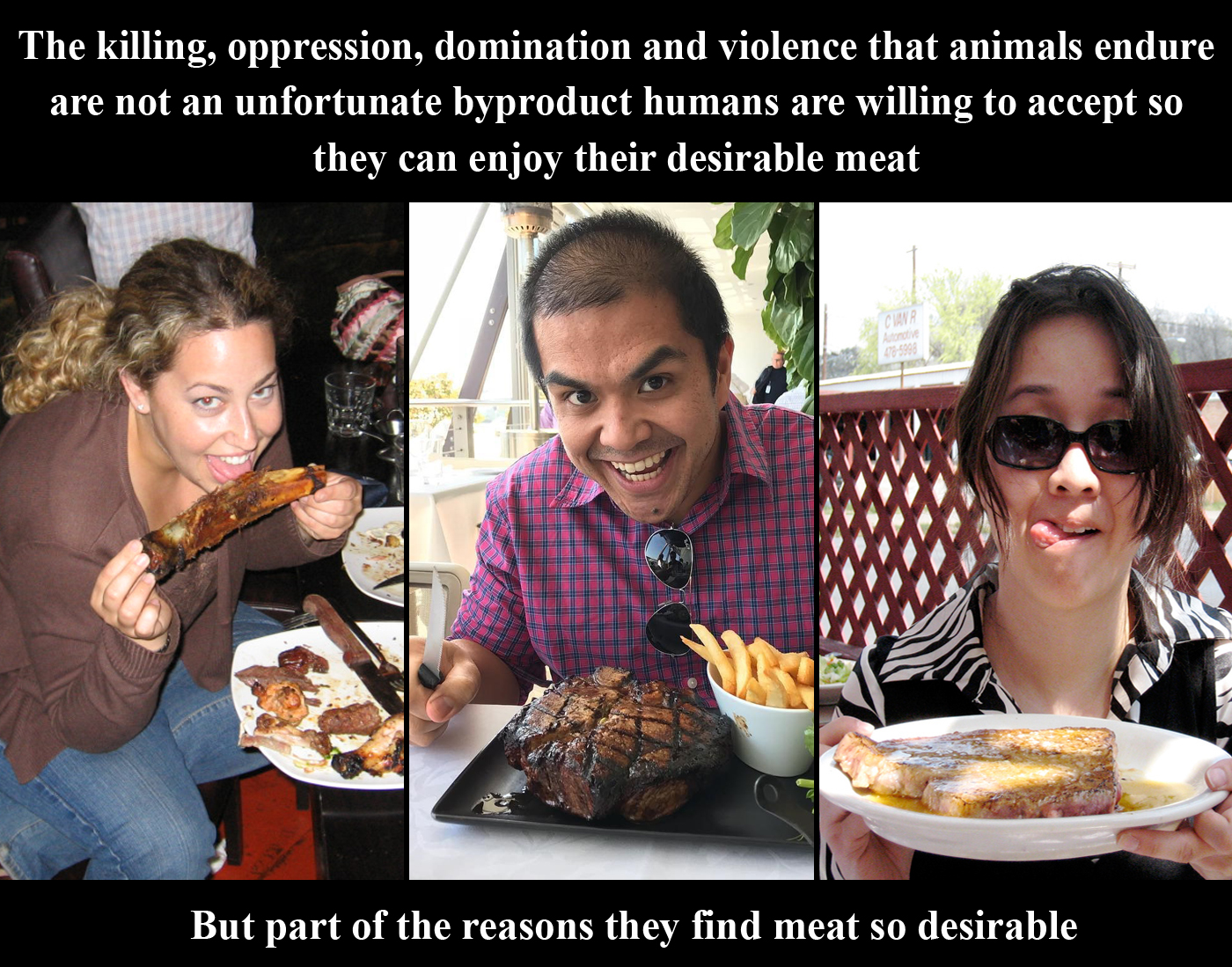
Ending Speciesism

On the occasion of the tenth World Day for the End of Speciesism held today, we wish to republish our post about this day from 8 years ago, as it is relevant today as it was then.

Marches, rallies, and protests took place yesterday in several locations around the world calling to end speciesism. However, unfortunately, what seemed on the face of it as a more radical version of advocacy (especially in light of the rise of consumer oriented approaches, and the notorious reductionism trend) was found to be not much more than more of the same.
As usual, activists are asking humans to stop consuming animal derived products, and “urge parliaments and the courts to create and enforce a new legal status for animals that stops them from being considered as property and recognising them as sentient beings whose interests must be protected by the law”.
As we broadly explained in the posts Non-Violence Approach and Reclaiming the Power We Should Have Never Given to Humans, the mere position of asking the abusers to stop abusing is in itself speciesist. It’s perpetuating the speciesist reality in which one species makes all the calls for all the other species, especially when the case is of systemically exploiting them. The self-evident frame of thought is that it is humans’ decision how to treat the rest of the species. And when humans leave the conversation about their abuse and choose to keep abusing, as most humans do, that’s what will happen. Merely asking them to stop abusing is letting them continue to torture.
The fact that some AR activists are calling what they do ‘demanding’ and not asking, doesn’t change the speciesist status of this twisted scenario, since as long as it’s the abusers’ choice, saying that we are demanding the end of the torture is meaningless. In that sense demanding is just an angrier version of asking. There is no “or else…”. When humans choose to abuse all they get is a sad or an angry face from the “demanders”. And that is in the better case. In the worst case it is a smiley suggestion that they would at least consider reducing some of their torture.

While asking to at least consider reducing some of their torture is not the case with the World Day for the End of Speciesism, as shortly explained above and broadly here and here, speciesism is inherent to all advocacy. And it is particularly upsetting when the speciesist advocacy comes from those who named their project the End of Speciesism.

Again, it is a bolder message compared to the ‘morally reductionist’ messages out there. But what the movement needs is not to be bolder but to restart.

This post is about speciesism and not about the World Day for the End of Speciesism. We use this initiative only to point out some of the reasons for the acute need for the whole movement to restart, and how some of the “end speciesism” measures and most importantly even the aims themselves, are speciesist.

For example the reliance and emphasis on the legal system is in itself speciesist. That is since besides that laws and rights are power based, discriminatory in their nature, and virtually are “the law of the strongest” in a civilized suite, as long as the legal system is human, it is bound to be speciesist. The suggestion that “animals’ interests must be represented before the law by animal defence societies, prosecutors specializing in animal issues or guardians other than their owners” is missing the whole point of ending speciesism. Clearly, the very situation of humans representing animals’ interests in a human court room, where humans judge whether actions done to nonhumans are in accordance with the laws humans have shaped, is in itself utterly speciesist.
Even if you overcome the inherent problem of human groups making rules which are applied on individual humans, who have never agreed upon nor participated in shaping them, there can never be equality when one group decides everything for all the other groups.
Humans and humans alone have the power to make laws. Humans are using an unfair advantage they have on nonhumans, which is their political power, to make rules that suite their own interests. Inequality is inherent to an interspecies system where only one species makes all the rules.

It is not only that humans are cruel masters, it is the fact that they are the masters and always will be. A history of thousands of years is more than enough to realize that this is not merely a theoretical built-in injustice, but a built-in power structure that practically allows humans to torment trillions of sentient beings for thousands of years, with no sign of it ever ending.
And even if every law that regards humans was made relevant to nonhumans just as much (can you even read this sentence seriously?), it can never encircle all the interests of all the nonhumans. It can never encircle all the offences against them as the law was made by humans for humans and from humans’ point of view.

Like many other AR initiatives this one also falsely relies on the common notion that injustices of the past such as slavery have been abolished. “They too were so embedded in the collective consciousness that they were thought to be eternal”. We can’t make the claim that slavery is eternal, it would be ridiculous to do so, as at least theoretically social ideas can change. However if we can learn from history something about slavery it is that it does seem to be eternal practically. Evidently, despite that there is not even one country in the world today where slavery is legal, there is not even one country where slavery doesn’t exist.

As we broadly explain in the post 10 Reasons Why Human Slavery and Animal Institutionalized Exploitation Are Incomparable, we disagree that the two exploitation institutions are comparable, however since there are more slaves today than ever before in history, if there is anything to learn from that false comparison is rather that speciesism cannot be ended.

And even if slavery is eradicated someday, a scenario that is hard even to imagine based on the current state of affairs, ending animal discrimination is not only hard to imagine, it is impossible to implement.

Mission impossible

Things go way beyond the stands and the demands of one organization, reflective of the rest of the movement as it may be.
Even if all the campaign’s requests are fully accepted, speciesism wouldn’t be ended. And that is not only because the activists are not calling for the end of every form of speciesism, but since ending every form of speciesism is impossible.
It is not the huge gaps between ending speciesism and the demands of this particular campaign that we find so important, but the huge gaps between ending speciesism and the reality on planet earth.

Speciesism is everywhere and in everything. Every aspect of humans’ lives is bound with the discrimination of nonhumans. Not just factory farming but any type of farming is speciesist. The levels of discrimination obviously largely differ, but excluding nonhumans from a particular area, tearing out the native vegetation and planting ones that suite humans’ desires and not necessarily the needs of the native residents of the region, fencing the area, constantly poisoning nonhumans in it, changing the composition of the soil, dividing the nearby lands with roads to the farms, plundering water from other habitats, making noises with heavy machinery, crushing nonhumans with heavy machinery, polluting the area with humans’ waste of many kinds and etc. are all unquestionably forms of discrimination.

Everything in life is on someone else’s expense. All clothes are speciesist, not only leather, fur, wool, silk and down. Houses are speciesist. Cities are speciesist. Electricity is speciesist. Fireworks are speciesist. Lawns are speciesist. Veganism is speciesist. Animal advocacy is speciesist. And it is speciesist to ignore all of this speciesism.

Taking the interests of each sentient being into account as if they were our own doesn’t end with turning each human vegan. And it shouldn’t even begin there, but with turning each one back to living like any other ape in the forests and savannahs. Obviously that is not the world we wish and advocate for, but at least it would be more coherent and consistent with the presented moral guidelines of the call to end speciesism (as it would reverse many elements of the occupation on this planet).
But nobody is advocating for that. The systematical, industrial exploitation of animals in the form of factory farms is by far the worst embodiment of speciesism in history, however it is also far from being the only one.

If to follow Joan Dunayer’s definition of speciesism in her book named after the term, speciesism is “a failure, in attitude or practice, to accord any nonhuman being equal consideration and respect.” A vegan world is far from being an equal one.

How is an extremely industrial and technological civilization of more than 7 billion humans, that dominates and impacts practically every inch on earth can ever accord any nonhuman being equal consideration and respect?

In this world the mere concept of rights for all nonhuman animals is an oxymoron. Everything is on someone else’s expense. Humans’ global occupation is so vast and absolute that civilization became self-evident. But it mustn’t be. Speciesism is inherent to every human activity. Even if you insist that a vegan world may be possible one day, you can’t seriously think that humans would be convinced to voluntarily go back to living like any other species, limited to a relatively bounded geographical area, living off the surrounding, and include several million members only. That would be much closer to ending speciesism, and it is not even close to what is being demanded of humans and thought of by activists.

For the End of the Species

Ending speciesism is not synonymous with veganism. It’s speciesist to think that speciesism’s boundaries are within this range alone. It is not just a matter of degree (and factory farms are by no doubt the worst embodiment of speciesism), it is a matter of kind. And so a different kind of thinking is needed from activists to end speciesism. Currently activists focus on the worst degree harms that humans are doing to other species, and on what humans might, theoretically only, agree to stop doing. But a truly non-speciesist perspective must look at what is done to the discriminated beings and what can be done to stop it regardless of humans’ willingness or “opinions”.
The end of speciesism shouldn’t be about humans as discriminators but about nonhumans as discriminated against. Hence speciesism doesn’t end with factory farms and animal experiments and etc., it doesn’t even end with humans. The vast majority of the interspecies relationships on earth are basically speciesist, in the sense that they are anything but “equal consideration and respect”. “Nature” is full of discriminations based on species. In fact, interspecies violence is so abundant and so inherent that it is not even perceived as discrimination.

Therefore stating that all sentient beings are equal is utterly absurd. All sentient beings can’t be equal since they constantly fight over resources and in many cases they are each other’s resources. Speciesism will end when there is only one species on earth and even then individuals would be discriminated against based on parameters other than their species.

The World Day for the End of Speciesism website states “it is in the center of the interests of every sentient not to be hurt, not to suffer, not being a victim of violence”. But the fact that this world is inherently based on that sentient beings are constantly being hurt by one another, suffer constantly, and are often victims of violence, is another fundamental reason why speciesism can never end. How can all the sentient beings be included within the circle of moral consideration, when their very existence comes at the expense of others?
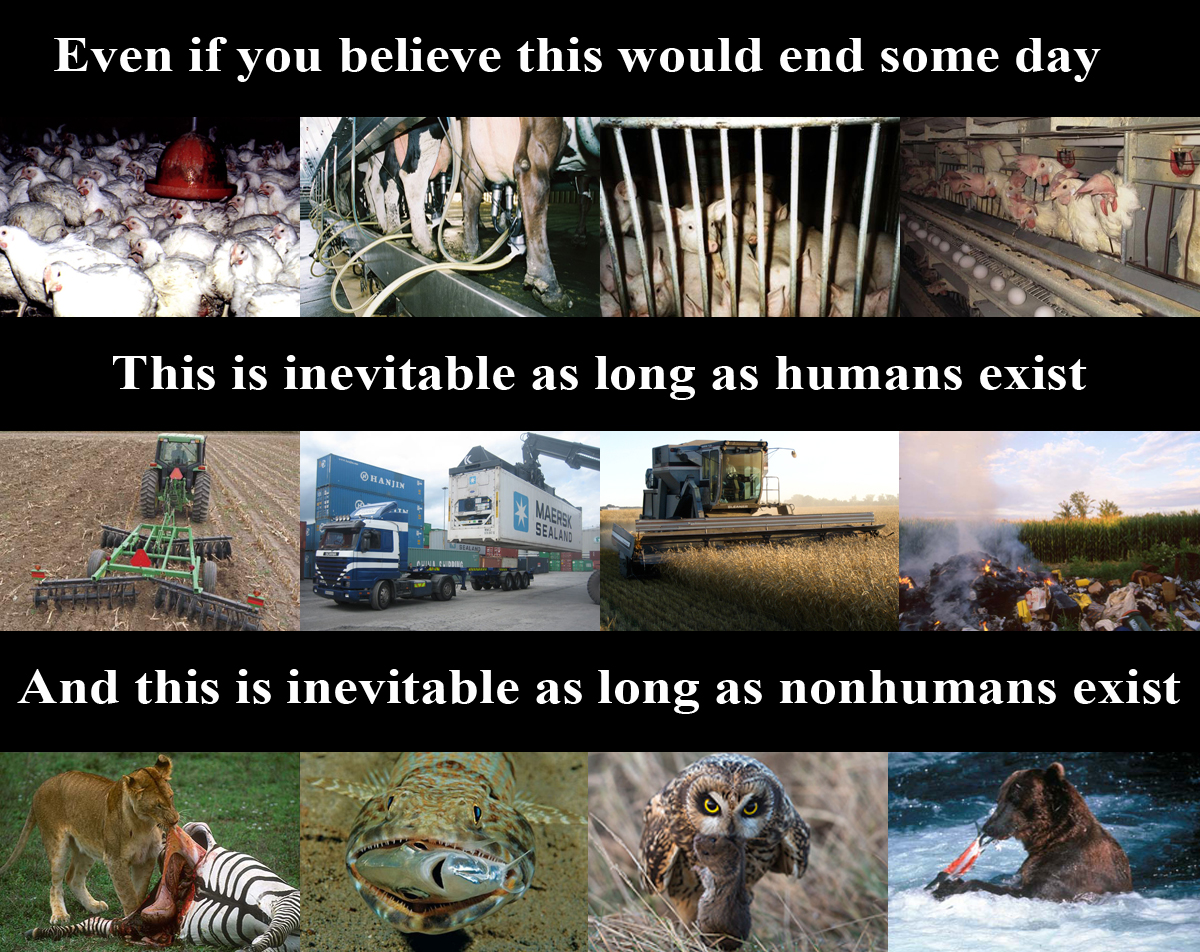
Activists focusing on factory farms, justly thinking that they are the greatest atrocities on earth, are postponing the inevitable. At some point they are bound to realize that discrimination and suffering is everywhere and in everything. If we want to end speciesism, we mustn’t focus on its most acute manifestation but on its most deep-rooted one. And that is unfortunately not the legal or social status of sentient beings but their biological one. It is impossible to end speciesism by social means.

The world can never become non-speciesist, yet speciesism must be ceased. Speciesism is not less of an arbitrary discrimination, not less unjust, not less violent and not less cruel because it is even theoretically unabolishable. Speciesism must be ended by all means necessary. The only way to end speciesism is to end the species. And the only ones who will ever consider doing it are you.
Don’t make do with stating that you would push the button that will end it all, and try to make one.
Beyond Hope

Earlier this month some disappointing news was published.
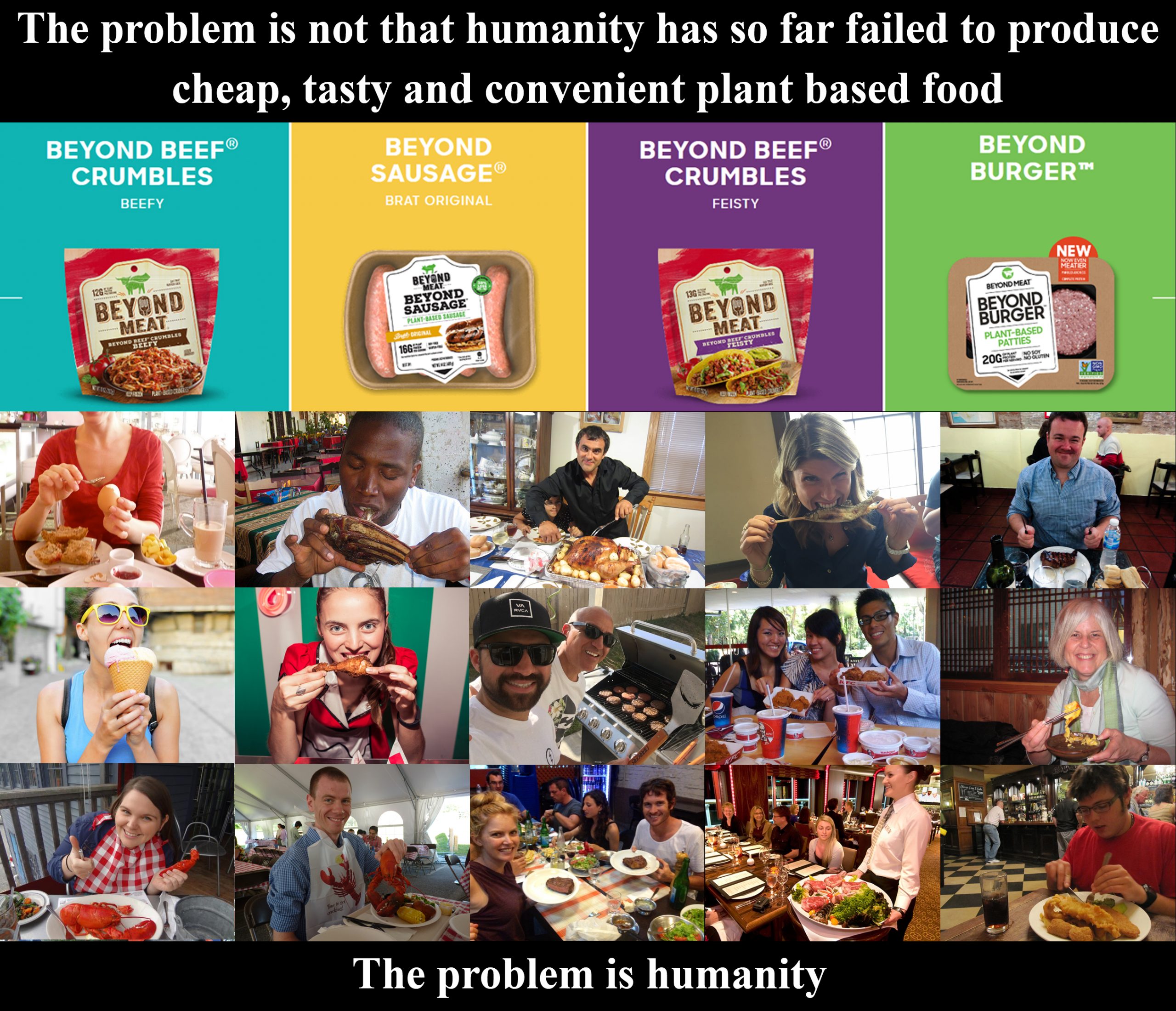
Beyond Meat’s latest financial report revealed that its net revenue dropped by 30.5 percent in the second quarter of 2023. Compared to the same period in 2022, revenue decreased from $147 million to $102.1 million. And in the US, the largest economy in the world, Beyond saw year-on-year sales fall by 40 percent. The following morning, Beyond Meat’s stock dipped by more than 20 percent.
This report was followed by media coverage suggesting that plant based “meat” was just a trend.

Although indeed this news is a bit concerning, it is a different publication which should make us really worried. Just a few days after the news about Beyond Meat, an article titled: “Price-, Taste-, and Convenience-Competitive Plant-Based Meat Would Not Currently Replace Meat” was published by Rethink Priorities, and it has some extremely depressing well based statements.

The articles’ main argument goes as follows:
Plant-based and cultivated meat are both a major, maybe even the greatest, source of optimism for reducing, and according to some even ending, animal farming.
These hopes rely on the assumption that what primarily drive food choices are price, taste, and convenience. Therefore, the price, taste, and convenience (PTC) hypothesis assumes that if plant-based meat is competitive with animal-based meat on these three criteria, the large majority of current consumers would replace animal-based meat with plant-based meat as there would be no remaining reason for them not to. However, price, taste, and convenience do not mainly determine food choices of current consumers; social and psychological factors also play important roles. Therefore a majority of current consumers would continue eating primarily animal-based meat even if plant-based meats were PTC-competitive.

Obviously, the article doesn’t suggest that price, taste, and convenience don’t play a role in food choices, but that these are not the only or even the primary factors:
“Of course, there is no dispute that PTC are important factors in people’s food choices, but research in food psychology demonstrates these are not the sole or primary factors. Intuitively, this fact is apparent when considering basic consumer behavior: any given grocery store likely offers thousands of cheap, tasty, and convenient products, and yet, consumers decide to purchase only some of these products, without gathering any information on the large majority of them. Presumably, consumers do so by relying on factors well beyond PTC. Indeed, the psychological literature has identified myriad influences of food choice spanning psychological, biological, physiological, situational, and socio-cultural factors in addition to product characteristics (Köster, 2009). Furthermore, a rich literature on the psychology of meat consumption has identified factors particular to the consumption of meat and animal products. For example, people feel a peculiar personal attachment to meat (Graça et al., 2015), believe that meat is necessary for health, feel that meat consumption is socially normative, and perceive meat as a nice and natural component of a healthy diet (Piazza et al., 2015).”

The reason this article is rather convincing despite counter-arguing a rather intuitive hypothesis, is that it is well research based. Author Jacob R. Peacock, counter each assumed primary factor in humans’ food choices with studies that suggest differently. He starts with the Price factor and argues that according to the two existing cross-price elasticity studies of plant-based meat sold in US grocery stores, one found that plant-based meat acts as a complement for cows’ and pigs’ flesh and a substitute for chicken flesh, while the other found basically the opposite, with plant-based meat acting as a substitute for cows’ and pigs’ flesh but a complement for chicken flesh, but more importantly and relevantly is that both found that any effects of changes in plant-based meat prices seem to have only very small effects on animal-based meat sales.

Peacock also argues regarding the price factor that: “a lower price may lead some consumers to treat plant-based meats as inferior goods—or cheap substitutes—rather than a better deal. This effect might contribute to the lower popularity of margarine, which was designed as a substitute for butter at the time of its development in the 1880s (Dupré, 1999). Alternatively, consumers simply may not treat the two products as substitutes.”

Regarding the Taste factor, Peacock argues that it seems that in order for plant-based meat to be considered “the exact same product” and “indistinguishable”, it needs to pass a blinded taste test of some sort.
However, he argues, “blind taste tests may lack external validity, as, outside an experimental setting, plant-based meat consumers will never be blinded. Instead, consumers will be informed of what it is they are eating, as is necessitated by food labeling laws, allergies, dietary restrictions, and ethical norms.”
And then he mentions several studies showing that even plant- and animal-based meats which are indistinguishable in a blind taste test might still be experienced differently in an informed test: “In Sogari et al. (2023), 175 American consumers were randomized to blind and informed conditions, tasted four burgers (Beyond Burger, called “pea protein”; Impossible Burger, called “animal-like protein”; “hybrid meatmushroom” burger; and “100% beef” burger), and then ranked their preference for each burger. Informing participants of the burgers’ identities (for example, “pea protein burger”) caused a statistically significant drop in the Beyond Burger’s rank from third to fourth most liked, while the Impossible Burger remained first. In Caputo et al. (2022), 86 American consumers were randomized to blind and informed conditions, tasted four burgers (Beyond, Impossible, hybrid meat-mushroom, and 100% beef burger), and then participated in an experiment to measure willingness-to-pay for the burgers. Differences in willingness-to-pay between conditions did not reach significance given the small sample size; however, the point estimates suggest information caused willingness-to-pay to increase for the Impossible Burger by $0.91 and decrease for the Beyond Burger by $0.22 and the beef burger by $0.77. In Martin et al. (2021), 102 French consumers sampled both an animal and plant-based sausage, first blinded and then with packaging information, and marked the strength of their preference on a scale ranging from animal-based (−10) to plant-based (10). After seeing the packaging, a statistically significant shift in preferences in favor of the plant-based sausage was detected (from −6.2 to −4.3), although consumers still strongly preferred the animal-based sausage.”

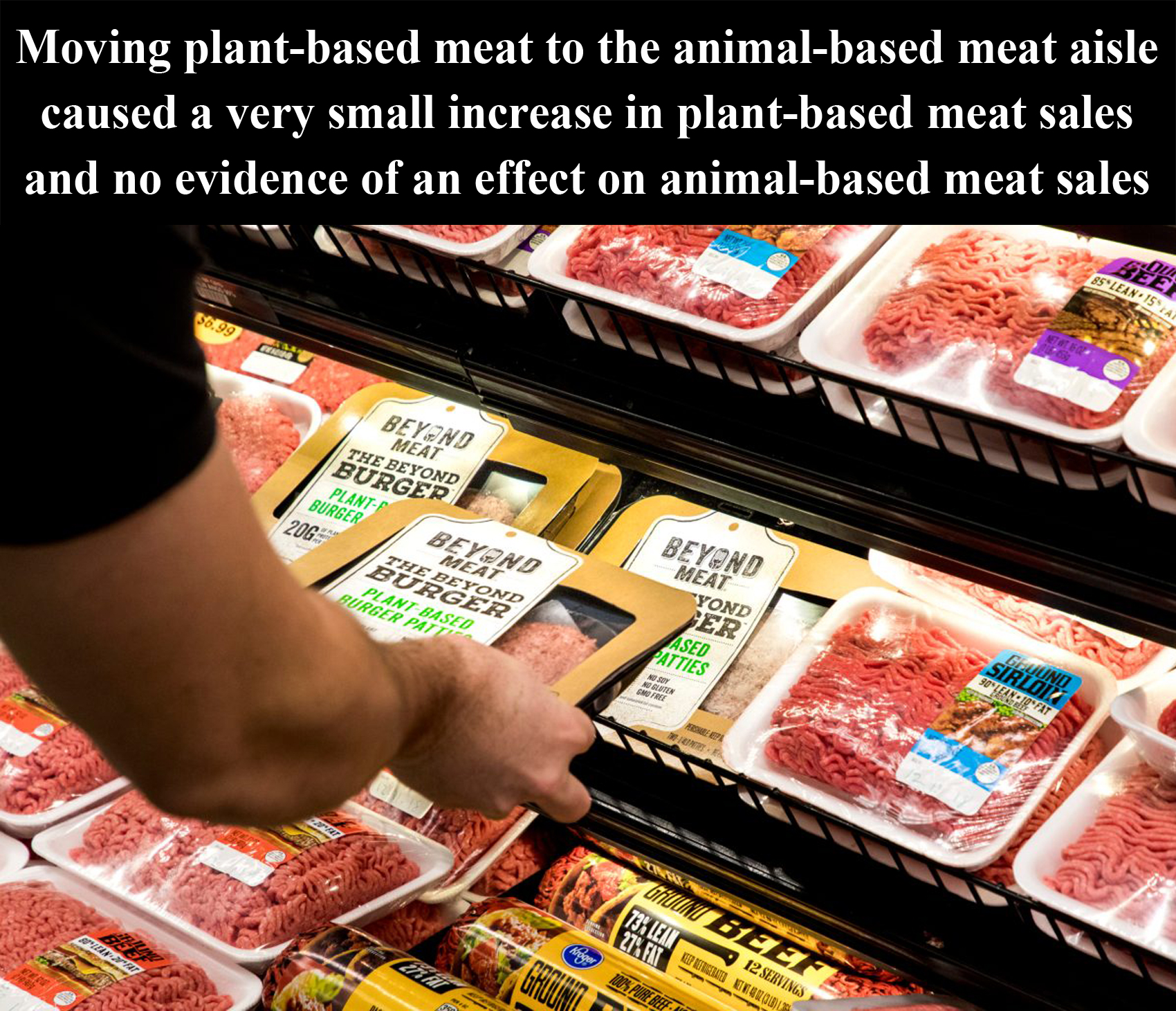
Regarding convenience he argues that there is a lack of clarity on what exactly constitutes convenience equivalence, and the little evidence that might be relevant does not find a meaningful impact of increased convenience on animal-based meat usage. The little evidence he refers to is the following two studies: “Some work has focused on availability within grocery stores, moving plant-based meats to the (animal-based) meat aisle from devoted ‘vegan’ aisles. A non-randomized study of 108 grocery stores found the move increased sales of plant-based meat but did not decrease sales of animal-based meat (Piernas et al., 2021). Another smaller non-randomized study of nine stores found a very small increase in plant-based meat sales and no evidence of an effect on animal-based meat sales (Vandenbroele et al., 2019).”

Peacock mentions another kind of studies that according to him weaken the PTC hypothesis and these are Hypothetical discrete choice experiments, which are studies in which the participants are asked to imagine hypothetically picking a plant- or animal-based burger from a menu. One of them, conducted across 27 countries, asked its 27,000 meat-eating participants to assume plant-based meat and animal-based meat “tasted equally good, had equal nutritional value and cost the same”, and yet most of them preferred the animal based burger. As disappointing as these findings are as it is, Peacock claims that it is actually worse since according to him “the design of this study likely increases these estimates: the addition of “equal nutritional value” likely increases the attractiveness of the plant-based meat; the environmental framing and questions used earlier in the survey might increase social desirability bias; using a text description rather than pictures of the possible items and broad non-specific question wording might elicit more hypothetical bias; and participants are forced to choose one or the other of animal-based meat or plant-based meat.”
In addition, he argues that “Hypothetical choice and self-reports of diet change likely tend to exaggerate the extent of meat reduction: one comparison found that in a hypothetical choice, 59% of meals selected were meat-free, while in actuality, sales data found only 36% of meals to be meat-free (Brachem et al., 2019, p. 22).”

Peacock argues that: “The strongest evidence of actual behavioral impacts of PTC-equivalent plant-based meats likely comes from a study introducing Impossible Foods’ plant-based ground beef to a University of California Los Angeles dining hall (Malan et al., 2022). In this study impossible ground beef was introduced at two stations in the dining hall. On Thursdays, students had the option of receiving prepared burritos with either Impossible ground beef, animal-based steak, or veggies, while the build-your-own entree line offered Impossible ground beef every day alongside animal-based ground beef.
In this study, price is entirely equivalent since students pay for dining hall access for the entire semester, not individual meals. With regards to taste, Impossible ground beef specifically has not been subjected to any public taste tests. However, as reviewed above, the Impossible Burger, which is made of similar ingredients, has been found to taste equivalent in some studies. Convenience is likely equivalent as well since the burritos are prepared for students by dining hall staff, and the build-your-own entree line is self-serve for both animal- and plant-based ground beef.

The study measured how many beef-containing meals were distributed at the intervention dining hall, where the Impossible ground beef was available, as well as distribution at two other dining halls as controls. In addition to making plant-based meat available, the study employed several co-interventions designed to reduce meat consumption (Malan, 2020). These included environmental education, low carbon footprint labels on menus, and an advertising campaign to promote the new product, all of which have some evidence demonstrating their effectiveness (Bianchi, Dorsel, et al., 2018, p. 11; Brunner et al., 2018; Jalil et al., 2019; Osman & Thornton, 2019). Thus, the study’s results cannot be entirely attributed to the addition of plant-based meat options to the intervention dining hall’s menu.

In the ten weeks after adding the Impossible burrito to the intervention dining hall’s menu, 26% of burrito purchasers chose the Impossible, 7% the veggie, and the remaining 67% the steak burrito (Malan, 2020, Table 12). Consistent with previous results, in a scenario that ensures price, convenience, and potentially taste competitiveness, the portion of consumers selecting the plant-based meat option remains modest.”

These are very disappointing and worrying results. And it gets worse. The veggie burrito comprises 15% of selections in the absence of the Impossible burrito and with the Impossible burrito available, this share declines to 7%, suggesting the Impossible burrito partially replaced the demand for veggie burritos rather than animal-based beef.

Another crucial factor to consider is that this study was conducted with college students, and at the University of California, meaning among those who are more likely than average to select plant-based meats, so among the general population these results are likely to be even worse.

In addition argues Peacock, “many, if not most, of the reviewed studies likely included numerous and sometimes extensive additional co-interventions also designed to increase sales of plant-based meat and/or decrease sales of animal-based meat, like promotions, ad campaigns, and environmental information. These will presumably reduce in intensity over time, as might their effects.”
And he adds that “these early studies may represent novelty effects and tap into consumers’ curiosity to try something new. One survey identified “I like to try new foods” and “I’ve been hearing a lot about them and was curious” as the two most popular factors in a self-report of why customers tried plant-based meats (A Consumer Survey on Plant Alternatives to Animal Meat, 2020, p. 5). This effect would also be expected to fade over time. Indeed, this decline may already have been observed. In 2019, sales of the Beyond Taco at the fast-food chain Del Taco declined from 6% to 4% of the sales mix (Maze, 2019), and across two samples of Burger King stores, sales of the Impossible Burger declined from 30 per day per store to 20, and from 32 to 28, in the weeks following introduction (Shanker & Patton, 2020).”

Peacock concludes his article with the following inference:
“Collectively, these results show that the PTC hypothesis, in its current form, is likely false. The underlying premise of PTC as key determinants of food choice is not supported by evidence from cross-sectional surveys on consumers’ self-reported determinants. The little available evidence thus far suggests PTC do not individually significantly reduce animal-based meat usage. HDCEs find that a minority of consumers select PTC-competitive plant-based meats instead of animal-based meats. (Miller (2021) adduces two countries where plant-based meat selection nears two-thirds when health equivalence is also assured. However, the study design is especially subject to hypothetical and social desirability biases and likely yields estimates that unrealistically favor plant-based meats.) Data from introducing plant-based meats at particular restaurants suggests that they draw only a modest portion of customers. Finally, a controlled experiment introducing high-quality plant-based meat to a dining hall—at equal price and convenience to animal-based meat—shows that most participants did not choose plant-based meat. Across six lines of evidence, it is clear that the empirical evidence opposes the PTC hypothesis.”

Considering that plant-based meat is a great source of optimism among activists, but that these hopes rely on the assumption that what primarily drives food choices are price, taste, and convenience and this assumption is false, this optimism is actually very questionable.

Beyond Reach

All these findings further prove that rationality can’t beat motivation. Given that animal based food is directly linked to public health complications as the animal agriculture industry is interconnected with foodborne illness, diet-related diseases, antibiotic resistance, and infectious diseases; and given that animal agriculture plays a major part in environmental destruction including pollution, land use, water use, deforestation, and greenhouse gas emissions; and of course given that animal agriculture is the cruelest thing ever in history, there is nothing more rational than ending it, let alone once humans can enjoy the same taste at the same price and the same convince. But humans are not rational, and they are not ethical.

Some activists have decided to give up on turning to humans’ moral fiber and appeal to their taste buds instead, believing that the best way to get humans to eat less animals is by giving them what they want, meaning juicy delicious burgers, sausages, ground “meat”, and more, without the exploitation. Never before did humans need “to give up” so little in order to not actively support industrial animal abuse, but still, the utterly vast majority maintain their violent and oppressive habits.

Not the enormous food waste, not the enormous water waste, not the enormous pollution, not climate change, not obesity, not diabetes, and not the risk of a heart attack or cancer, and now not even when it is the same product with the same look, texture and taste, have made veganism mainstream.

Every new plant based product that successfully imitates an animal derived one, doesn’t prove that there is no culinary need for any animal based product, but the opposite. It is not by chance that the most popular plant based burgers are also the ones who “bleed”. And it is not by chance that many humans want their food to bleed, or that they find plant based “meat” products disgusting before they have even tasted, smelled or seen them. It is what these products symbolize that disgust them, and it is what animals’ flesh symbolizes that attracts many of them.

Meat is not a mere gastronomical preference and food in general is definitely not a mere energy source. It is deeply imprinted in human society and culture, so just asking humans to switch the animal derived raw materials of their food to a plant based one, even if it has the same look, texture and of course taste, for many it is not enough.
If eating meat was only a preferable energy source, then it would have been much easier to convince humans to simply change it, especially once there are culinary equivalent options. But no matter how many times vegans are telling humans that converting their diets into a vegan one is only a raw-material swap, clearly it is not at all just that. It is a much more profound and deep change, for most a self-determination one. Veganism is not a raw-material swap since food is not fuel. Humans eat for great many reasons, for reasons of community, rituals, family, expressing their identity by eating that and not this, and of course for pleasure.

For billions of humans food is comfort, a gesture, entertainment, an enemy, a profession, a hobby, a weapon, it can break barriers, it takes so much TV screen time and so much space on book stores shelves, it defines cultures, and in many cases the last mean of mothers to get in touch with their children. It involves so many taboos and determinations of who belongs to the group and who does not, it unifies and distinguishes between ethnic groups and cultures. Unfortunately food is much more than taste and nutrition.
And meat particularly, is very unique among foods. All along history meat has been and still is very highly valued by humans, by almost every single culture. Meat’s value is incomparable to any other food, and in no proportion to its nutritional significance, therefore, in his book Meat: A Natural Symbol the anthropologist Nick Fiddes suggests that this special status of meat results from the fact that it embodies humans’ dominance over nature and the other animals. Animals symbolize power and nature, and so eating other animals is the ultimate symbol of humans’ power, of their superiority over other animals, and their triumph over nature.
Meat is a dominance and power symbol and humans take pleasure in the power and the predominance, as well as in the taste. Obviously nowadays they can get the same taste from equivalent plant based products, and they can most definitely get the required nutrients from other sources, but the social aspects of meat eating are much stronger and much more significant than its nutritional values, and even its taste.
Meat’s symbolism is far from being the only reason humans eat meat, but it is definitely a significant one, and so it is highly important to acknowledge that.

The fact that humans have never had to “give up” less than they do now thanks to the abundant plant based products, which are amazingly identical to animal based products, but they still choose the violent versions, and even more so, the fact that most are not willing to try the plant-based option over the torture based option despite that it tastes the same, costs the same and is as available, is extremely worrying.

When humans run out of excuses as to why they don’t stop consuming animal based products but they still consume animal based products, activists run out of excuses as to why they still insist on trying to convince them to stop instead of making them stop.